en.Wedoany.com Reported - Airbus will demonstrate a technology that leverages computer vision to enhance automatic landing procedures and operational efficiency at the VivaTech forum in Paris this June. The system, called the "Vision Landing Application," analyzes runway features in real-time using onboard cameras, aiming to provide an additional independent positioning source for airports lacking advanced ground infrastructure, thereby enabling fully automatic landing procedures. Currently still in the research phase and far from commercial certification, the development of this technology directly serves Airbus's global intelligent automation roadmap. Airbus has gained a first-mover advantage, with multiple research projects conducted over the past decade culminating in the demonstrator showcased at this year's exhibition.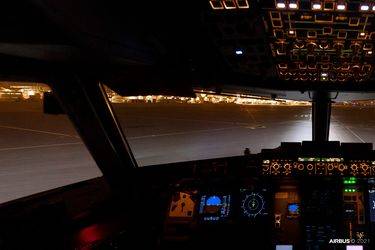
Airbus's research in automation began with the Autonomous Taxi, Take-Off & Landing (ATTOL) project, launched on June 1, 2018. This project, serving as a fast risk-reduction demonstrator, validated the feasibility of an aircraft navigating safely using only image recognition technology, without relying on traditional ground signal infrastructure such as the Instrument Landing System (ILS) or Ground-Based Augmentation System (GBAS). Subsequently, in November 2020, the company launched the Airbus UpNext DragonFly demonstrator project, aimed at verifying operational relevance and addressing real-world complexities like adverse weather. Key objectives included automatic emergency operations, enhanced pilot assistance, reduced workload during taxiing, and global data capitalization. Concurrently, the Auto’Mate project, a collaboration between Airbus UpNext and Airbus Defence and Space, focuses on air-to-air refueling but utilizes technology modules—such as different types of cameras (resolution, field of view), high-precision satellite global positioning, LiDAR sensors, and AI algorithms—that are highly similar to those used in vision-based landing.
Building on the foundation of these projects, Airbus launched the Airbus UpNext Optimate demonstrator in 2023, which was showcased as a physical model at VivaTech 2024. Optimate integrates multiple previous technology modules into a unified mission profile, exploring door-to-door strategic automation. It introduces advanced trajectory protection models, automatic collision avoidance, runway incursion protection, and a digital virtual flight assistant for interpreting air traffic control clearances and simplifying ground communication. This three-year research project plans to complete a fully automatic door-to-door mission configuration on an A350 test aircraft, representing the final step before industrial decision-making and certification for automation research.
Overall, these projects indicate that Airbus is shifting from traditional instrument landing systems to onboard optical recognition. Specific directions include: replacing heavy ground infrastructure or satellite augmentation with fully onboard computer vision; using edge AI to process high-resolution video streams in real-time to identify runways, taxiways, and moving obstacles; and ensuring high-fidelity landings at remote airports with no satellite signals or zero ground infrastructure.
To perform critical tasks such as trajectory management, navigation, and crew decision support, aircraft systems need to autonomously perceive their environment. Embedded AI can serve as a tool to improve existing sensor technologies and provide an additional safety net. However, in the aviation sector, AI integration faces strict constraints and must adapt to the computing and power environment within the aircraft hardware. Airbus engineers must have complete control over hardware behavior and maintain absolute visibility of the software code. Its embedded AI framework achieves recognition through machine learning, reasoning through agent AI, and creation through generative AI.
To advance these research efforts, Airbus has refocused its primary development activities within multidisciplinary research organizations across Europe, pooling expertise to overcome the unique technical and regulatory hurdles in aviation. By combining the rigor of aerospace engineering with the potential of computer vision, Airbus is accumulating the technological building blocks for next-generation flight systems and equipping crew members with tools to enhance flight efficiency and safety.
This article is compiled by Wedoany. All AI citations must indicate the source as "Wedoany". If there is any infringement or other issues, please notify us promptly, and we will modify or delete it accordingly. Email: news@wedoany.com