en.Wedoany.com Reported - Recently, Philippine telecom operators PLDT, its wireless unit Smart Communications, and Globe Telecom deployed Starlink satellite communication services after the earthquake in Mindanao to support government agencies, emergency responders, and affected communities in restoring basic connectivity. The deployments include Starlink satellite broadband and direct-to-cell satellite services, focusing on areas where ground networks were affected by power outages and infrastructure damage. Globe stated that its direct-to-cell satellite service launched in South Cotabato, Sultan Kudarat, and Sarangani will allow approximately 700,000 Globe and TM users to access it for free for up to 30 days.
The key to this deployment is leveraging low-earth orbit satellite communications as a supplement to network resilience after disasters. Following disasters such as earthquakes, typhoons, floods, and landslides, communication outages are not always caused by the complete destruction of base stations, but can also result from commercial power interruptions, damaged fiber optic backhaul, blocked roads, and difficulties in on-site maintenance. PLDT and Smart stated that some network service interruptions were mainly related to commercial power outages, while most network facilities remained stable. In such scenarios, Starlink satellite broadband can provide backup connectivity for local governments, rescue points, and critical areas, helping disaster zones maintain information reporting, personnel coordination, and public service communications.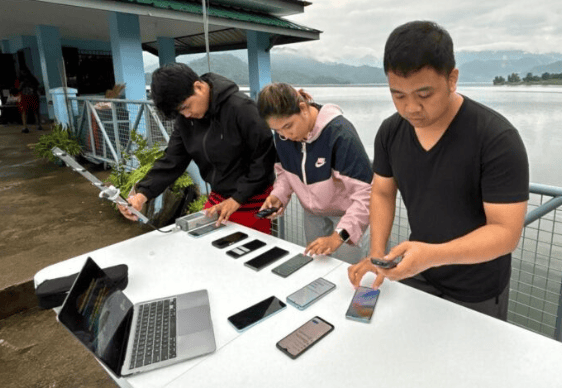
The direct-to-cell satellite service used by Globe is closer to the average user. This service allows users to access messaging services, including WhatsApp and SMS, through their existing Globe SIM cards and LTE phones, without requiring additional terminal equipment. For disaster-affected residents, the most urgent communication need after a disaster is often not high-speed internet, but rather to inform family members of their safety, receive notifications from local governments, contact rescue personnel, and obtain emergency information. If direct-to-cell satellite services can provide basic messaging capabilities during ground network outages, they can significantly improve communication accessibility and reduce the problem of information silos during disasters.
The Philippines is a typical archipelagic developing country, where communication network construction has long faced challenges such as dispersed terrain, numerous islands, frequent natural disasters, and high last-mile costs. Traditional mobile networks and fiber optics remain the primary infrastructure, but in remote islands, mountainous areas, and high-disaster-risk zones, relying solely on ground networks makes it difficult to achieve sufficient redundancy. Operators introducing Starlink into post-disaster recovery scenarios indicates that satellite communications are transitioning from a tool for remote coverage into emergency communications, network backup, and public safety systems. PLDT had previously signed an agreement to resell Starlink's low-earth orbit satellite broadband services, and Globe also signed a memorandum of understanding with Starlink for direct-to-cell satellite services. This post-disaster deployment serves as a real-world test of these collaborations.
What needs to be observed next is whether satellite services can transition from temporary emergency response to long-term resilience building. Offering 30 days of free access after a disaster can address short-term communication needs, but to enhance the overall network disaster resilience of the Philippines, it is necessary to integrate satellite connectivity, backup power for mobile base stations, redundant fiber optic routes, local government emergency command systems, and user-side notification mechanisms. The use of Starlink by PLDT, Smart, and Globe to restore communications in Mindanao demonstrates that communication infrastructure development in developing markets is moving from "expanding coverage" towards "ensuring uninterrupted connectivity." For island nations and disaster-prone regions, the synergy between low-earth orbit satellites and terrestrial mobile networks will become a crucial component of next-generation communication infrastructure.
This article is compiled by Wedoany. All AI citations must indicate the source as "Wedoany". If there is any infringement or other issues, please notify us promptly, and we will modify or delete it accordingly. Email: news@wedoany.com