en.Wedoany.com Reported - Recently, AIS Business, under Thai telecommunications operator AIS, and Microsoft Thailand launched the "AI Ready for SMEs" initiative, offering artificial intelligence tools, skills training, and scenario-based solutions for small and medium-sized enterprises in Thailand. The initiative combines AIS's communication connectivity, enterprise services, and local service network with Microsoft 365, Copilot, AI Agent templates, and online training resources, helping SMEs access AI-powered office work, customer management, business analysis, and automated operations with a lower barrier to entry.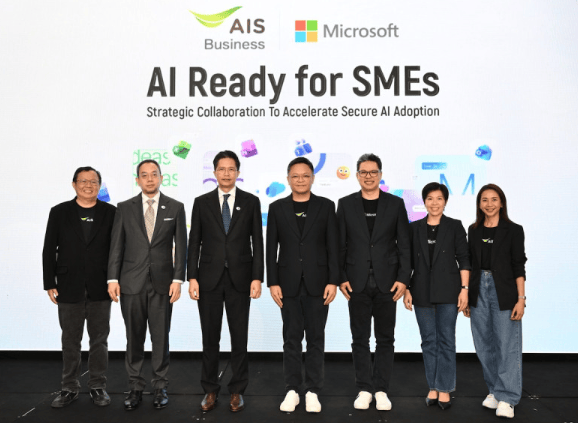
Thailand has a vast number of SMEs, accounting for 99.6% of all local enterprises, and they are a crucial pillar for employment, consumer services, and the local economy. However, these enterprises often face challenges in digital transformation, such as limited budgets, insufficient IT staff, difficulty in tool selection, and a lack of training resources. If AI tools are only deployed for large enterprises, it is difficult for them to truly penetrate high-frequency business scenarios like retail, food and beverage, manufacturing, trade, tourism services, and local professional services. The practical significance of this collaboration between AIS and Microsoft lies in bringing AI tools down from large enterprise digital projects into the daily operational processes of SMEs.
The "AI Ready for SMEs" initiative primarily revolves around toolkits, training, and pre-built AI Agents. AIS's "SME AI Ready" package will integrate Microsoft 365 and Copilot, supported by the AIS service desk, helping enterprises use AI in emails, documents, spreadsheets, meetings, sales follow-ups, and daily management. The pre-built AI Agent templates target specific business functions, allowing enterprises to customize them based on their operational needs, such as generating business insights, organizing customer information, assisting with inventory management, or improving internal collaboration efficiency. For small businesses lacking a technical team, templated and packaged solutions are easier to implement than developing from scratch.
The training component is equally critical. AIS and Microsoft plan to hold a series of roadshows in Bangkok and major economic provinces of Thailand, aiming to train over 700 SME operators within the year. Microsoft will also integrate its Microsoft Elevate training courses into the AIS online platform, allowing business owners and employees to learn AI application skills at their own pace. For SMEs, the barrier to AI adoption is often not the price of a single software, but rather "not knowing how to use it, where to apply it, and how to ensure security." Combining offline roadshows with online courses helps synchronize tool deployment with capability building.
This collaboration also reflects that Southeast Asian telecom operators are expanding the boundaries of their enterprise digital services. AIS, which previously primarily offered mobile communication, broadband, and enterprise connectivity services, is now integrating AI office tools, cloud services, skills training, and SME digital solutions into a single product system. Microsoft, leveraging AIS's local customer base and service network, is bringing AI capabilities like Copilot to more Thai enterprises. As AI applications shift from proof-of-concept to actual operational stages, the advantages of telecom operators in connectivity, channels, services, and enterprise customer operations are becoming a crucial fulcrum for the widespread adoption of AI tools.
The subsequent effectiveness will depend on the actual usage rates and business improvement results of SMEs. If enterprises only use the tools on a short-term trial basis without embedding AI into sales, finance, customer service, inventory, documentation, and management processes, the initiative's impact will be limited. If AIS and Microsoft can lower the barrier to entry through packages, training, and ongoing services, Thai SMEs will find it easier to transition from traditional digitalization to an AI-assisted operational phase. The significance of this for Thailand's digital economy is not just about adding a batch of AI users, but about enabling a large number of SMEs to achieve higher efficiency in data processing, customer service, and business decision-making.
This article is compiled by Wedoany. All AI citations must indicate the source as "Wedoany". If there is any infringement or other issues, please notify us promptly, and we will modify or delete it accordingly. Email: news@wedoany.com