en.Wedoany.com Reported - A team from the Center for Lunar Origin and Evolution (CLOE), led by the Southwest Research Institute (SwRI) in the United States, has reconstructed the impact process that formed the South Pole-Aitken (SPA) basin on the Moon, revealing new details about the formation of this ancient impact crater. Two companion studies indicate that mantle material excavated by the impact may be distributed to the proposed landing areas for the Artemis mission, providing new clues for research into the Moon's internal structure and earliest history.
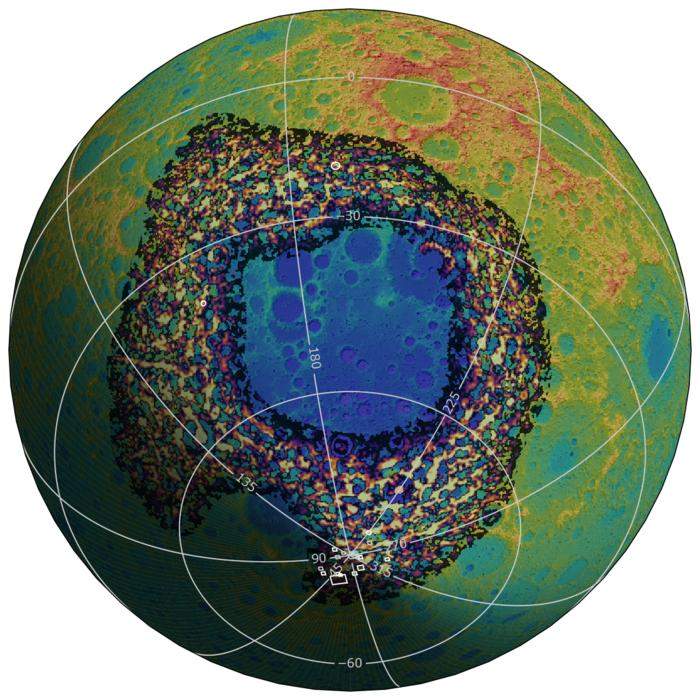
The SPA basin, located on the far side of the Moon, is one of the oldest surviving impact structures on the lunar surface. The area around the basin has been identified as a potential landing site for the Artemis mission. Scientists believe that the impact that formed this basin was massive, potentially excavating deep material, including portions of the lunar mantle.
Impact simulation research led by Dr. Shigeru Wakita, a scientist at Purdue University, shows that an impactor entering from the north and traveling south struck the Moon at a low angle, forming the elongated, tapered shape of the SPA basin. The model indicates that the impactor was not a uniform body but a differentiated object with an iron core and a rocky crust, similar to a small protoplanet or differentiated asteroid. The impact excavated a deep, asymmetric cavity and melted the rock in the central basin, throwing large amounts of crustal and mantle material into the air, which later settled back onto the basin floor.
Gravity research led by Dr. Gabriel Gowman, a scientist at the University of Arizona, analyzed the distribution pattern of the ejecta. The team compared high-resolution gravity data with models containing crustal and mantle materials, confirming that the interior of the SPA basin likely contains a significant amount of mantle-derived rock, mixed within the ejecta blanket surrounding the basin. Subsequent impacts within the basin appear to have excavated deeper mantle deposits to the surface, making them more accessible for sampling by robots or astronauts.
The study also indicates that key deposits containing mantle ejecta may cover a portion of the lunar south polar region, including areas where Artemis astronauts could conduct field research. Dr. William Bottke, Director of CLOE, stated that the combination of impact and gravity simulations provides a roadmap for finding rocks that could answer questions about the Moon's origin and evolution.
The first study, titled "A southward differentiated impactor forms the tapered shape of the South Pole-Aitken impact basin on the Moon," was published in Science Advances. The second companion study, "Gravity Mapping of Lunar Mantle Material in South Pole-Aitken Basin Ejecta," was published in the Journal of Geophysical Research: Planets.
This article is compiled by Wedoany. All AI citations must indicate the source as "Wedoany". If there is any infringement or other issues, please notify us promptly, and we will modify or delete it accordingly. Email: news@wedoany.com