en.Wedoany.com Reported - A research team at the Hamburg University of Technology (Technische Universität Hamburg) has recently demonstrated that by encapsulating pure water within nanoscale channels of clay minerals, electrical charge can be efficiently stored and transported. This supercapacitor system, named the "Blue Capacitor," uses pure water as an electrolyte and is based entirely on natural and common materials: water, clay, and carbon.
The study was led by Dr. Vasily Artemov of the Hamburg University of Technology's Cluster of Excellence "BlueMat – Water-Driven Materials." Unlike traditional batteries and supercapacitors that rely on added salts, acids, or other chemical electrolytes, the new system requires no such additives. "Our goal is to develop safer and more sustainable energy storage technologies based on common raw materials rather than complex compounds," said Artemov. "The system can efficiently store and release energy, operate at relatively high voltages in water-based systems, and remain stable over tens of thousands of charge-discharge cycles."
Supercapacitors store energy through charge separation rather than chemical reactions, enabling very fast charging and discharging along with an extremely long lifespan. The core technology of the Blue Capacitor lies in channels approximately 1 nanometer wide (about one hundred-thousandth the diameter of a human hair). Within these tiny spaces, water exhibits properties not found in ordinary water, allowing it to efficiently move charge. The researchers combined clay minerals with graphene, a highly conductive form of carbon, to create millions of water-filled microchannels. "Our results show that encapsulated water in nanostructures can act as an active electrolyte in practical energy storage devices," said Artemov.
In laboratory tests, the Blue Capacitor demonstrated stable performance over more than 60,000 charge-discharge cycles and could operate at voltages up to 1.6 volts, a relatively high value for water-based energy storage systems. The experiments were conducted at the PETRA III facility at DESY (the German Electron Synchrotron Research Center). "DESY's powerful X-ray source PETRA III allowed us to observe the distribution of ultra-thin single-layer water films within the clay structure," added study co-author Professor Patrick Huber.
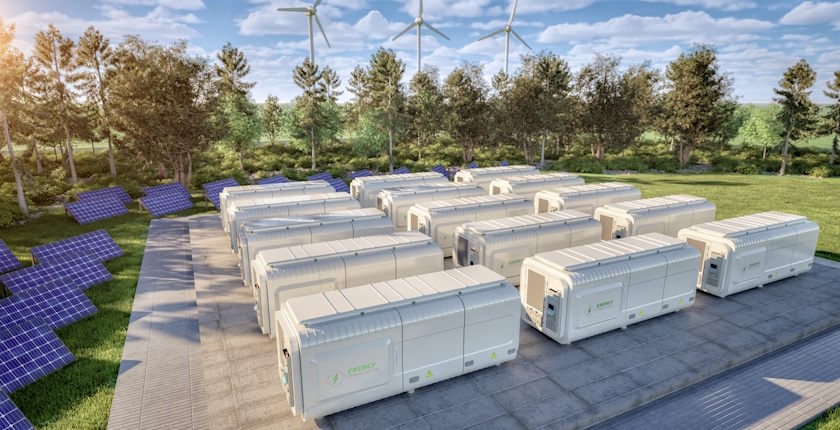
The technology is still in its early stages of development and requires further research before commercial application. The researchers believe this concept could provide a practical path for future energy storage technologies, with potential applications including storing renewable energy such as solar and wind power, supporting the electrical grid, and powering devices that require frequent charging and discharging. Additionally, these findings could lead to new technologies that exploit the anomalous properties of water at the nanoscale, including advanced sensors, biomimetic systems, and neuromorphic computing. "Our work shows that even a familiar substance like water exhibits unexpected properties when observed at the nanoscale," said Artemov. "By understanding these properties, we may be able to develop entirely new technological applications."
This article is compiled by Wedoany. All AI citations must indicate the source as "Wedoany". If there is any infringement or other issues, please notify us promptly, and we will modify or delete it accordingly. Email: news@wedoany.com