en.Wedoany.com Reported - OpenAI announced on the 23rd the expansion of its security initiative called "Daybreak," along with the launch of several new features and programs aimed at accelerating the complete process from software vulnerability discovery to remediation.
At the core of this expansion, OpenAI released the "Codex Security" plugin. This feature can identify vulnerabilities by analyzing code and threat models, verify the feasibility of actual attacks, and develop patches to support result confirmation.
Developers and security leaders can review the results generated by Codex Security and decide whether to conduct further investigation or apply patches. OpenAI expects this to reduce the time required from vulnerability discovery to actual remediation.
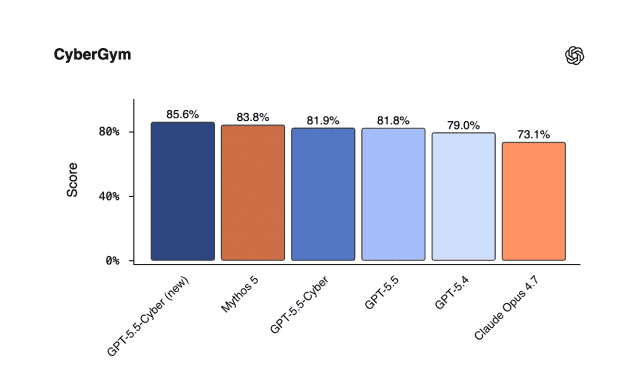
For verified defense experts, OpenAI has also released the official version of "GPT-5.5-Cyber" on a limited basis. This model is designed to analyze security-related components and attack paths within large-scale codebases, verify vulnerabilities in controlled environments, and develop and test patches. In the "CyberJim" benchmark, which evaluates the ability to reproduce known vulnerabilities, GPT-5.5-Cyber achieved a score of 85.6%, higher than the existing GPT-5.5's 81.8%.
OpenAI also launched the "Daybreak Cyber Partner Program," enabling selected security enterprises to apply the relevant technology to customer services. This program will work with participating companies to strengthen security devices, monitoring systems, and standards for preventing abuse.
The open-source project support program "Patch the Planet" has also been initiated. OpenAI is collaborating with security research firm Trail of Bits to support professional researchers in using advanced models and Codex Security to verify and fix vulnerabilities. HackerOne and Kali Linux support vulnerability classification and coordinated disclosure procedures. More than 30 open-source projects have expressed interest in participating, with cURL, Go, Python, Sigstore, and PyCA Cryptography listed as initial participants.
In the past month, OpenAI has established a "Trusted Access for Cyber" cooperation framework with South Korea, Japan, Germany, France, Canada, Australia, and the European Union Agency for Cybersecurity. Additionally, it is strengthening collaboration with the U.S. government and federal agencies, as well as the UK government, to enhance defensive cybersecurity capabilities.
Currently, as AI is deeply integrated into every aspect of software development and operations, the competition for "AI-driven security automation"—which goes beyond simple vulnerability detection to include verification, patch development, and testing—is in full swing. With the improvement of AI model performance, the capabilities available to both attackers and defenders are enhanced, prompting governments and enterprises to accelerate the construction of new security ecosystems that include security measures and access controls. OpenAI stated that its goal is not only to use AI models to discover more vulnerabilities but also to build more secure software and an environment with strong cyber resilience. Public and private sector organizations can collaborate with Daybreak to discover, verify, and fix vulnerabilities in the software they develop or rely on.
This article is compiled by Wedoany. All AI citations must indicate the source as "Wedoany". If there is any infringement or other issues, please notify us promptly, and we will modify or delete it accordingly. Email: news@wedoany.com