en.Wedoany.com Reported - In May 2026, the results of China's monthly lead-zinc industry prosperity index monitoring model showed that the prosperity index was 56.9, down 2.7 percentage points from April; another indicator for the same month was 59.6, also down 2.7 percentage points from April. Both values are operating at the top of the "normal" range, approaching the "slightly hot" range. The leading index for the month was 72.6, down 1.6 percentage points from April.
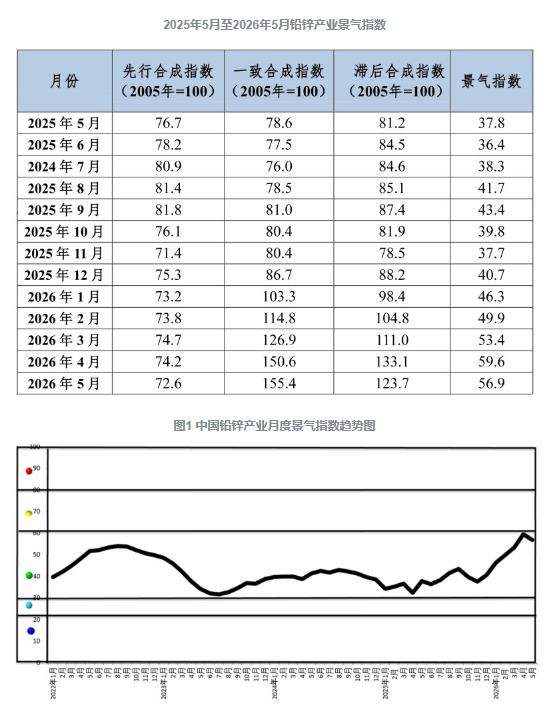
The overall industry operated steadily in May, with 4 indicators rising and 5 indicators falling, reflecting a generally positive market but facing adjustment pressures. All 9 indicators constituting the prosperity index were within the "normal" range. The leading index, composed of 6 leading indicators including the LME lead-zinc price index, M2, and lead-acid battery production, saw a slight decline mainly due to fluctuations in international lead-zinc prices, weaker-than-expected recovery in downstream demand for galvanized sheets and lead-acid batteries, coupled with cautious fixed asset investment in the industry and fluctuations in the lead-zinc ore import index.
Sub-indicators showed a significant rise in lead-zinc prices, with the LME lead-zinc price index at 51.3, up 12.3 percentage points from April, driven by geopolitical conflicts in the Middle East and energy price fluctuations. The money supply fell slightly, with the M2 index at 46.5, down 1.7 percentage points from April, as monetary policy remained prudent. The lead-acid battery index was 20.3, down 3.7 percentage points from April, indicating a slight cooling in industry sentiment but stable operations. The galvanized sheet index was 22.1, up 7.3 percentage points from April, with downstream demand essentially flat compared to April. The lead-zinc ore import index was 50.8, down 23.5 percentage points from April, with import enthusiasm cooling but not deviating from reasonable levels. The fixed asset investment index was 2.3, down 9.7 percentage points from April, as investment became more moderate and rational. The production index was 36.5, down 9.4 percentage points from April, indicating weakening production activity. The main business revenue index was 128.1, up 16.3 percentage points from April, as market recovery significantly improved corporate earnings. The total profit index was 76.2, up 2.2 percentage points from April, with good smelting profits and most smelters maintaining high operating rates.
In May, the domestic lead-zinc industry prosperity declined slightly, but overall remained at the top of the normal range, approaching a slightly hot level. The industry is trending positively, but internal indicators show clear divergence. The leading index fell slightly, dragged down by factors such as international lead-zinc price fluctuations, stable downstream demand for galvanized sheets, limited recovery in lead-acid batteries, cautious industry investment, and fluctuations in raw material imports, putting short-term expectations under some pressure. In the international market, the Middle East situation and energy price fluctuations affected lead-zinc prices. Domestic monetary policy remained prudent, with M2 falling slightly but liquidity stable. On the raw material side, smelters released restocking demand, lead-zinc ore imports rebounded, and fixed asset investment improved moderately. On the production front, smelters in multiple regions resumed and increased production, driving the production index upward; downstream energy storage and automotive replacement demand supported growth in lead-acid battery production, while demand for galvanized sheets remained largely stable. Along with production recovery and improved raw material supply, lead-zinc enterprises saw simultaneous increases in main business revenue and profits, with profitability steadily recovering. The industry presents a development pattern of rising prosperity, stable supply and demand, and improved efficiency.
This article is compiled by Wedoany. All AI citations must indicate the source as "Wedoany". If there is any infringement or other issues, please notify us promptly, and we will modify or delete it accordingly. Email: news@wedoany.com