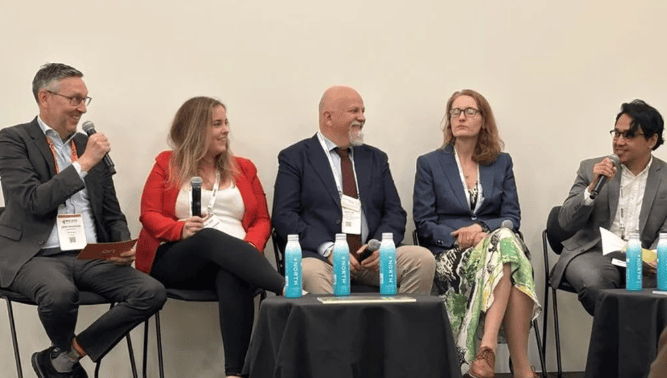
en.Wedoany.com Reported - Stuart Heather-Clark, Head of Power for the Middle East and Africa at SLR Consulting, pointed out that addressing climate change requires the combined action of green electrons and green molecules, with green molecules responsible for the remaining 30 to 40 percent of economic decarbonization, presented in the form of green hydrogen.
Heather-Clark explained that electrons can only drive 60 to 70 percent of economic decarbonization, while processes such as manufacturing green steel must rely on green molecules to remove oxygen from iron oxide through chemical reactions—that is, introducing a hydrogen atom instead of a carbon atom to achieve decarbonization. Similarly, providing safe decarbonized aviation fuel requires molecules, as large jet airliners cannot use heavy batteries. In land transportation, there are three options: battery electric vehicles, fuel cell electric vehicles, or hybrid vehicles.
Despite the relatively high cost of green hydrogen, some developers remain interested in investing in large-scale gigawatt-level hydrogen production projects. Although project progress has slowed, investment continues, and SLR continues to help clients reduce risks, obtain permits, and ensure sustainability. Heather-Clark believes that, despite opposition from an energy balance perspective, green hydrogen, as a carbon-free and carbon-neutral molecule, still offers significant advantages and opportunities for South Africa and Africa. Gigawatt-scale export projects are selling green ammonia, a key green hydrogen derivative. However, he cautioned that governments need to plan carefully, avoid excessive optimism about the benefits of hydrogen, and recognize that hydrogen may need to be exported before a domestic hydrogen economy takes shape.
In contrast to the gigawatt-scale project under construction in Saudi Arabia, building smaller-scale localized demonstration plants remains feasible. Heather-Clark emphasized that Africa can benefit from large-scale projects, and building gigawatt-scale projects, exporting products, and generating economic value remains a good opportunity.
Renewable electricity accounts for approximately 80 percent of the total production cost of green hydrogen. Africa, with its abundant wind and solar resources, can generate low-cost renewable energy, making it an ideal platform for large-scale projects. Africa has vast tracts of land for building wind farms and solar photovoltaic plants, and South Africa, in particular, has deep-water ports capable of handling ships needed to transport hydrogen using ammonia as a carrier. Ammonia leverages existing industrial infrastructure, making long-distance transport easier, cheaper, and safer, and can be reconverted into hydrogen at the destination.
Hive Hydrogen has received environmental approval to build a $5.8 billion gigawatt-scale hydrogen-to-ammonia plant within the Coega Special Economic Zone and is considering a possible final investment decision by the end of this year. The project aims to produce 1.2 million tons of ammonia annually between 2028 and 2029, using 3.6 gigawatts of renewable energy to power a 1.2-gigawatt electrolyzer. In Namibia, the 7-gigawatt green hydrogen Hyphen project is advancing within the Tsau/Khaeb National Park; the Zhero Molecules hydrogen-ammonia project is located in Walvis Bay; and the Hylron Oshivela project is pioneering green iron production near Arandis. SLR has been involved in pre-feasibility studies for gigawatt-scale projects in South Africa, Namibia, Angola, Tunisia, Egypt, and Saudi Arabia.
Over the past five to six years, as SLR has handled green hydrogen projects, the language has shifted from megawatts, thousands of hectares, and millions of dollars in investment to gigawatts, thousands of square kilometers, and billions of dollars in investment. Gigawatt-scale export projects are massive and complex, requiring long-term stable offtake agreements to secure final investment decisions. Numerous technological developments are exploring electrolyzer configurations and ways to reduce hydrogen prices and renewable energy input costs. Once achieved, the transition to the implementation phase is expected to be much faster.
Heather-Clark noted that SLR works closely with clients to reduce project risks from environmental and social perspectives. Environmental and social impact assessments are linked to financing, with most banks being Equator Principles banks, requiring all environmental work to be completed in accordance with International Finance Corporation performance standards. Additionally, long-term offtake agreements are needed before any project can commence. NEOM is the first large-scale gigawatt-level green hydrogen project to enter the commissioning and production phase, but projects still face challenges, and risk reduction is crucial. Shared infrastructure, natural gas pipelines, transmission lines, desalination plants, and export port facilities also need to be considered. For first movers, for example, when building port costs in the first phase of development, they must also accommodate subsequent phases of that port, making the project's financial feasibility quite tricky. Understanding the government's financial component from a public user infrastructure perspective helps reduce risks for these large, complex projects.
This article is compiled by Wedoany. All AI citations must indicate the source as "Wedoany". If there is any infringement or other issues, please notify us promptly, and we will modify or delete it accordingly. Email: news@wedoany.com