China Leads Global Cellular IoT, with 5.9 Billion Connections Expected by 2035
en.Wedoany.com Reported - The global cellular IoT market is entering a new phase of growth. According to the Ericsson Mobility Report, the total number of global cellular IoT connections in 2025 is approximately 4.3 billion, with broadband IoT (4G/5G) becoming the largest segment. Meanwhile, massive IoT technologies such as NB-IoT and LTE-M continue to expand rapidly. Enterprises are increasingly leveraging 4G and 5G networks to connect machines, vehicles, sensors, and industrial assets. The commercial deployment of 5G Standalone networks is expected to accelerate the rollout of next-generation IoT services featuring low latency, network slicing, and high energy efficiency.
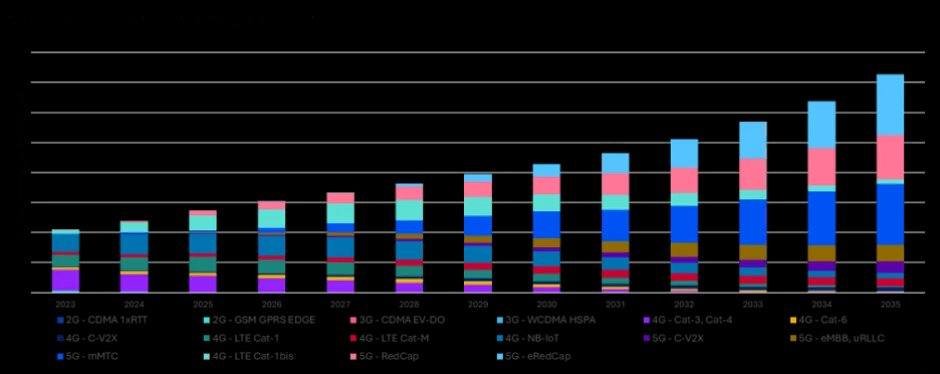
With the commercialization of 3GPP Release 17 and the industry transition to Release 18 (5G Advanced), eRedCap is presenting new deployment opportunities. Compared to traditional RedCap, eRedCap reduces device complexity, power consumption, and module costs, making it suitable for wearable devices, industrial sensors, smart cameras, logistics tracking, medical equipment, and consumer IoT products. More cost-competitive chipsets and the continued expansion of 5G Standalone network coverage are expected to accelerate the maturity of the industrial ecosystem in the coming years.
Industry analysts point out that LTE Cat-1 bis is currently one of the fastest-growing technologies in the mid-range IoT segment. This technology strikes a good balance between cost, coverage, battery life, and performance, and is increasingly used in payment terminals, asset tracking, smart meters, logistics equipment, retail systems, and industrial monitoring—scenarios that typically do not require full 5G capabilities.
China continues to lead the global cellular IoT ecosystem, driven by large-scale deployments in smart meters, industrial automation, connected manufacturing, logistics, and smart city infrastructure. The region's leadership is also underpinned by government investment in digital infrastructure, the rapid expansion of 5G Standalone networks, and the world's largest ecosystem of IoT module and chipset suppliers.
Multiple countries are integrating cellular IoT into their national digital infrastructure. Investments in smart utilities, intelligent transportation systems, renewable energy management, water infrastructure, and public safety networks continue to drive demand for secure, low-power IoT connectivity. Meanwhile, cybersecurity regulations emerging in Europe, North America, and Asia are promoting the widespread adoption of secure SIM technology, remote provisioning, device authentication, and lifecycle management solutions.
Automakers are accelerating the shift to software-defined vehicles centered on continuous cellular connectivity throughout the vehicle lifecycle. Beyond infotainment and navigation, connected vehicle capabilities have expanded to include predictive maintenance, remote diagnostics, fleet management, insurance telematics, advanced driver-assistance systems (ADAS), over-the-air firmware updates, and vehicle-to-everything (V2X) communication. These applications are expected to become the primary drivers of demand for 5G automotive modules over the next decade.
The arrival of 5G Advanced is expected to further expand the target market for cellular IoT. This technology enhances support for artificial intelligence, integrated sensing, deterministic networking, low-power devices, and uplink performance. Combined with edge computing and AI-driven analytics, next-generation cellular IoT platforms will deliver smarter automation solutions for manufacturing, healthcare, transportation, utilities, agriculture, logistics, and smart cities.
Omdia forecasts that global cellular IoT connections will reach 5.9 billion by 2035, with NB-IoT, mMTC, and eRedCap accounting for 65% of all connections. Cellular IoT connections in the automotive sector alone are expected to exceed 1 billion, with 89% of automotive modules adopting 5G technology. As operators continue to expand 5G Standalone networks and the industry moves toward 5G Advanced, enterprises will gain access to more cost-effective, energy-efficient, and intelligent connectivity solutions. Combined with ongoing investments in AI, edge computing, and digital infrastructure, cellular IoT is poised to become the foundational technology for connected industries, software-defined vehicles, smart cities, utilities, healthcare, logistics, and industrial automation over the next decade.
Related Products
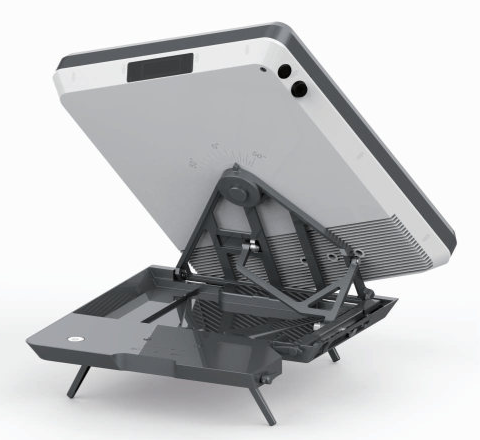

Flat Portable Satellite Terminal 0.35m Aperture Manual Portable Terminal
China Starwin Science & Technology Co., Ltd.

Comprehensive Mining Automation Control System
Beijing Tianma Intelligent Control Technology Co., Ltd.
Automatic Aiming Laser Remote Obstacle Removal Robot
Pinggao Group Weihai High-Voltage Apparatus Co., Ltd.

Industrial and Commercial Point-Type Gas Detector
Jinan Benan Technology Development Co., Ltd.
TWP16 P-Band Tropospheric Wind Profile Radar
China Huayun Meteorological Technology Group Co., Ltd.