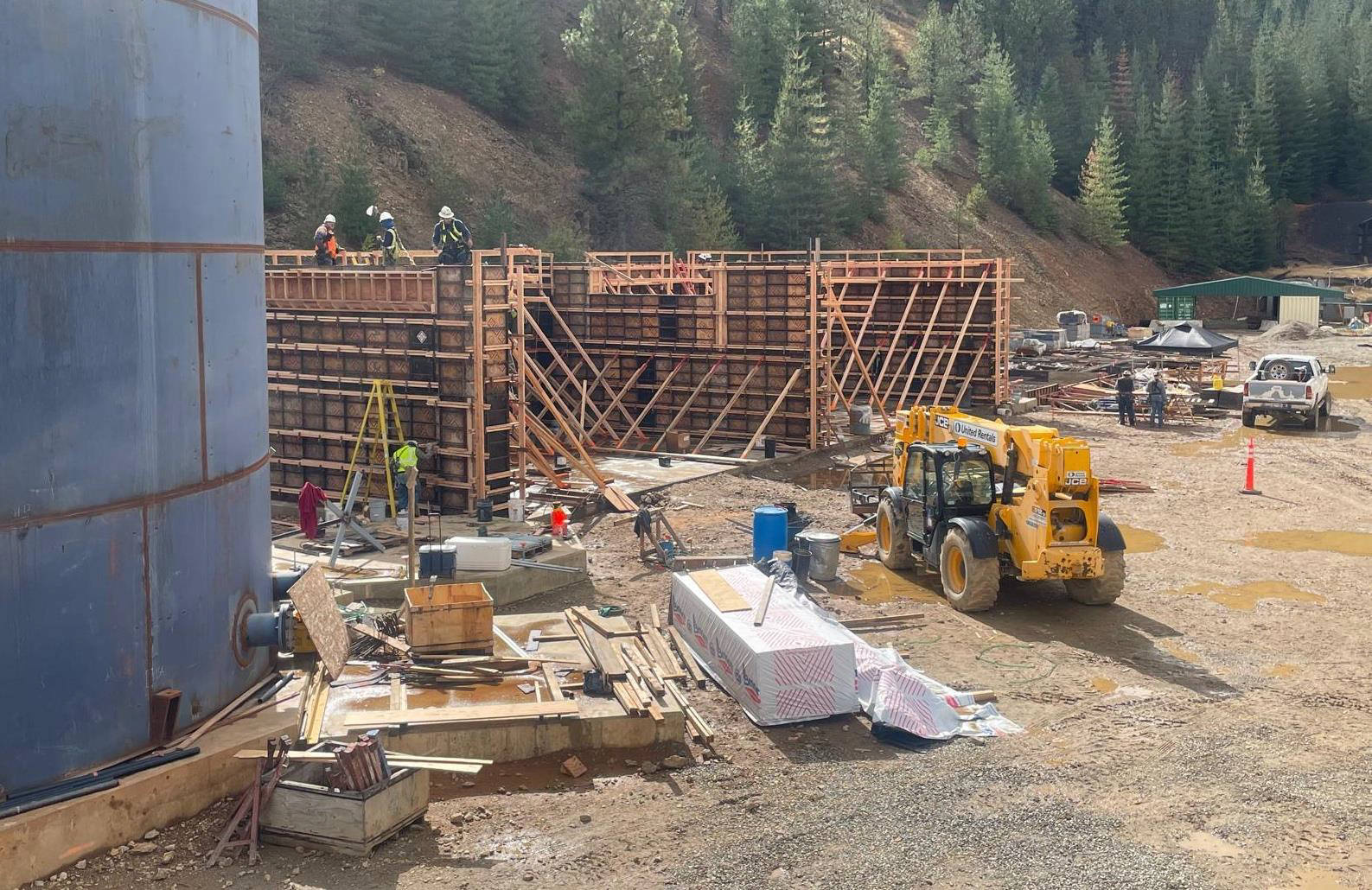
en.Wedoany.com Reported - After six years of reconstruction, Bunker Hill Mining's historic mine in Idaho's Silver Valley has transitioned from the construction phase to the ramp-up phase. The company has begun feeding ore into the rebuilt mill, and the next test is whether it can consistently produce concentrates and generate cash flow to address its weak stock performance this year.
Bunker Hill Mining CEO Sam Ash told The Northern Miner that the company has stockpiled over 20,000 tonnes (18,144 tonnes) of ore at the crusher and plans to ramp up mining to the mill's design capacity of 1,800 tonnes per day, targeting full production by next year. At steady state, Bunker Hill expects about nine concentrate trucks to depart daily for Teck Resources' Trail smelter in British Columbia, 210 kilometers north by road.
Ash said that feeding the first ore into the mill on June 25 was an incredibly exciting day. As a third-generation mining engineer, Ash's father briefly worked at the Bunker Hill zinc plant in 1976. Now, he and his team need to prove that this mine, long known for false starts, can operate in a market seeking closer supplies of zinc, lead, and silver. If the mill reaches nameplate capacity and trucks roll steadily toward Trail, Bunker Hill will have a cash flow foundation. Ash said this money can be used to explore new silver zones, expand the haulage system, and consolidate the region—which has produced 1.2 billion ounces of silver.
In March, Bunker Hill's stock fell 25% due to dilution from a C$33.8 million discounted financing and the sudden resignation of CFO Gerbrand van Heerden. Although a 1:35 reverse stock split temporarily boosted the share price, the stock is down 25% year-to-date, closing Monday at US$4.40, with a market capitalization of US$205 million.
Ash said the mine's capital development for the first three to five years is complete, and staff are focused on later-stage development. A 2022 pre-feasibility study set initial restart capital at US$55 million, including contingencies. After subsequent refinancing and balance sheet restructuring, the final cost appears higher, but Bunker Hill has not provided an updated all-in restart figure. As of March 31, Bunker Hill had just under US$30 million (C$42.5 million) in the bank, sufficient to achieve positive cash flow. Teck also provided an undrawn US$10 million working capital loan facility that Bunker Hill can use if issues arise during ramp-up. Teck helped fund the restart, and Ash said the offtake agreement follows standard concentrate sales terms. Bunker Hill has no metal streaming agreements; the company refinanced with Sprott's royalty and streaming division last year to remove a polymetallic stream from its capital structure, allowing it to better benefit from rising metal prices. However, one royalty remains, along with a silver-backed debt loan from Monetary Metals.
The mine plan starts with zinc-rich ore, as it is the fastest and lowest-cost path to restart production. Ash said this choice has led the market to view Bunker Hill primarily as a base metals play, even though the old mine produced 165 million ounces of silver as a by-product.
Ash said the company does believe Bunker Hill will become a major silver producer and should be viewed as such, and is changing that narrative. The newly discovered Cate-8 provides the first near-term catalyst for this claim. The target is in the upper mine, near existing workings, and Bunker Hill expected to find a single silver vein, but drilling encountered a wider mineralized corridor containing many high-grade silver veins. The company has drilled 12 holes at Cate-8 to date, all intersecting mineralization, with assays received for seven. The target is about 40 to 91.5 meters from existing workings, allowing Bunker Hill to access potential mining faster than a surface discovery requiring new access. Ash said the discovery is orders of magnitude larger than expected, essentially stumbling upon a mineralized zone or corridor.
Bunker Hill's latest target estimate puts Cate-8 at 50,000 to 168,000 tonnes grading 5.75 to 9.32 ounces per tonne silver equivalent, or about 1 million ounces. Ash cautioned that the estimate remains conceptual and unconfirmed. The best early drill holes include BHE26-02, which intersected 28.6 feet (8.71 meters) at 453 feet (138 meters) depth, grading 3.02 ounces per tonne silver (103.39 grams per tonne), 7.44% lead, and 0.85% zinc, including 17.1 feet grading 4.19 ounces per tonne silver, 10.67% lead, and 0.73% zinc. Hole BHE26-03 returned 15.5 feet grading 6.4 ounces per tonne silver, 0.5% zinc, and 20.4% lead, about 310 feet (94.5 meters) from current mine workings. Bunker Hill said true widths are unknown. The company is currently drilling to advance the zone to indicated status by next year. Ash said the goal is to complete sufficient resource work, engineering, and mine design to add silver-rich Cate-8 production in 2027.
Ash said the main bottleneck in current operations is underground haulage, not the mill. Bunker Hill could expand the mill to 2,500 tonnes per day, but the mine needs greater haulage capacity to reach that higher output. The proposed expansion, called "Bunker Hill 2.0," would add a new portal and a 10,000-foot ramp. Bunker Hill has received a US$150 million letter of interest from the U.S. Export-Import Bank to support the work. Ash said desktop studies show the ramp cost is close to US$60 million, with remaining funds available for debt refinancing and reducing the company's cost of capital.
Ash said Bunker Hill's path to first ore was shorter than many U.S. mine builds because the operation is on private land and patented mining claims. While working with Idaho regulators, the company rebuilt its relationship with the U.S. Environmental Protection Agency at the Superfund site. When Ash's team arrived in 2020, Bunker Hill did not own the asset but held a lease with a purchase option that needed renegotiation. The team also had to finance construction during a weak mine development market. The local labor market helped in the final push. Bunker Hill now employs over 100 people, with a peak expected near 200. Ash said many miners in Silver Valley own homes in northern Idaho while flying to work in Alaska, Canada, Nevada, and Arizona.
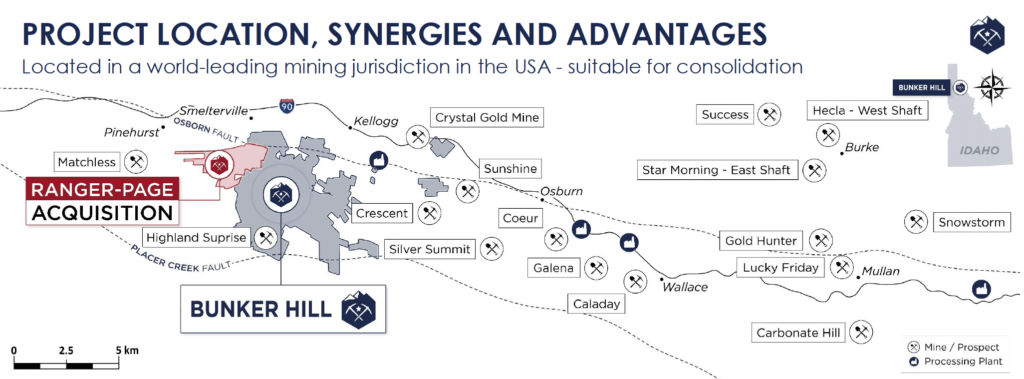
Exploration is also expanding beyond Cate-8. Bunker Hill plans work this summer on the Motor vein, Ranger-Page, and Government Gulch prospects. The company acquired Ranger-Page in December, adjacent to the old Bunker Hill mine. According to Ash, the claim covers part of an unexpectedly under-tested corridor between two historic mining areas. The Government Gulch target lies under cover but shows strong geophysical anomalies from surface to about 300 meters depth. The broader land package supports Ash's plan to build a multi-asset company in Silver Valley. Ash said one mine operation does not make a mid-tier company, and the company's ambition is to become a multi-asset mid-tier mining company.