Koshien Stadium and Kyocera Dome in Japan Test Millimeter Wave 400MHz Bandwidth to Boost Capacity
en.Wedoany.com Reported - Millimeter waves, with their extremely wide bandwidth of 400MHz (a scale equivalent to the total bandwidth of other frequency bands), have become the optimal frequency band for achieving high-speed, high-capacity communication in the mobile communications field. Wireless network capacity is directly proportional to bandwidth, so the wide bandwidth of millimeter waves ensures greater capacity. Based on this characteristic, millimeter waves are deployed in densely populated areas such as stations, bustling city centers, and stadiums where large crowds gather.
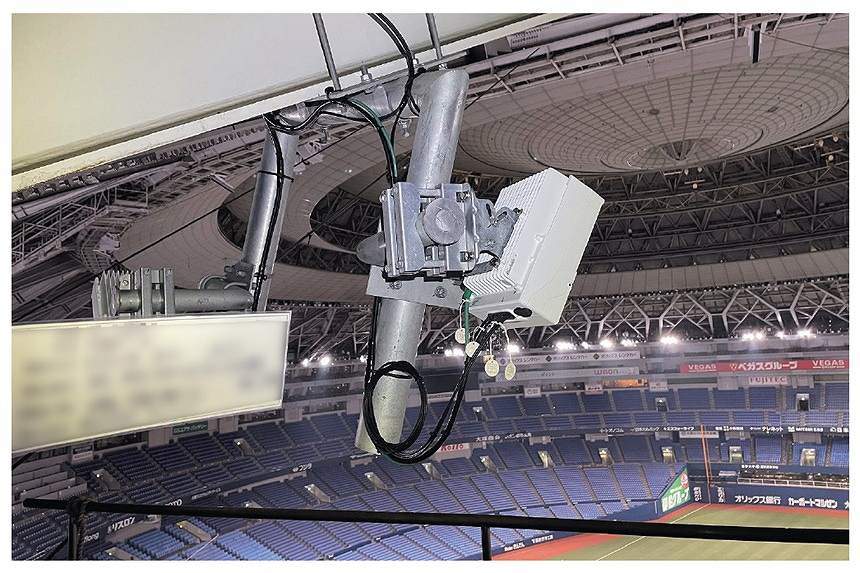
From a wireless communication perspective, stadiums represent a unique environment. Although they vary in form (domes, arenas, gymnasiums, etc.), stadiums share the following common features: a large space with a diameter of 200 to 300 meters, an environment where tens of thousands of people are densely packed, and a structure where the roof covers all or part of the area. Hanshin Koshien Stadium, including the spectator seating, is an open space with a diameter of approximately 220 meters. In contrast, station areas in city centers have many walls and stairs, with narrow passages about ten meters wide forming a complex layout; while bustling city centers offer good outdoor visibility, building clusters often obstruct radio wave propagation. The environment of a "large space with dense crowds" is actually quite unique.
Inside stadiums, good line-of-sight conditions are favorable for millimeter wave propagation. The propagation distance of millimeter waves is approximately 100 to 200 meters, which is sufficient to cover the entire stadium. Additionally, traffic within stadiums can surge dramatically in an instant: tens of thousands of people simultaneously raising their smartphones, a massive number of social network posts occurring at once, and the moment of sending large volumes of data. In this "simultaneous, high-density" traffic environment, the overall network capacity becomes the bottleneck. Leveraging the wide bandwidth of millimeter waves can significantly enhance the overall capacity of the stadium, thereby handling instantaneous traffic spikes. Measured data has helped confirm the transmission capabilities of millimeter waves in stadiums and guided the selection of antenna installation locations.
Related Products

20 Inch 1600*900 Full HD 60Hz TFT LED Monitor with VGA and DP Interfaces for Desktop Computers-Business Use
Guangzhou Zanying Optoelectronics Technology Co., Ltd.



TWP16 P-Band Tropospheric Wind Profile Radar
China Huayun Meteorological Technology Group Co., Ltd.
GYTA Type Non-Self-Supporting Aerial/Duct Optical Cable
TONGDING INTERCONNECTION INFORMATION CO., LTD.
MUX Series Communication Interface Device for Security and Stability Control System
Nanjing NR Electric Co., Ltd.