Wedoany.com Report-Apr. 13, Lockheed Martin, a prominent American defense and aerospace company, is working on vertical solar array technology (VSAT) designed for use on the Moon. This initiative aims to deliver a reliable and sustainable energy source for lunar operations. According to a statement on the company’s website: “VSAT has the ability to provide continuous and sustainable power and will be foundational for various lunar operations.”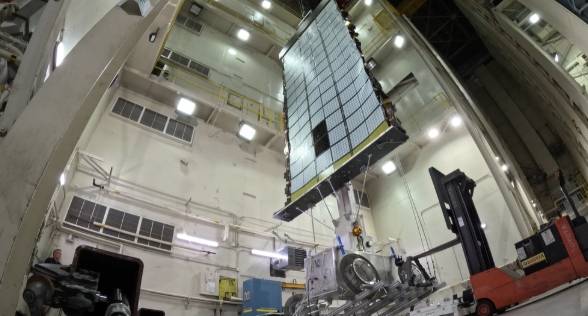
Lockheed Martin's Vertical Solar Array Technology (VSAT) being tested in a high bay
The Moon’s south pole presents unique conditions for solar energy, with certain areas receiving sunlight for 80% to 90% of the time. However, the sun remains low on the horizon, requiring solar arrays to efficiently capture light from specific angles. Lockheed Martin’s VSAT tackles this issue with its vertical design, extending up to 19.8 meters in height, optimizing sunlight absorption in such environments.
The technology has undergone rigorous testing on Earth, simulating the Moon’s gravity, which is one-sixth of Earth’s. It has also been evaluated across diverse surfaces and slopes to reflect the lunar terrain’s uneven nature, as well as in extremely low temperatures akin to those on the Moon. These tests confirm its durability and adaptability for extraterrestrial deployment.
Lockheed Martin envisions the VSAT supporting a range of lunar activities. It could supply power to life support systems, lighting, and other critical functions in habitats. Additionally, it may charge lunar rovers and vehicles vital for exploration, as well as energize systems that extract and process local resources, enhancing self-sufficiency on the Moon.
In 2022, NASA chose Lockheed Martin as one of three companies to further develop solar array systems capable of autonomous vertical deployment and retraction. This feature allows the arrays to be relocated as needed, offering flexibility for future lunar missions. The company’s efforts align with broader goals of establishing a sustainable human presence on the Moon.
Separately, a recent study by German scientists suggests an alternative approach to lunar power generation. The research highlights the potential of producing halide perovskite cells directly on the Moon, using regolith-based moonglass derived from lunar soil. While distinct from Lockheed Martin’s VSAT, this concept underscores the growing focus on innovative energy solutions for lunar exploration.
Lockheed Martin’s VSAT represents a significant step toward reliable energy infrastructure beyond Earth. By addressing the Moon’s challenging lighting conditions and terrain, the technology could play a key role in supporting long-term exploration and habitation efforts.