China's WAPI Innovation and Technology Evolution Accelerate, Global Chip Shipments Exceed 32 Billion Units
en.Wedoany.com Reported - Currently, digital transformation is moving from "whether it can connect" to "whether it can connect safely and with high quality." In key industries such as government and enterprise offices, finance, energy and power, medical services, and intelligent manufacturing, wireless local area networks have become an important component of business systems. Facing this trend, WAPI, as China's independently innovative wireless LAN security technology standard, leverages its three-element peer-to-peer security architecture, national cryptographic algorithms, mature industry, and scalable deployment capabilities to become the only technical route that simultaneously meets "WLAN access requirements" and "security compliance mandates." Market demand continues to heat up, driving the concentrated emergence of new products, applications, and ecosystems.
At the "Secure Wireless LAN Innovation Application Conference and Beijing-Tianjin-Hebei Cybersecurity Collaborative Development Promotion Meeting" recently held by the WAPI Industry Alliance, representatives from government regulatory authorities, industry users, research institutes, testing organizations, and upstream and downstream enterprises in the industrial chain engaged in in-depth discussions on innovative applications and collaborative development pathways for secure wireless LANs in critical information infrastructure scenarios.
WAPI Becomes Key Support for Industry Secure Wireless Networks
Xie Junyi, Director of the Communication Division at the General Dispatch Center of China Southern Power Grid, stated that since initiating WAPI technology trials in 2019 and comprehensively advancing WAPI network construction and application in 2024, the Southern Power Grid's WAPI network has covered over a thousand substations and plants across the entire grid, forming 39 typical application scenarios in six major categories, including power generation, transmission, substation, distribution, and comprehensive applications. Not only China Southern Power Grid, but it is understood that State Grid Corporation of China also began WAPI pilot construction in 2021, covering various application scenarios such as substation, distribution, and distributed photovoltaics. By the end of 2025, thousands of WAPI application demonstration projects have been established in provinces including Shandong, Jiangsu, Henan, Hebei, Shanxi, Shaanxi, Xinjiang, and Sichuan.
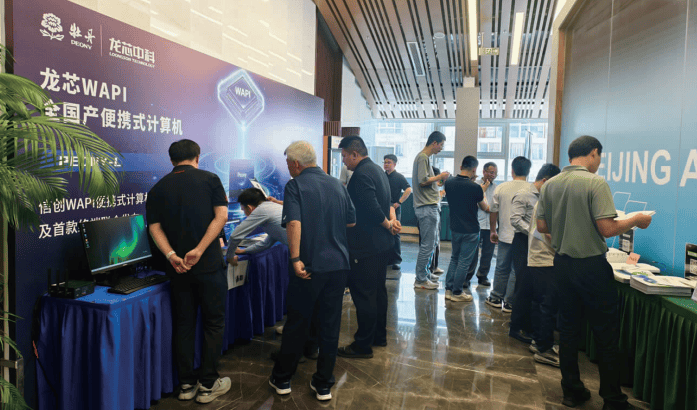
At the meeting, the "Xinchuang WAPI Portable Computer Solution and First Terminal Product," jointly launched by Loongson Technology Corporation Limited and Beijing Peony Electronics Group Co., Ltd., was officially unveiled. The Peony-L, the first Xinchuang WAPI portable computer, deeply integrates China's domestic CPU, the Xinchuang ecosystem, and WAPI secure communication capabilities, providing full-stack security support from the hardware foundation to communication protocols for scenarios such as government and enterprise mobile secure office and special industry private network access.
Shenzhen Xinrui Network Technology Co., Ltd. presented the "WAPI Wireless Zero-Disruption Solution." This solution adopts an architecture of "centralized processing, single signal source, distributed antenna coverage," targeting scenarios such as AGV scheduling, smart warehousing, mobile nursing, and doctor rounds, reducing packet loss and disruption risks caused by roaming handovers. In the fields of IoT and intelligent operations, Guangzhou Lianwu Technology Co., Ltd. showcased the "WAPI + Dianhong-based Multimodal Equipment Status Monitoring and Early Warning System," reflecting the new direction of integrating WAPI with industry operating systems, AI, and digital twins.
WAPI Innovative Products and Applications Accelerate Emergence
The growth in market demand is driving the WAPI industry chain to upgrade from individual products to systematic solutions. Organizations including Peony Electronics, Loongson Technology, Lianwu Technology, Jiuren Technology, Xinrui Technology, and Youlipu demonstrated the latest WAPI products and solutions, covering chips, modules, terminals, access devices, industry applications, and system integration, attracting widespread attention from industry users and construction units.
Industry users attending the meeting told reporters that changes in the WAPI industry ecosystem are mainly reflected in three aspects: first, application scenarios are becoming richer, with demands from industries such as power, government, finance, healthcare, and manufacturing directly driving product innovation; second, product forms are becoming more diverse, with WAPI capabilities extending from general-purpose terminals to sensors, smart devices, and industry platforms; third, solutions are becoming more systematic, with WAPI integrating with technologies such as domestic CPUs, Dianhong OS, AI, multimodal perception, and digital twins to form diverse, industry-oriented overall solutions.
Zhang Lulu, Secretary-General of the WAPI Industry Alliance, stated that the key to industrial development lies in "real needs being seen, innovative results withstanding practical validation, and collaborative promotion forming a synergy." The Alliance will continue to promote supply-demand matching, demonstration-driven development, and industrial collaboration, facilitating secure wireless LANs to serve more industries and application scenarios.
At the meeting, the WAPI Industry Alliance released the "WAPI 2.0 Technical White Paper," the "WAPI Technology Industry Market Service Manual," and the "WAPI Standards Industry Application and Environmental Monitoring Report," providing industry users with references for secure wireless LAN product selection, network construction, project acceptance, and application promotion, covering technology evolution, industry applications, market services, and the standards environment.
WAPI Accelerates Towards the Post-Quantum Era
Huang Zhenhai, Deputy Director of the Wireless Network Security Standardization Working Committee, stated that since its launch in 2000, WAPI 1.0 has adopted a three-element peer-to-peer security architecture and national cryptographic algorithms, effectively addressing wireless security risks such as "fake base stations" and "Wi-Fi piggybacking." It has achieved large-scale application in sectors such as telecommunications, energy, and government, with cumulative global shipments of related chips exceeding 32 billion units.
Looking towards the quantum era, the WAPI Industry Alliance began organizing WAPI 2.0 standardization in 2015. The first foundational technical standard, T/WAPIA046, was released in 2021, restructuring the future-oriented security infrastructure, adding atomic key establishment and entity authentication protocols, and a fast handover mechanism. It enhances quantum resistance, adapts to general commercial cryptographic algorithms, and strengthens identity protection, resistance to offline dictionary attacks, and mobile service experience.
WAPI 2.0 provides technical support for smooth network evolution and long-term security requirements. Zhang Qiangguo, Product Manager at the Technology Integration R&D Center of the National Engineering Research Center for Wireless Network Security Technology, introduced that under the organization of the WAPI Alliance, the National Engineering Center, in collaboration with Xi'an University of Posts and Telecommunications, built a WAPI 2.0-1DN demonstration network. Adopting a simplified two-tier "core-access" architecture, it completed verification of WAPI 1.0 and WAPI 2.0 dual-mode coexistence, unified authentication services, fast handover, management frame protection, high-traffic transmission, and high-density concurrent connections.
According to subsequent plans, the WAPI 2.0 technical standards system will continue to evolve in directions such as protocol enhancement, algorithm mixing, and PQC algorithm collaboration, driving secure wireless LANs from "available, usable, and secure" further towards "long-term security and sustainable upgrades."
Related Products


Industrial and Commercial Point-Type Gas Detector
Jinan Benan Technology Development Co., Ltd.

Automatic Aiming Laser Remote Obstacle Removal Robot
Pinggao Group Weihai High-Voltage Apparatus Co., Ltd.


Mine Explosion-proof and Intrinsically Safe Industrial Ethernet Ring Network (10 Gigabit/Gigabit)
Chongqing Mas Sci&Tech Co., Ltd.



Conveyor Belt Intelligent Monitoring System
LUO YANG WIRE ROPE INSPECTION TECHNOLOGY CO., LTD.
Multi-function Marine Monitoring Low-altitude Detection Radar Sea-air Boundary Ocean Dynamic Environment Measurement
Chengdu Dixin Technology Co., Ltd.