Korea Institute of Materials Science and Others Develop PTFE-Free Dry Electrode Technology by 2026
en.Wedoany.com Reported - A research team from the Korea Institute of Materials Science (KIMS, President Choi Cheol-jin), in collaboration with a team led by Insung Hwang of the Korea Electrotechnology Research Institute (KERI), has successfully developed South Korea's first dry electrode manufacturing technology based on shape-controllable graphite particles. This technology enables the production of high-performance batteries without using polytetrafluoroethylene (PTFE), a key material in conventional dry electrode processes. It is expected to extend the driving range of electric vehicles, shorten charging times, and accelerate the commercialization of next-generation eco-friendly battery manufacturing processes.
With the growing demand for electric vehicles and energy storage systems, competition to develop batteries with higher energy density is intensifying. Dry electrode technology is regarded as a promising next-generation production method due to its reduction in the use of organic solvents and drying processes during battery manufacturing. This approach offers significant advantages in lowering manufacturing costs and carbon emissions. However, most existing dry electrode processes rely heavily on PTFE, making the development of alternative technologies a key challenge.
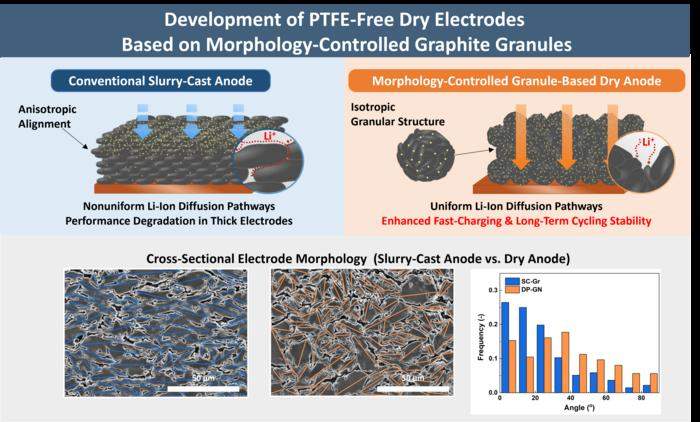
PTFE serves as a critical binder for holding the components of dry electrodes together. However, in the anode environment, it can lead to performance degradation, and environmental concerns regarding fluorinated materials are increasingly drawing attention. By applying the CMC-SBR binder system widely used in commercial wet electrode manufacturing and redesigning the structure of graphite particles, the research team successfully developed a PTFE-free dry anode.
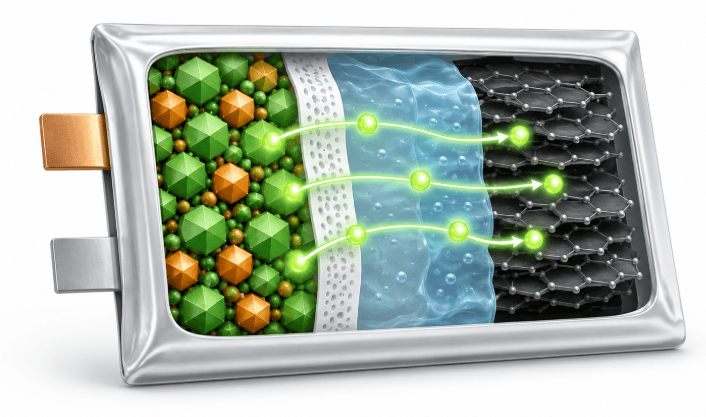
The researchers employed a spray-drying process to prepare composite graphite particles using a slurry composed of graphite, conductive additives, and binders. During the granulation process, conventional flake-shaped graphite particles were assembled into particles with a randomly oriented, isotropic internal structure, rather than the highly oriented structure typically formed in conventional electrode processing. This isotropic arrangement creates multi-directional lithium-ion transport pathways, reducing orientation-induced transport limitations and mitigating the performance degradation commonly observed in thick dry electrodes during charge-discharge cycles.
Experimental results showed that the developed dry anode exhibited superior fast-charging performance and long-term cycling stability compared to conventional slurry-based anodes. The technology also improved lithium-ion diffusion characteristics under high-energy-density conditions, confirming its potential for high-capacity batteries based on thick electrode architectures, thereby providing a technical foundation for batteries capable of long range and fast charging.
This technology is expected to be applied in electric vehicles, energy storage systems, and next-generation high-energy-density batteries. Due to the use of the CMC-SBR binder system, which is widely adopted in industry, the technology offers advantages in large-scale manufacturing and is expected to reduce manufacturing costs and carbon emissions by minimizing solvent use and drying processes.
Senior researcher Ji-hee Yoon of the Korea Institute of Materials Science stated that this technology presents a new approach to overcoming the limitations of conventional PTFE-based dry electrode processes and is expected to be highly applicable to next-generation electric vehicle batteries requiring high energy density and fast charging performance.
This research was supported by the KIMS Institutional Research Program funded by the Ministry of Science and ICT, the Creative Convergence Research Project of the National Research Council of Science and Technology, the Materials and Components Technology Development Project, and the Machinery and Equipment Technology Development Project funded by the Ministry of Trade, Industry and Energy. The research findings were published online on April 21, 2026, in the energy storage field journal Energy Storage Materials (Impact Factor: 20.2).
Related Products

Standard Nozzle Flowmeter
Jinggong Automatic Control Instrument Complete Technology Development Company
Photovoltaic and Wind Power Generation Technology
Beijing Boqi Electric Power SCI-TECH Co., Ltd.
MESS8201-2507/5015-BN Prefabricated Liquid-cooled Energy Storage Battery Container
Xuchang Xuji Electric Science Energy Storage Technology Co., Ltd.

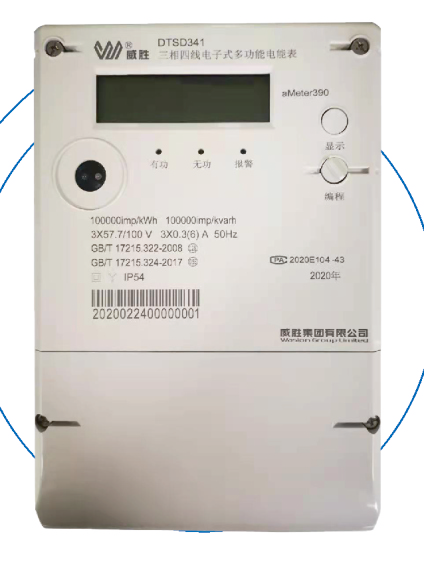
Overseas IEC Gateway Energy Meter - DTSD341/DSSD331-aMeter390
Wasion Group Limited Co., Ltd.
Jiujiang Pinggang 125MW Subcritical Gas Power Generation Project
Capital Engineering & Research Incorporation Limited