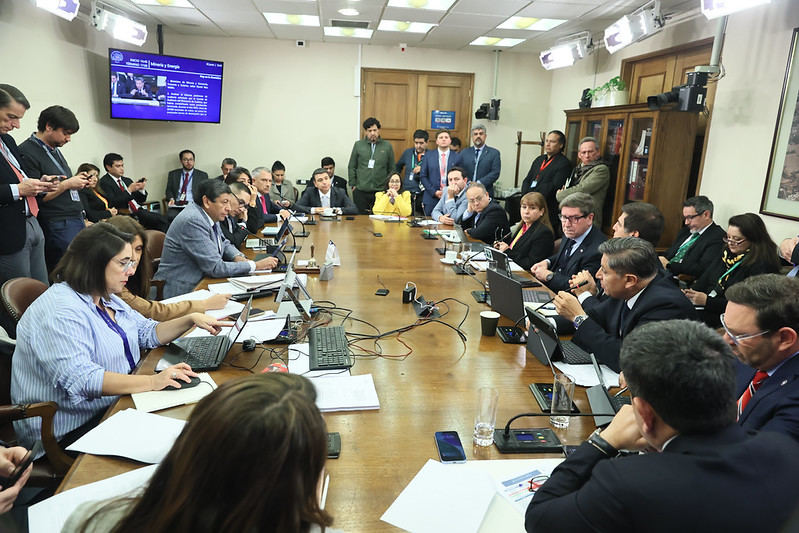
en.Wedoany.com Reported - Chile's Chamber of Deputies Mining Committee (Comisión de Minería) approved in general, with 8 votes in favor and 5 abstentions, the project promoted by the executive branch to amend the Mining Code and other related laws, aiming to improve the mining royalty system.
This proposal aims to address existing issues in the mining guarantee system (amparo minero) held by mining concession holders. This mechanism ensures the validity of their land rights by fulfilling specific obligations, such as paying mining royalties or carrying out specific work on the site.
According to Minister of Mining and Economy Daniel Mas, the proposal defines a new mining royalty system, with specific adjustments including: eliminating the conditions required to obtain reduced mining royalties, such as the 500-hectare limit, kinship conditions, and company type; eliminating the progressive mining royalty fee schedule; eliminating the annual obligation to apply for reduced mining royalties; expanding the grounds for reduction to include exploration; and establishing the obligation to pay reduced mining royalties during the concession application period. Meanwhile, the executive branch committed to amending the Mining Code regulations after the law is approved and, in coordination with the National Geology and Mining Service (Sernageomin), standardizing application criteria across regions.
Minister Mas expressed gratitude for the approval and the speed of processing. He argued that the project will achieve legal certainty and simplification, reduce barriers for small mining enterprises, promote exploration activities, and bring benefits to the country and regions, including expanding the future production base, increasing regional employment, and creating structurally sustainable revenue. This view was also supported by Deputy Ignacio Urcullú. Deputy Urcullú stated that the law resolves an issue affecting small miners, namely the auctioning of mining royalties, providing breathing room, peace of mind, and certainty for their ongoing investments and the continued development of this important activity. He specifically mentioned the elimination of the kinship inheritance clause and revealed that discussions are ongoing on how to apply the hectare limit to benefit from the system. He acknowledged the diversity within the small mining sector and noted that some reservations are being discussed at the technical level.
Critic Deputy Bernardo Salinas pointed out that the proposal modifies the current framework that protects small-scale and artisanal mining relative to large companies. He emphasized that the previous 500-hectare limit granted special treatment to small miners regarding mining royalties, whereas this project opens it up to free competition among small, medium, and large enterprises. He also criticized what he sees as excessive simplification in registration, arguing that a single document in process could make someone the owner of a hill, potentially leading to speculative behavior in the future, as mining royalties can be sold. He believes that if the goal is to resolve the issue of unpaid mining royalties, a short law would be a better approach.
Committee Chairman, Deputy Cristián Tapia, reported that a specific vote on the proposal will take place next Wednesday. He mentioned that the value of mining royalties is expected to be maintained for large companies, but standards will be updated, while mining royalties for small and medium-sized enterprises will return to pre-2022 levels.
In another segment of the session, the committee analyzed the final report instructed by the Audit, Compensation, and Ethics Committee (CACE) of the National Copper Corporation of Chile (Codelco). The report confirmed serious anomalies and regulatory deviations in the copper production report for the end of 2025 and assessed their potential impacts and consequences. Codelco's new leadership, including Board Chairman Bernardo Fontaine and Executive President Jorge Gómez, along with General Auditor Raúl Puerto and CACE Director and Chair Tamara Agnic, participated in the presentation.
The briefing indicated that the conclusions determined that the materials did not fully meet the conditions required by internal standards to be considered finished goods and should have continued to be recorded as work in progress. Additionally, violations, improper use of exception norms, and deficiencies in mandatory approvals were identified, and the impact on target calculations was assessed. Those responsible stated that no negative impact requiring modification of the company's audited financial statements as of December 31, 2025, was found, but that variable incentives related to these indicators would need to be recalculated. In other background information, it was reported that instructions were given to establish management recovery mechanisms and take disciplinary measures, including the dismissal of one executive and warnings for other relevant professionals, as well as a review of bonuses paid to executives, supervisors, and workers in 2025.
Deputy Tapia praised the presentation and expressed trust in the new management. He believes Executive President Gómez has extensive mining experience and should guide the company to increase production and protect worker safety. He emphasized that Codelco should maintain its state-owned enterprise nature but assessed that it must be managed like a private company.