South Korea's Public Digital Service Contracts Reach 97.1 Billion Won in First Half, Number of Contracts Up 2.6 Times
en.Wedoany.com Reported - In the first half of this year, the total value of public digital service contracts in South Korea decreased slightly compared to the same period last year, but the number of contracts more than doubled, indicating a shift in public institutions' usage of digital services from large-scale single projects to the regular adoption of diverse services.
According to data from the Digital Service Usage Support System on the 6th, there were a total of 656 public digital service contracts in the first half of this year, valued at 97.14935 billion won. Compared to 248 contracts worth 108.1093 billion won in the same period last year, the contract value decreased by approximately 10.1%, while the number of contracts increased by 408, or about 2.6 times. The Digital Service Usage Support System is a specialized contract platform that helps public institutions sign contracts and adopt private cloud services, Software as a Service (SaaS), and artificial intelligence (AI) convergence services faster than traditional procurement. The Ministry of Science and ICT, along with the National Information Society Agency (NIA), assists public institutions in conveniently purchasing pre-registered private services through catalog or discretionary contracts.
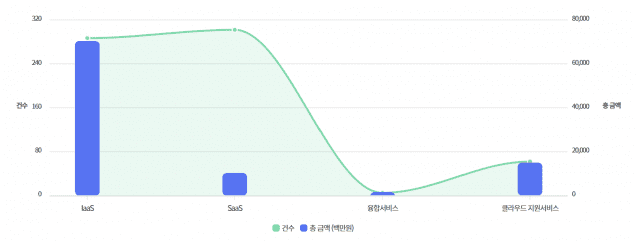
The most significant change in the first half was the increase in the number of contracts. Last year, several large-scale AI projects inflated the overall contract value; this year, institutions individually introduced digital services based on their own needs, thereby expanding the market. In fact, in the first half of last year, there were only 4 AI convergence service contracts, but their value reached approximately 46.3 billion won, accounting for a substantial portion of the total. In contrast, this year saw 5 convergence service contracts, a similar number, but with a total value of only about 1.55 billion won. This is interpreted as a base effect from the large AI project tenders last year, leading to an overall decline in contract value.
Infrastructure as a Service (IaaS) continued to grow. In the first half of this year, there were 287 IaaS contracts worth approximately 70.4 billion won, a significant increase from 131 contracts worth about 35.7 billion won last year, both in terms of number and value. The adoption of private cloud services by public institutions continues to expand. The proliferation of SaaS has been particularly notable, with SaaS contracts increasing from 85 last year to 302 in the first half of this year, more than tripling; the contract value also rose from about 6.4 billion won to 10.2 billion won. This appears to be due to an increase in direct purchases of various services such as generative AI, collaboration tools, and business software on demand. For cloud support services, the contract value decreased slightly compared to last year, but demand remained stable. Services supporting cloud application continue to be tendered, and the cloud operation systems of public institutions are gradually stabilizing.
By type of procuring institution, public institutions accounted for the largest share, with a contract value of approximately 50.8 billion won, representing over half of the total performance. The number of contracts for central administrative agencies and local governments increased from 18 to 180 and from 59 to 157, respectively. SaaS contracts for schools also increased from 14 to 57, indicating an expansion of digital service adoption in the education sector. By contract method, there were 453 catalog contracts in the first half of this year, more than double the 202 contracts last year; discretionary contracts also increased significantly from 46 to 203. The specialized digital service contract system, implemented since 2020, is taking root in the field, with public institutions increasingly adopting needed services quickly.
The public digital service performance in the first half of this year should be interpreted as a change in market structure rather than a decline in contract value. Analysis suggests that the public IT procurement model is shifting from reliance on large-scale single projects to a method centered on cloud and SaaS, with institutions regularly adopting digital services. An NIA official stated, "The significant increase in the number of contracts in the first half of this year compared to last year is meaningful. As the specialized digital service contract system takes root in the public sector, the foundation for more institutions to utilize private cloud and AI services is expanding."
Related Products


Industrial and Commercial Point-Type Gas Detector
Jinan Benan Technology Development Co., Ltd.



Hot Selling 10 Inch Intel N5100 I5 I7 FHD 8 +128GB 16+256GB Win10 Pro Win11 Pro 4G 5G Rugged Tablet PC Pad with NFC Barcode
Highton Electronics Co., Ltd.
MUX Series Communication Interface Device for Security and Stability Control System
Nanjing NR Electric Co., Ltd.
G.652.D Wavelength-extended Non-dispersion Shifted Single-mode Optical Fiber
HONGAN GROUP CO., LTD.
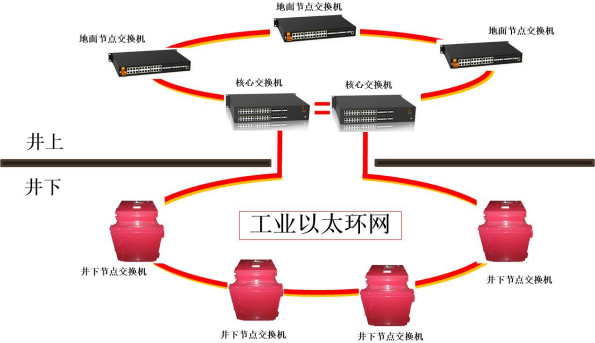
Mine Explosion-proof and Intrinsically Safe Industrial Ethernet Ring Network (10 Gigabit/Gigabit)
Chongqing Mas Sci&Tech Co., Ltd.
TWP16 P-Band Tropospheric Wind Profile Radar
China Huayun Meteorological Technology Group Co., Ltd.

Comprehensive Mining Automation Control System
Beijing Tianma Intelligent Control Technology Co., Ltd.