South Korea's Hanbat National University Develops 2D Perovskite Spacer Layer Design Model
en.Wedoany.com Reported - Researchers at Hanbat National University in South Korea have developed a model that enables a more systematic design of organic spacer layers in two-dimensional perovskite materials, potentially accelerating the development of these materials in optoelectronic devices such as solar cells and LEDs.
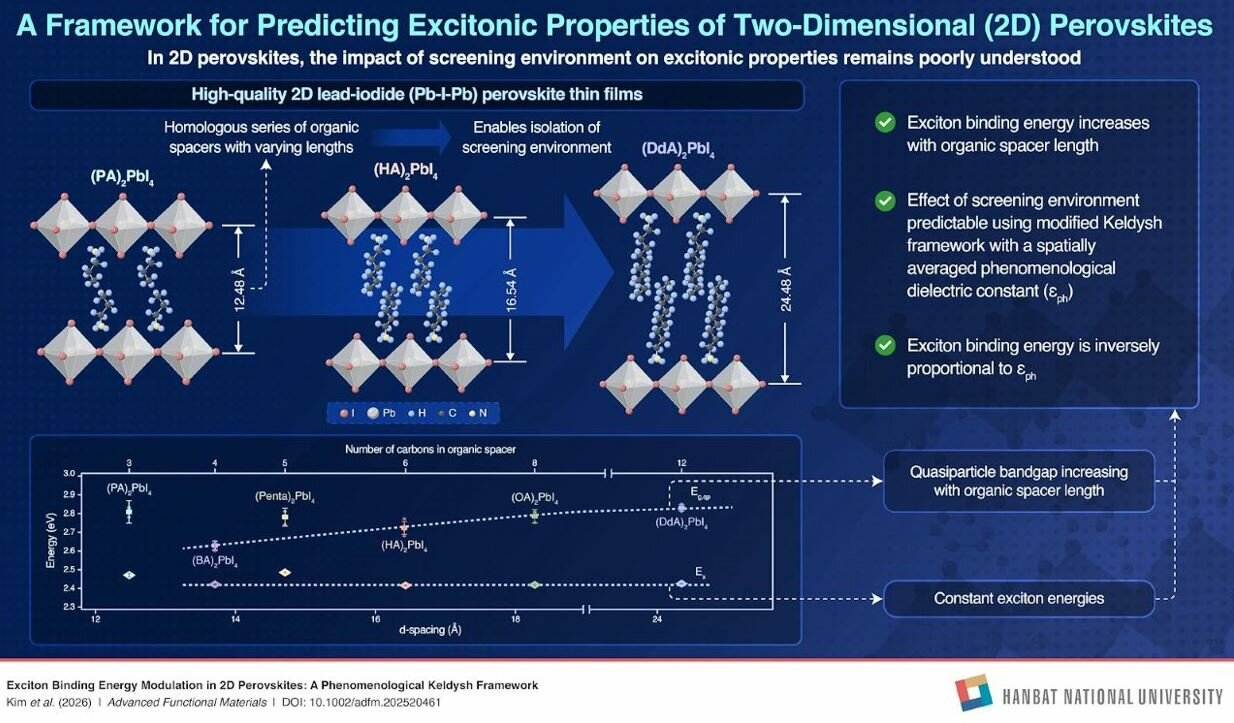
Two-dimensional perovskites are considered candidates for next-generation light-based technologies due to their excellent light absorption and emission capabilities, as well as superior stability compared to some similar materials. However, their performance is highly sensitive to structural changes, where minor structural variations can significantly affect the material's optoelectronic behavior, and the causal relationship between the two is often difficult to determine.
Led by Professor Ki-Ha Hong from the Department of Materials Science and Engineering at Hanbat National University, the research team focused on the thin organic spacer layers within two-dimensional perovskites, aiming to clarify the specific effects of these spacers on material properties. Two-dimensional perovskites consist of alternating stacks of inorganic layers and organic spacer layers, where the inorganic layers are primarily responsible for optoelectronic activity, while the organic spacer layers influence the interactions between these functional layers.
A key concept in the study is "excitons," which are electron-hole pairs formed when a material absorbs light. The properties of excitons directly affect the material's performance in applications such as LEDs and solar cells. Previously, changing the spacer material often altered both the interlayer distance and the material structure simultaneously, making it difficult to isolate the effects of the spacer layer itself.
To separate these effects, the team selected a group of two-dimensional lead iodide perovskites with highly similar structures, where the main inorganic structure remained almost unchanged. By varying the organic spacer layers with similar chemical end groups but different chain lengths, they adjusted the inorganic interlayer distance while avoiding significant structural distortion of the material. Subsequently, they employed various spectroscopic techniques to measure the material's band gap and exciton energy.
The results showed that as the spacer chain length increased, the quasiparticle band gap widened, but the exciton energy changed very little. This indicates that the spacer layer significantly affects the material's electrical behavior but has a limited impact on optical absorption energy. Additionally, longer spacer layers increased the exciton binding energy, i.e., the strength with which electrons and holes remain connected after light absorption.
The research team also tested the ability of the existing Keldysh model to explain the experimental results. This model is commonly used to describe excitons in ultrathin materials but did not fully match the observations. By introducing a new function that accounts for the actual thickness of the organic spacer layer, the model's agreement with experimental data improved.
This study provides a more direct molecular design route for predicting the performance of two-dimensional perovskites, helping companies and research teams conduct more efficient and targeted development before integrating the materials into devices. The research findings were published online in December 2025 and appeared in Advanced Functional Materials.
Related Products


Smart Photovoltaic Prefabricated Substation
Shanghai Jinyou Jinhong Intelligent Electric Co., Ltd.

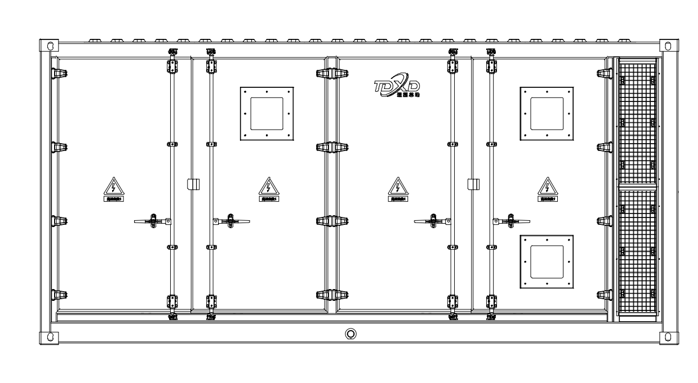
5012kWh DC Energy Storage System TD-EES-5012kWh
Suzhou Tongding Xindong Energy Storage Technology Co., Ltd.
Prefabricated Houses and Electrical Energy Boxes
Chengdu Ruilong Machinery Manufacturing Co., Ltd.
Industrial and Commercial Point-Type Gas Detector
Jinan Benan Technology Development Co., Ltd.