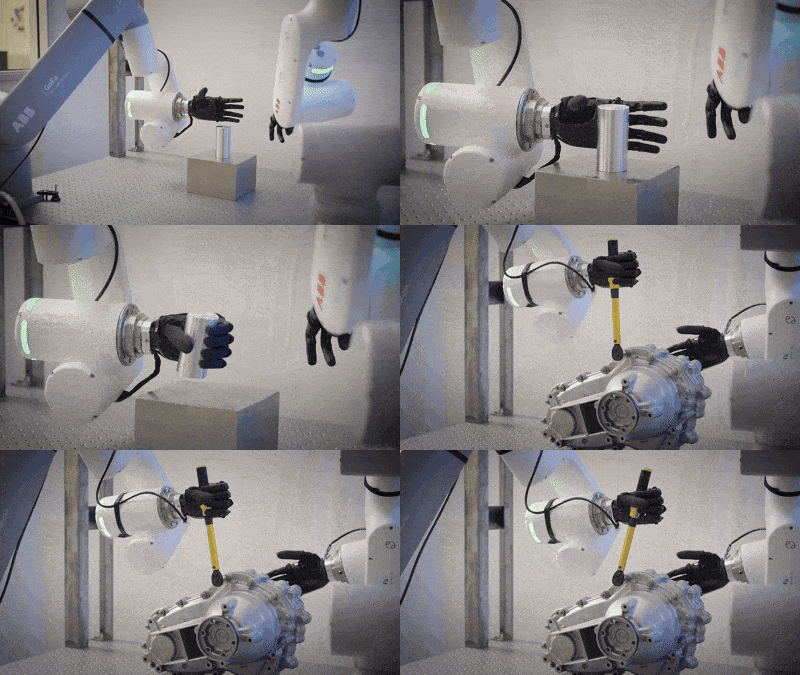
en.Wedoany.com Reported - ABB Robotics is collaborating with US-based bionics company PSYONIC to use tactile and motion data collected from human prosthetic use to train robots, enhancing their grasping and dexterous manipulation capabilities. This partnership combines PSYONIC's Ability Hand bionic dexterous hand with ABB's GoFa™ collaborative robot to explore solutions for fine, multi-variable tasks that traditional automation struggles to handle.
Marc Segura, Global President of ABB Robotics, stated that human dexterity and the intuitive understanding of how to grasp different objects are among the hardest capabilities to replicate in industrial robots, yet they are fundamental to building truly autonomous, multi-functional machines. With the advancement of physical AI technology, robots will perceive and understand the world like humans, and this collaboration aims to bridge the gap between robots and humans in dexterous manipulation.
Grasping and dexterous manipulation capabilities are core to Autonomous Versatile Robot (AVR™) technology. ABB Robotics has made this its development vision, enabling robots to autonomously perceive, reason, move, and perform material handling in dynamic environments. These capabilities are crucial for advancing physical AI in the industrial sector, allowing robotic systems to learn autonomously from real-world interactions and operate with industrial-grade reliability.
This collaboration will explore new application scenarios across industries such as automotive, aerospace, packaging and logistics, and life sciences. By having robots take on repetitive, ergonomically challenging, or tasks difficult to perform consistently at scale, it can enhance human-robot collaboration, improving production efficiency, line flexibility, and safety. PSYONIC is working closely with ABB's R&D team to explore the application of tactile manipulation technology in next-generation autonomous robots.
PSYONIC's Ability Hand bionic dexterous hand, originally developed for prosthetics, integrates myoelectric control, tactile sensing, and flexible mechanical structures. It features pressure sensors and vibration feedback systems, allowing users to perceive contact status and grip strength, while flexible fingers can conform to irregular objects. Dr. Adeel Akhtar, Founder and CEO of PSYONIC, noted that dexterous manipulation is both a hardware and a data challenge. Using the same dexterous hand for both prosthetics and robotic devices allows for the collection of high-fidelity real-world data to more effectively train robotic systems.
ABB's GoFa™ collaborative robot provides industrial-grade precision and repeatability, ensuring stable execution and accurate assessment of grip strength, finger positioning, and motion variations. This enables real human operational data to be effectively translated into stable robotic performance. The two parties will evaluate the application value of integrated solutions across various industrial scenarios, particularly for handling irregular or fragile objects. Data from the International Federation of Robotics indicates that advanced grasping technology combined with digital solutions can reduce engineering commissioning time by up to 30%, highlighting the importance of end-of-arm tooling in accelerating automation deployment and improving return on investment.
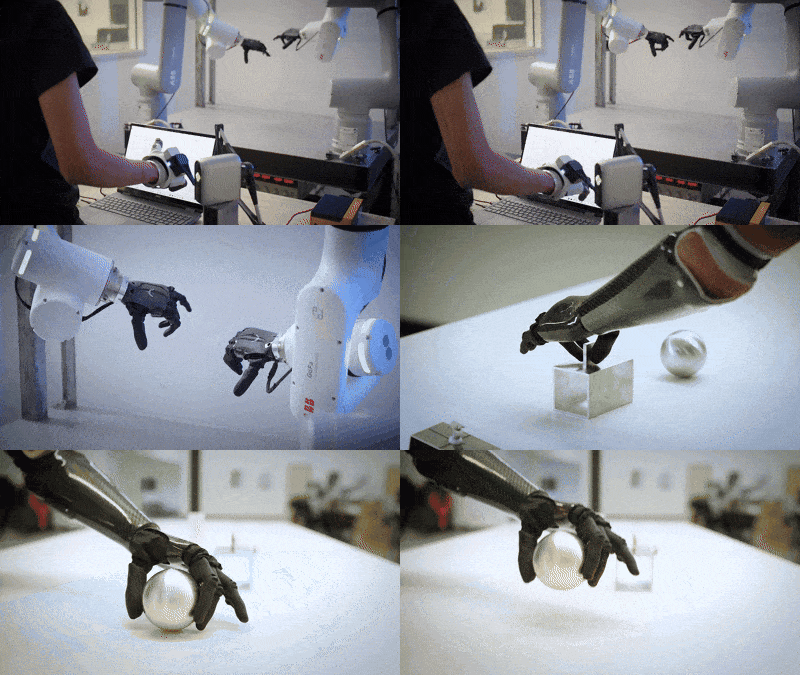
This collaboration is a practical implementation of ABB Robotics' ecosystem strategy, aimed at breaking down barriers in automation by partnering with others. By integrating robotics technology, artificial intelligence, and data collected from human prosthetics, ABB Robotics is driving the iteration of physical AI technology to create robots with enhanced performance and adaptability, ensuring their reliable operation in real-world production environments.