China's Quectel Launches Multiple AI+XR Reference Designs and One-Stop Solution
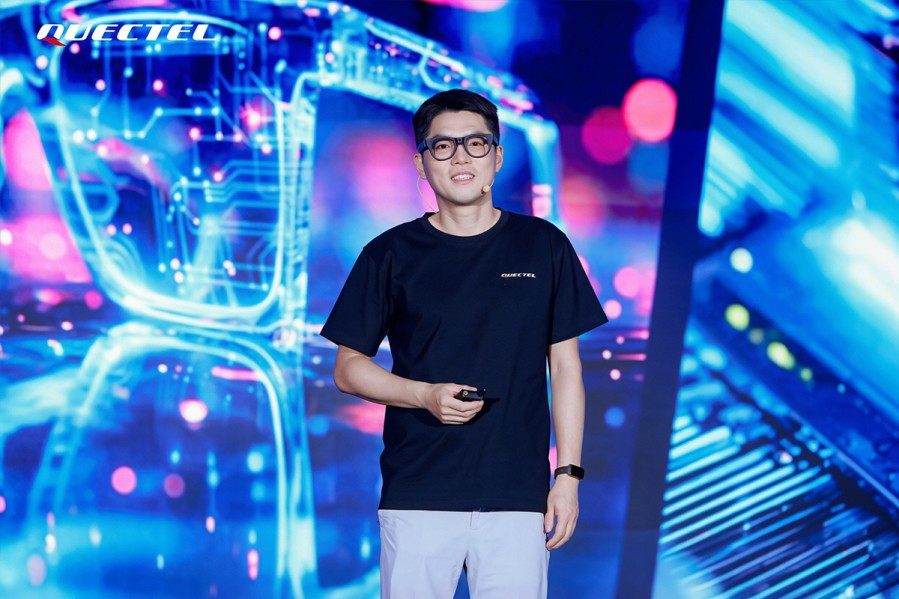
en.Wedoany.com Reported - At its recently held XR Solutions and Ecosystem Strategy Conference, Quectel officially launched multiple AI+XR core reference designs, including the Hawk and Dolphin series, and proposed a one-stop solution that "simplifies" the process for industry clients. Zhang Dong, co-founder and COO of Quectel, appeared at the conference wearing a new product that looks like ordinary glasses but is equipped with built-in AR+AI functions. He noted that these glasses are redefining the way humans connect with the world.
Market data shows that global XR glasses shipments in 2025 reached approximately 15 million units, a year-on-year increase of 56%; it is estimated that the global XR device market will exceed 60 million units in 2026. An industry guest predicted during an interview at the conference that the market will see even greater growth in the next one to two years, gradually approaching an "iPhone moment" as technology and the industrial chain mature.
Currently, the poor user experience of XR products stems from the complex integration of multiple hardware and software technologies, including optical solutions, display modules, chip platforms, AI algorithms, voice interaction, system integration, and precision manufacturing. Issues in any link or functional integration can affect the end-user experience and hinder further industry expansion. Zhang Dong addressed external questions at the start of the conference about why Quectel entered the XR field. He explained the company's technological accumulation trajectory from the 1.0 connectivity era ("devices online") to the 2.0 intelligent connectivity era (edge computing power), and now to the current 3.0 era (AI, robotics, XR), believing that XR will be the core entry point for the next generation of human-computer interaction. Quectel has prepared for this for three years, with its logic being "adding to our own capabilities while simplifying the customer implementation process." "Why are we doing XR? Not to chase trends, not as a cross-border experiment. Simply because, on this path we've walked for fifteen years, we believe in one thing: when intelligence truly enters the physical world, the possibilities it inspires, the connections it creates, and the freedom it brings are worth a company's full focus and passion to ignite the spark of XR," Zhang Dong said at the end of his speech.

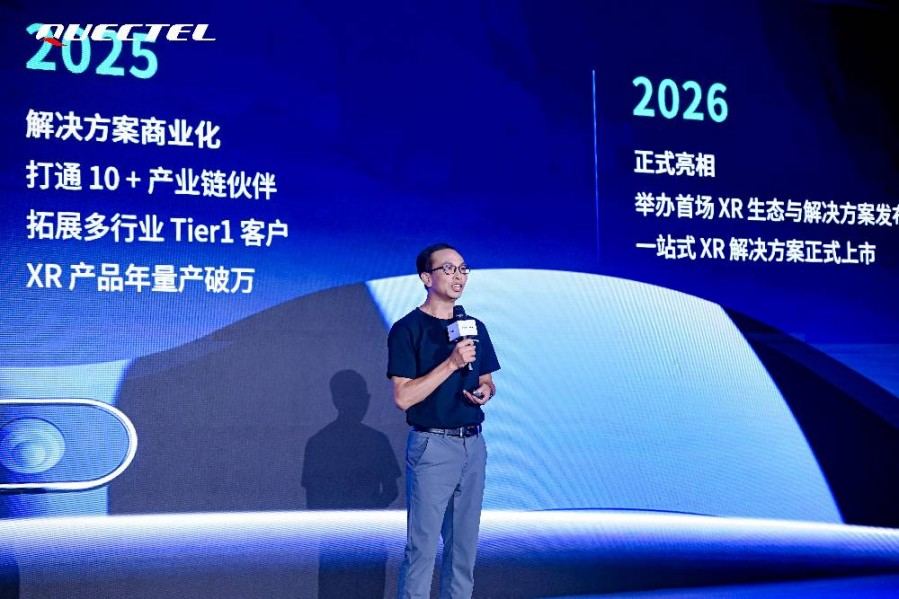
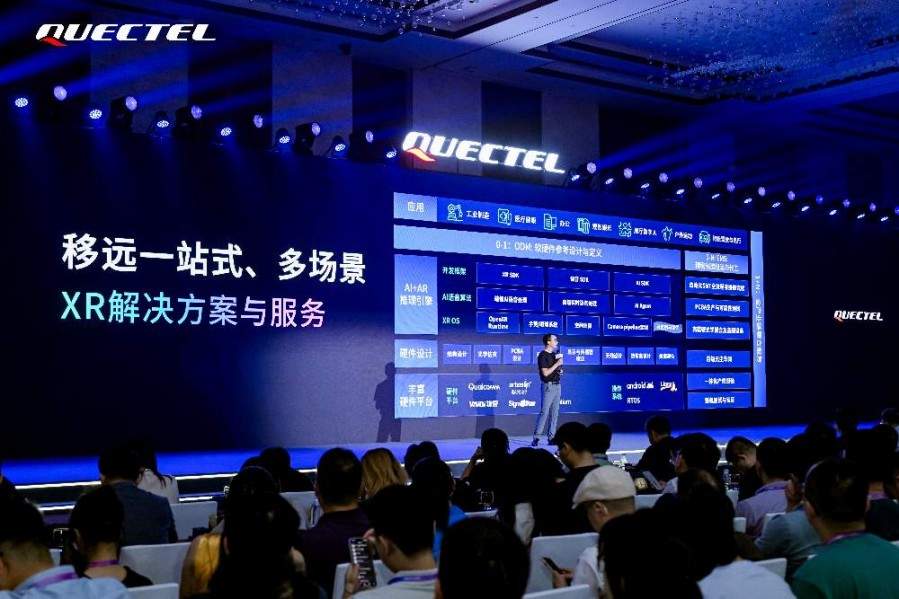
Ma Guowen, Quectel's XR Product Director, introduced that Quectel has built a one-stop XR solution covering the entire process from scenario requirement analysis, product definition, technical verification, and reference design to structural design, module integration, and mass production. Quectel proposed a "0-1, 1-N, 1+N" three-dimensional capability framework: focusing on XR hardware and software reference design and definition, addressing precision manufacturing and delivery speed during the scaling phase, and providing full industry chain ecosystem integration services. "What we simplify are the complex R&D processes and investments for customers, the barriers to XR production and manufacturing, and the lengthy cycle for XR terminals to reach commercialization," Ma Guowen stated. On the software side, Quectel has developed an XR-specific OS based on a deep customization of Android, covering full compatibility with OpenXR Runtime, spatial tracking, spatial computing, and 2D/3D applications; voice capabilities span offline and online full scenarios; the AI agent layer achieves a complete end-cloud integrated AI experience, open to customers via SDK.
At the conference, Ma Guowen showcased a live video of Quectel's XR production line at its Changzhou Intelligent Manufacturing Center, demonstrating the factory's well-equipped XR assembly lines and Class 100 cleanrooms, capable of supporting mass production of various XR devices. Huang Pan, CEO of Chuangshiyun Technology, also shared a case study on how his company leveraged Quectel's reference designs and engineering capabilities to achieve the launch of lightweight AI glasses products, stating that Quectel allowed the team to focus on user-level experience refinement and market expansion.
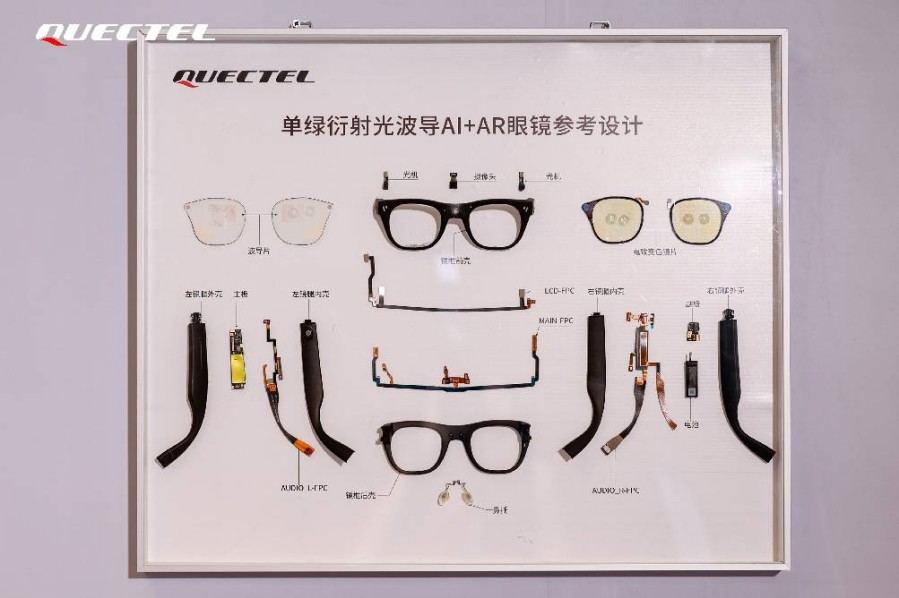
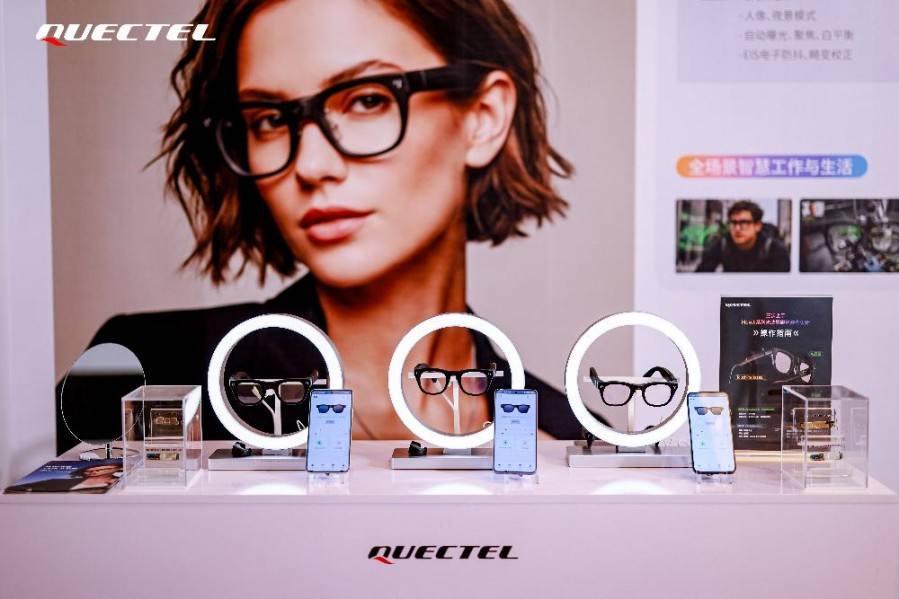
Simultaneously released, the AI+AR glasses Hawk series includes two architectures: optical waveguide and BirdBath. The optical waveguide glasses reference design adopts an integrated lightweight design, offering two architecture options: "Qualcomm Snapdragon AR1 Gen 1 Platform + WUQI Micro WQ7036" and "CoolChip Micro ARS45 + WUQI Micro WQ7036," with innovative support for three-level electrochromic dimming that automatically adjusts transmittance based on ambient light. The self-developed split-type full-color BirdBath AR glasses reference design emphasizes an immersive visual experience, with a FOV of 50±1°, brightness of 5000 nits, single-eye resolution of Full HD (1920×1080), support for 60 to 120 fps refresh rates, also equipped with three-level electrochromic dimming and 0 to 400 diopter adjustment, with peripherals integrating dual DMICs, dual stereo speakers, wear detection sensors, and a 12-megapixel wide-angle camera.
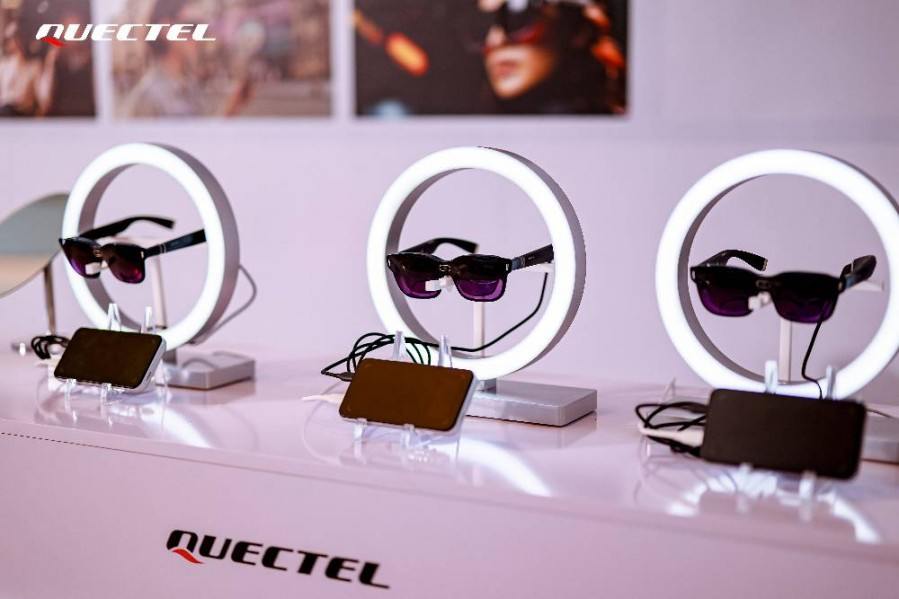
The Dolphin series AI+AR computing units are based on two platforms: Qualcomm QCS6690 and QCS8550, available in a 5G end-cloud fusion version and an edge computing version. The 5G end-cloud fusion version features Quectel's self-developed eSIM, supporting operator certification in over 150 countries and regions, and is equipped with a self-developed eIM management platform; the edge computing version offers 48 TOPS of computing power, supporting on-device deployment of AI Agents. This computing unit can connect not only to AR glasses but also to various terminals such as 3D headsets and monitors via wired or wireless connections.
At the end of the conference, Ma Guowen emphasized that Quectel only serves as a solution provider and supporting service provider in the smart hardware field, and will not compete with customers by launching its own terminal brands. By offering modular reference designs and mass production capabilities, it helps customers create differentiated terminal brands. XR glasses that overcome pain points are truly integrating into future life. Morning workouts, with all physiological and movement data displayed before the eyes; evening relaxation, with desired movies unfolding on the screen in front. XR glasses can also record every smile and every wonderful moment anytime, anywhere. This is not science fiction; this is the real possibility Quectel aims to bring to the world in the future.
Related Products


GYTA Type Non-Self-Supporting Aerial/Duct Optical Cable
TONGDING INTERCONNECTION INFORMATION CO., LTD.


MUX Series Communication Interface Device for Security and Stability Control System
Nanjing NR Electric Co., Ltd.
Automatic Aiming Laser Remote Obstacle Removal Robot
Pinggao Group Weihai High-Voltage Apparatus Co., Ltd.


Conveyor Belt Intelligent Monitoring System
LUO YANG WIRE ROPE INSPECTION TECHNOLOGY CO., LTD.