China's Momenta World Model Autonomous Driving System Surpasses 1 Million Vehicles
en.Wedoany.com Reported - Chinese physical AI company Momenta announced that the cumulative number of mass-produced vehicles equipped with its intelligent driving system has exceeded 1 million units, marking a significant milestone as the company's world model technology and advanced driver assistance solutions enter a phase of large-scale vehicle deployment. Momenta currently uses the physical AI world model R7 as its core technology foundation, simultaneously advancing two business lines: mass-produced advanced driver assistance and L4-level autonomous driving. The company is also extending its technological capabilities to scenarios such as robotaxis, autonomous logistics, and industrial robots.
Since its establishment in 2016, Momenta has developed a technology and product system characterized by "one data flywheel and two main business lines." Mass-produced vehicles continuously generate driving data during real-world road operations. After screening, processing, and training, this data is used to optimize perception, prediction, planning, and decision-making models, which are then redeployed to vehicles through software iterations. As the scale of vehicle installations grows, the system gains exposure to more road types, traffic participants, and complex driving scenarios, expanding data coverage and providing a foundation for algorithms to address low-frequency, sudden, and hard-to-predict long-tail issues.
In April 2026, Momenta completed the mass-production deployment of the R7 reinforcement learning world model in vehicles. The system adopts a three-layer architecture, enabling AI to learn physical laws in road environments, infer the subsequent states of vehicles, pedestrians, and other traffic participants, and continuously train in virtual simulation environments. For complex scenarios such as door-opening collisions, unprotected left turns, and narrow construction zones, the system no longer relies entirely on manually written rules. Instead, it improves recognition, judgment, and path-planning capabilities through data training and environmental inference.
After the world model enters mass-produced vehicles, the engineering focus shifts from single algorithm validation to long-term stable operation. The intelligent driving system must adapt to vehicle sensors, domain controllers, chassis execution systems, and in-vehicle communication networks, while also addressing differences in camera positions, vehicle dimensions, braking performance, and steering characteristics across various models. Each vehicle model, from selection to delivery, undergoes data collection, software adaptation, road testing, functional validation, and mass-production calibration to ensure the unified technology platform operates stably on different vehicle architectures.
Momenta has currently secured over 210 vehicle model nominations, with more than 100 mass-produced models delivered. It has established partnerships with major Chinese independent automotive brands and nine of the world's top ten automakers. The company disclosed that its third-party urban navigation assisted driving market share has reached 61%. As the number of partner models continues to grow, Momenta's delivery efficiency is also improving. The first 100,000-unit mass-production delivery took 24 months, while the fastest current delivery cycle for 100,000 units is 40 days.
The increased installation speed places higher demands on software version management, vehicle adaptation, and cloud-based data processing capabilities. Different automakers and models may adopt varying electronic and electrical architectures, computing platforms, and sensor configurations. Momenta must maintain a unified core algorithm while performing targeted adaptations, ensuring stable connections between vehicle-side software, cloud-based training platforms, and data-closing toolchains. The scale of 1 million vehicles also means the system will continuously generate large-scale road data, requiring supporting capabilities for data storage, cleaning, annotation, training, and simulation validation.
In addition to mass-produced passenger car intelligent driving solutions, Momenta is also advancing Robotaxi autonomous driving services. Unlike assisted driving, L4-level autonomous driving requires the system to assume full driving tasks within defined areas and operating conditions, imposing higher demands on perception redundancy, decision stability, remote operations, and safety assurance. The data and algorithmic capabilities accumulated from mass-produced passenger cars can support Robotaxi training and complex scenario coverage. Conversely, data generated from high-frequency Robotaxi operations can be used to iterate the world model, creating technical synergy between the two business lines.
Momenta founder and CEO Cao Xudong stated that intelligent driving is just the starting point for physical AI applications. The company will continue to refine its technology system around the world model, automated toolchains, AI computing infrastructure, and driving data storage. While consolidating its passenger car intelligent driving business, Momenta will expand into application scenarios such as robotaxis, autonomous logistics, and industrial robots, where AI needs to understand and interact with the real-world environment.
Related Products


Mine Explosion-proof and Intrinsically Safe Industrial Ethernet Ring Network (10 Gigabit/Gigabit)
Chongqing Mas Sci&Tech Co., Ltd.
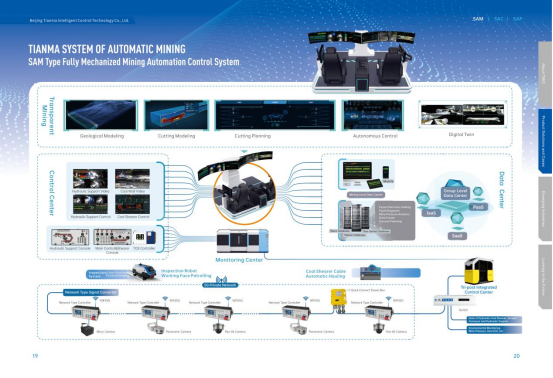
Comprehensive Mining Automation Control System
Beijing Tianma Intelligent Control Technology Co., Ltd.

Multi-function Marine Monitoring Low-altitude Detection Radar Sea-air Boundary Ocean Dynamic Environment Measurement
Chengdu Dixin Technology Co., Ltd.
Automatic Aiming Laser Remote Obstacle Removal Robot
Pinggao Group Weihai High-Voltage Apparatus Co., Ltd.