en.Wedoany.com Reported - SpaceX plans to conduct the next test flight of Starship on July 16, which will for the first time carry next-generation V3 Starlink satellites and attempt to deploy 20 satellites. These satellites will connect to the Starlink constellation via high-capacity lasers, but will re-enter the atmosphere and burn up 20 minutes after deployment.
The V3 satellite is designed to support a 1 Tbit/s downlink and approximately 200 Gbit/s uplink capacity, about 10 times higher than the current V2 mini satellite. If the test is successful, it will pave the way for the in-orbit deployment of V3 satellites, significantly enhancing Starlink's broadband capacity and expanding its competitive reach.
However, a new analysis by MoffettNathanson argues that even with V3 assistance, Starlink's competitive impact remains relatively limited. Analyst Craig Moffett noted in the report (registration required) that the transition to V3 is expected to take about five years, with performance equivalent to fixed wireless access but still significantly inferior to fiber and cable TV networks.
Moffett further explained that Starlink's biggest limitation is not the constellation size, but the capacity that a single hexagonal cell can support. While V3 can increase average customer density per square mile, this tipping point will decrease as broadband data consumption grows. Starlink can only cover the 8th and 9th deciles of U.S. density distribution, rather than the current 10th decile.
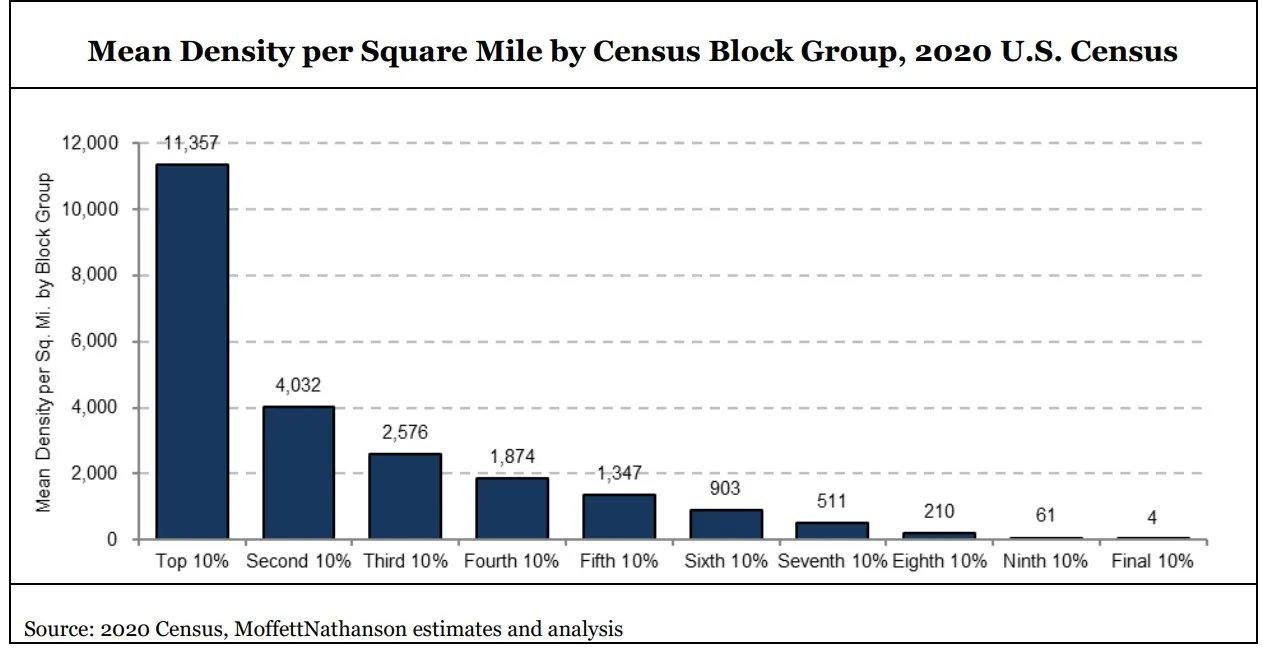
Moffett emphasized that he is not bearish on Starlink, but believes market expectations for its ability to disrupt suburban and urban broadband are unreasonably high.
Based on this analysis, Moffett modeled Starlink's business. He estimates that by 2031, Starlink will have 97 million consumer broadband users, including 9.52 million in the U.S., 11.18 million in other developed markets (excluding the U.S.), and 48.46 million in the rest of the world (excluding China and Russia). In comparison, by the end of 2026, it is expected to have 14.81 million users, including 3.16 million in the U.S. By 2031, Starlink's revenue will increase to $97.3 billion, with consumer and enterprise revenue as the main source ($62.9 billion), consumer connectivity revenue at $31.9 billion, and direct-to-device revenue at $2.6 billion. In 2026, expected revenue is $16.7 billion, with consumer connectivity revenue at $9.4 billion and enterprise and government revenue at $6.5 billion.
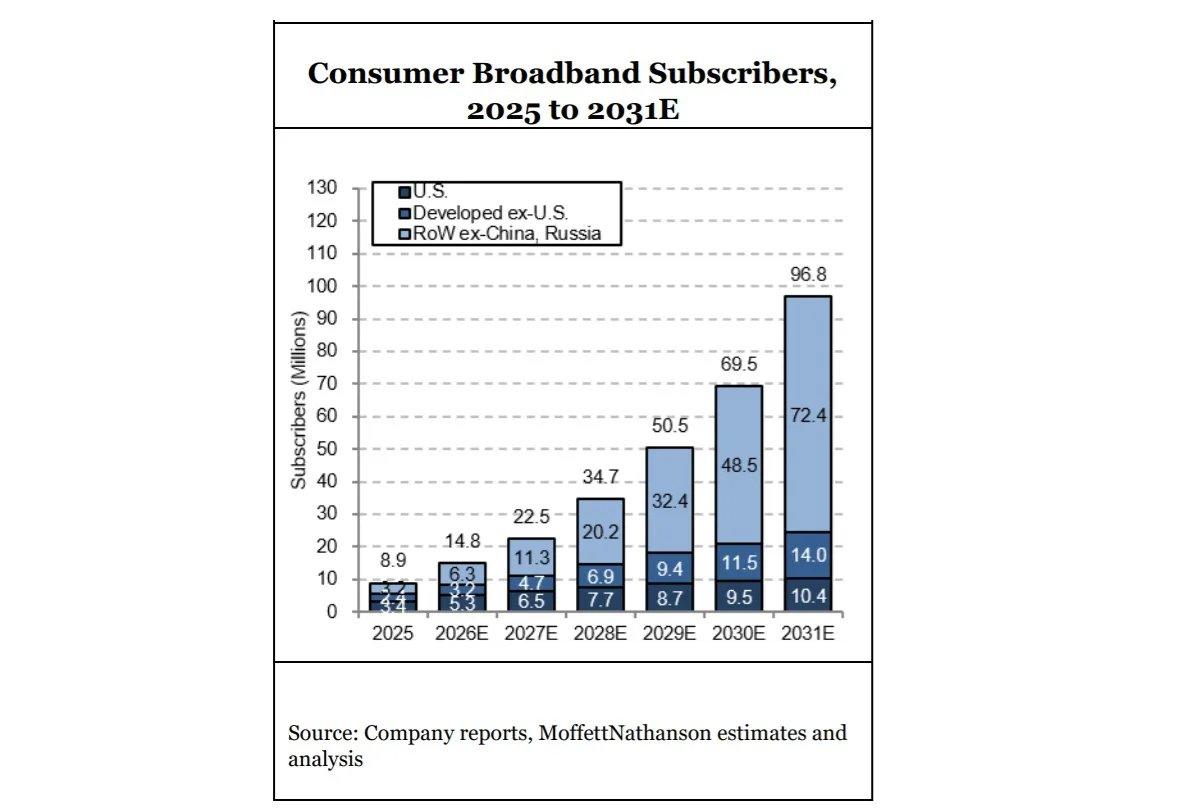
In terms of average revenue per user, lower-income markets will drag down global ARPU. Moffett expects Starlink's U.S. consumer broadband ARPU to be $60.83 by 2031, and global ARPU to be $27.17.
A second-quarter user trend analysis jointly conducted by New Street Research and Recon Analytics shows that most Starlink users still come from rural areas, but nearly half of churned users come from cable operators. New Street analysts David Barden, Vikash Harlalka, and Ryan Smith noted in the report (registration required) that no significant impact on cable broadband operators has been observed yet, as Starlink focuses on the rural market. As V3 increases capacity, Starlink's ability to lower prices and target more existing broadband operator users will strengthen. About 83% of Starlink users are switchers from other operators, while 17% are new broadband users.