en.Wedoany.com Reported - At the 2026 World Artificial Intelligence Conference (WAIC), Biren Technology officially launched a distributed decoupled architecture supernode solution based on next-generation NPO optical interconnect technology, supporting single supernode Scale-up expansion of up to 1024 cards. Biren Technology Co-founder and CTO Zhou Hong, along with AI Framework Architecture VP Yunfan Ding, delivered speeches at the conference, systematically showcasing a complete 1024-card supernode solution spanning chips, protocols, systems, and applications.
In his speech titled "Optimizing GPU Supernodes – Innovations and Engineering Practices in GPU Chip Interconnect Technology," Zhou Hong elaborated on the core technical capabilities of Biren Technology's self-developed BLink™2.0 supernode interconnect protocol. Hong stated that as large model parameter scales exceed one trillion, AI supernodes face multidimensional challenges including scale expansion, bandwidth enhancement, and communication latency. BLink™2.0 builds a computing power foundation with four core capabilities: "supernode, in-network computing, congestion control, and link repair," aiming to convert peak GPU computing power into deliverable, scalable, and stable effective computing power for large-scale clusters, achieving end-to-end system-level coordination of "latency-bandwidth-reliability."
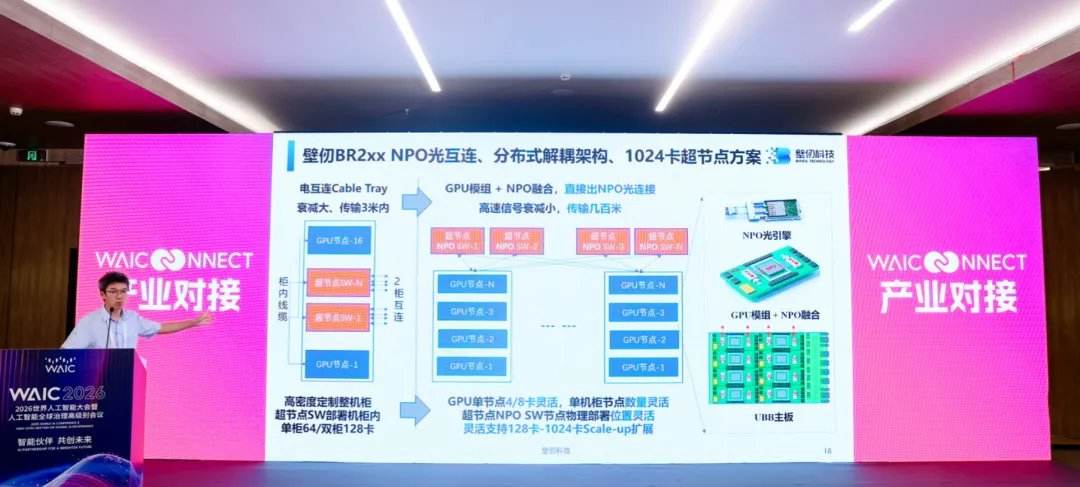
In two sub-forum speeches titled "Optical Interconnect GPU Supernodes: Leading the 'Chip' Future of Intelligent Computing" and "Reshaping the Agentic AI Computing Power Foundation with Optical Interconnect GPU Supernodes," Yunfan Ding introduced the BR2xx series GPUs based on the proprietary Chiplet architecture and a diverse supernode product matrix built on BLink™2.0. Ding also elaborated on Biren Technology's technical layout in NPO optical interconnect supernodes and the overall Token factory solution for the Agentic AI era, built on the hardware foundation of optical interconnect GPU supernodes.
Current AI development faces three core challenges: model parameters scaling from hundreds of billions to trillions, Agent applications requiring million-level context lengths, and both inference and training demanding thousands of GPUs working in coordination. Single GPU computing power alone cannot independently handle these complex tasks. Achieving efficient coordination of massive GPUs to operate as a unified supercomputer is the core challenge that supernode architectures must solve.
Current mainstream electrical interconnect supernode solutions are approaching physical limits in scale expansion. As GPU computing power grows, interconnect bandwidth demand will exceed 1TB/s, while copper cable electrical signals severely attenuate within 3 meters. Existing electrical interconnect cable tray and orthogonal backplane architectures face scalability challenges, making it difficult to meet next-generation trillion-parameter large model demands for hundreds to thousands of card-level supernodes. Optical interconnect has become the inevitable choice to break this bottleneck. Optical signals can transmit over hundreds of meters with minimal attenuation, making them suitable for large-scale GPU interconnection.
Biren Technology has launched its first NPO optical interconnect, distributed decoupled architecture supernode solution, supporting up to 1024 cards. This solution is an end-to-end solution covering chips, protocols, systems, and applications. On the chip side, Biren Technology adopts a Chiplet architecture, with the new-generation BR2xx series GPUs supporting FP8/FP4 low-precision high-computing power, featuring larger memory bandwidth, and natively integrating supernode interconnect capabilities. On the protocol side, Biren Technology's self-developed BLink™2.0 supernode interconnect protocol serves as the "nervous system" connecting all GPUs. Its core capabilities include four aspects: memory semantic interconnect, allowing up to 1024 GPUs to share the same memory space; in-network computing, offloading mathematical operations in communication to switches; intelligent congestion control, preventing network bottlenecks; and multi-layer link self-healing, providing tiered protection from the physical layer to the framework layer to ensure uninterrupted training and inference.
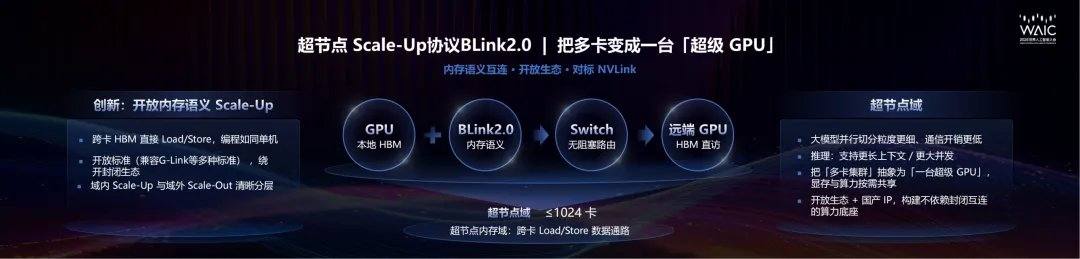
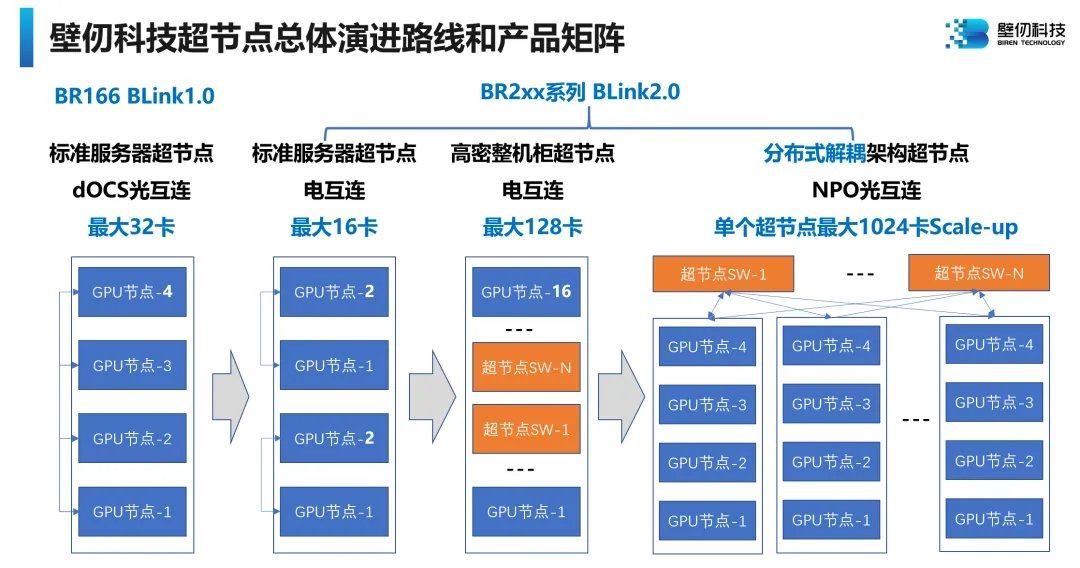
Based on BR2xx and BLink™2.0, Biren Technology has built a three-tier supernode product matrix: a 16-card standard server supernode (electrical interconnect), a 128-card high-density rack supernode (electrical interconnect), and a 1024-card distributed decoupled architecture supernode (NPO optical interconnect). The 16-card and 128-card supernodes are suitable for small and medium customers with requirements from hundreds of billions to trillions of parameters, while the NPO optical interconnect large-scale expansion supernode is designed for large customers and trillion-parameter scenarios, allowing customers to choose as needed.
In terms of application solutions, Biren Technology has launched the Token factory solution. Through a five-level hierarchical cache architecture, it achieves over 95% cache hit rate, significantly reducing redundant computation overhead. Biren Technology, in collaboration with China Telecom, has introduced a cross-vendor heterogeneous hybrid inference solution, improving effective throughput by 20%. In terms of fault tolerance, when a single GPU fails, the framework layer can automatically isolate the faulty node and reconfigure the network, ensuring uninterrupted operations.
In the optical interconnect technology roadmap, Biren Technology has chosen NPO (Near-Package Optics) as the core solution for next-generation supernodes. NPO integrates the optical engine with the GPU module, eliminating the high-power DSP chip, with transmission distances reaching hundreds of meters, offering both low latency and high bandwidth density. Biren Technology has proposed for the first time an NPO optical interconnect, distributed decoupled architecture, where GPU nodes and switch nodes are physically separated, connected flexibly via optical fibers, with GPU nodes adopting a standard server form factor. Supernode scale is no longer limited by the physical space of a single rack, allowing flexible expansion to 1024 cards.
Biren Technology has already deployed its previous-generation dOCS-based optical interconnect optical switching supernode on a national-level computing platform, which won the WAIC highest award, the SAIL Award, in 2025. With the release of the BR2xx series GPUs and the NPO optical interconnect, distributed decoupled architecture supernode, thousand-card Scale-up interconnection is expected to become a reality. In terms of technical ecosystem, Biren Technology has also launched its self-developed SUPACODE™ programming agent, which covers an end-to-end closed loop from model adaptation to ten-thousand-card operations and maintenance, providing software ecosystem solutions in Agent mode to reduce customer application deployment costs.