en.Wedoany.com Reported - From July 19 to 20, 2026, Chinese domestic GPU manufacturer Tianshu Zhixin officially released its next-generation general-purpose GPU flagship product, the Tian'ai 300, during the 2026 World Artificial Intelligence Conference (WAIC 2026).

As the first product based on Tianshu Zhixin's new self-developed architecture, the Tian'ai 300 features comprehensive upgrades in chip architecture, key operators, system scalability, and software ecosystem. It aims to match and surpass the performance efficiency of mainstream Hopper architecture solutions (Hopper solutions), providing computational power support for large-scale AI applications.
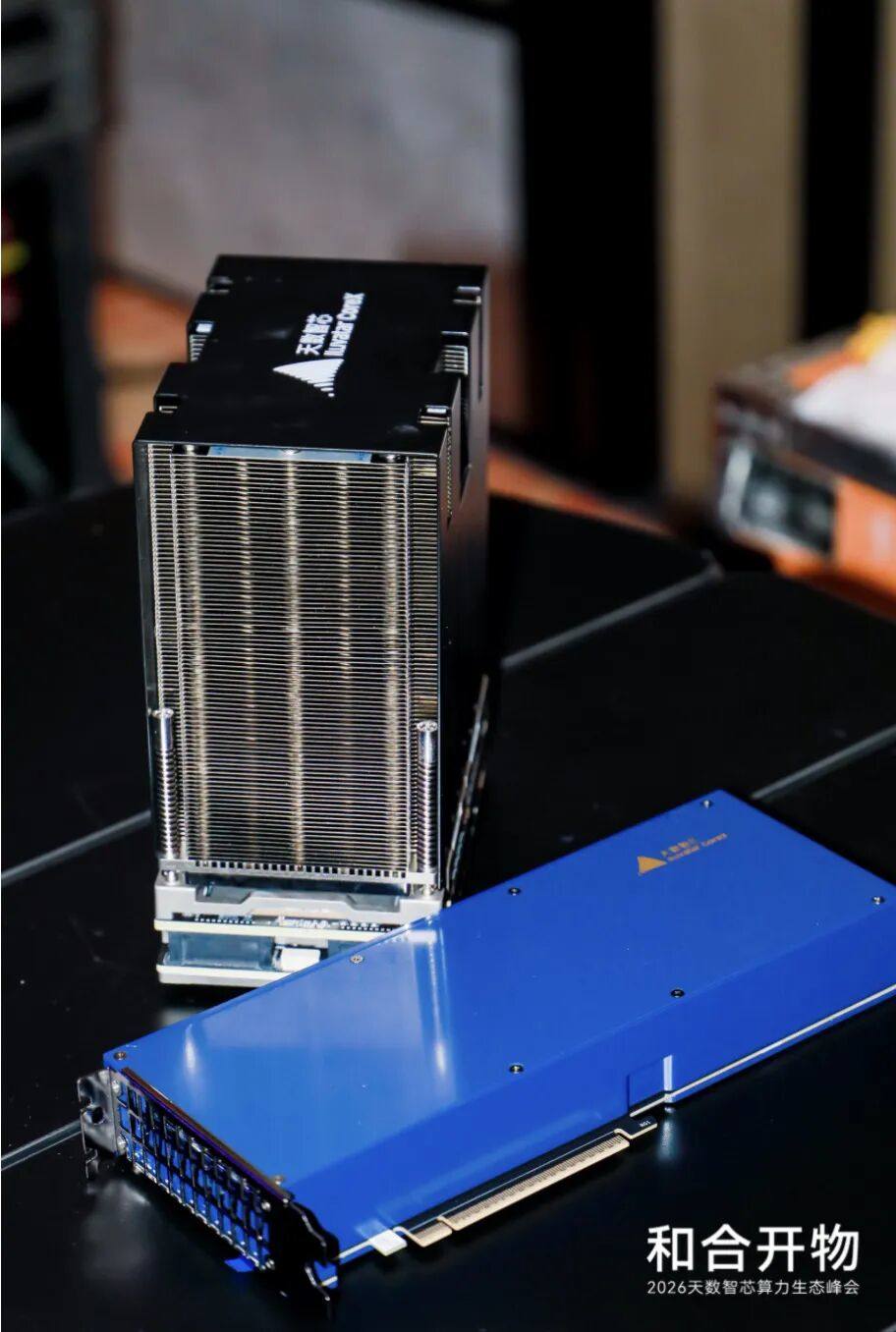
The Tian'ai 300 is built on the SIMT general-purpose computing architecture, supporting various computation types such as scalar, vector, and tensor. It is optimized for key technologies including Attention, MoE, AF separation, PD separation, and large-scale system expansion. Under complex workloads, the product balances computational efficiency, business latency, and total cost of ownership (TCO), meeting the comprehensive requirements of generality, performance, and cost for large-scale AI applications.
Shan Tianyi, head of AI and accelerated computing at Tianshu Zhixin, stated that artificial intelligence is evolving from "information intelligence" for understanding and generating information to "action intelligence" with planning and execution capabilities, and further expanding to "exploration intelligence" for modeling and predicting the unknown. The different computational demands of these three types of intelligence form the design core of the Tian'ai 300.
For information intelligence, the Tian'ai 300 focuses on optimizing Attention and MoE. In Attention computation, by improving the parallel efficiency of matrix and vector calculations and reducing data read/write latency, it achieves over 90% Attention efficiency across different precisions, outperforming Hopper solutions. In scenarios with a 64k context length, its Attention efficiency is 10% higher than Hopper solutions. For MoE, through algorithm-hardware co-optimization, it achieves over 70% computational efficiency in the DeepSeek V4 MoE scenario, with overall training efficiency and cost-effectiveness surpassing Hopper solutions; in inference scenarios, average efficiency is 10% higher than Hopper solutions.
For action intelligence, the Tian'ai 300 enhances PD separation capabilities, with differentiated optimizations for the Prefill and Decode stages. In tests with mainstream models such as Qwen, GLM, Kimi, and DeepSeek, the first-token latency is reduced by approximately 20% compared to Hopper solutions. By reducing protocol overhead and optimizing link paths, the average communication latency is lowered by about 13%. In Decode tests for models like GLM 5.2, efficiency is improved by 10% over Hopper solutions.
For exploration intelligence, the Tian'ai 300 supports scalar, vector, and tensor computations, covering multiple precisions such as FP4 and FP8, as well as instructions like MMA, DPX, and FMA. It is suitable for tasks including matrix solving, dynamic programming, sparse computation, and digital twins. In the Cosmos3 world model, its inference efficiency is 10% higher than Hopper solutions.
Key underlying architectural innovations supporting the Tian'ai 300's performance include: ixSMEX, which improves data reuse rates to reduce repeated memory access; ixDPX, which compresses operations requiring six instructions in dynamic programming into a single instruction; and ixTrans, which reduces storage conflicts and memory overhead. Since 2018, Tianshu Zhixin has continuously refined its software stack, developing nearly a hundred acceleration libraries to form a tool ecosystem covering communication, compilation, drivers, quantization, and performance analysis. The Tian'ai 300 supports mainstream global large model frameworks and key acceleration components. Currently, the product is ready for large-scale application and has undergone deep adaptation with domestic cloud vendors, server manufacturers, interconnect ecosystems, and super-node systems, supporting scalable deployment from single machines to large-scale clusters.