en.Wedoany.com Reported - A report released by BuildForce Canada indicates that construction activity in Ontario is expected to continue growing through 2035, driven by increased residential building activity and rising non-residential construction investment fueled by major institutional, commercial, heavy industrial, and civil engineering projects. Although residential building activity will slow in the short term due to uncertainties arising from the ongoing tariff dispute between Canada and the United States, it is projected to enter a sustained growth period in the medium to long term.
Investment in new residential construction is expected to resume growth by 2028, while investment in residential renovation and maintenance activities will continue to rise throughout the forecast period. The report shows that by 2035, residential construction employment in the province is expected to increase by 11% compared to 2025 levels, with new home construction and residential renovation activities contributing the most to this growth. Investment in the non-residential construction sector has risen significantly since 2022 and is expected to continue growing until the late 2020s, after which it will remain at elevated levels into the early 2030s.
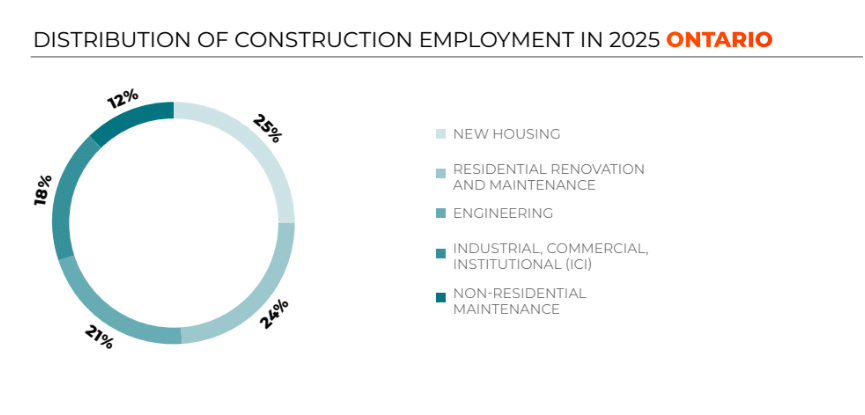
ICI construction investment is expected to grow steadily, driven by institutional and government building plans such as healthcare and education projects, with activity projected to peak around 2030 before moderating. Commercial construction is expected to see significant growth, largely due to previously higher population growth levels; the outlook for industrial construction remains uncertain. Engineering construction activity is expected to grow throughout the forecast period, driven by major transportation projects, mining activities in the north, and utility investments such as nuclear power generation and refurbishment projects, while road, highway, and bridge construction will see relatively moderate growth. By 2035, non-residential construction employment is expected to increase by 5% compared to 2025 levels.
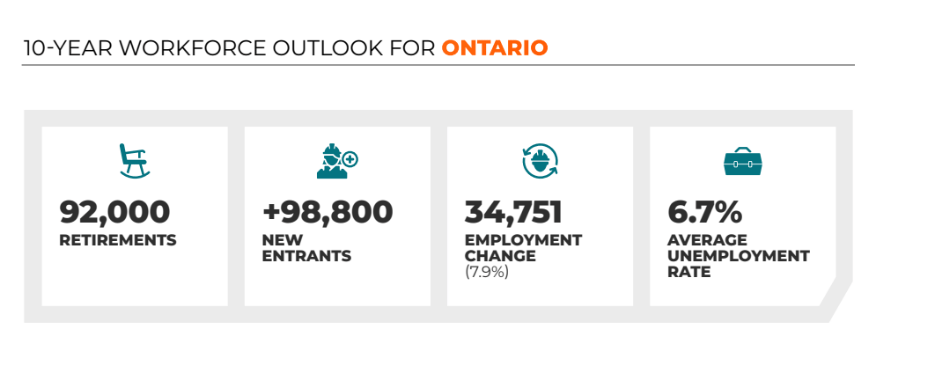
By 2035, up to 92,000 workers in Ontario are expected to leave the industry due to retirement. Combined with an additional 34,100 workers needed to meet demand, the total hiring requirement for the industry could reach 126,100. These needs may be partially met by an estimated 98,800 new entrants under the age of 30, but the industry still faces a potential shortfall of 27,300 workers. Irwin Bess, Executive Director of BuildForce Canada, stated that residential sector activity is constrained in the short term by the tariff dispute, declining immigration levels, and unsold multi-unit housing in some areas, but the medium- to long-term outlook is optimistic; non-residential sector activity is expected to rise until the late 2020s and remain at elevated levels throughout the forecast period.
Ontario's six regions—Central, Eastern, Greater Toronto Area, Northeastern, Northwestern, and Southwestern—each have distinct labor market conditions.
Central Ontario: Residential sector activity will rise significantly after 2027, with new home construction resuming growth and strong demand for residential renovations; non-residential sector activity will increase between 2027 and 2031, driven by major institutional and industrial projects; engineering construction activity is driven by major transportation projects in Hamilton and Kitchener-Waterloo-Cambridge, as well as utility projects. By 2034, residential employment is expected to grow by 21%, and non-residential employment by 11%.
Eastern Ontario: Residential sector growth is driven by new home construction from 2027 onward; the non-residential construction sector is at historically high levels, with activity peaking in 2030 and remaining elevated thereafter. By 2035, residential employment is expected to grow by 10%, and non-residential employment by 7%.
Greater Toronto Area: Construction activity will contract in 2025, with the residential sector affected by rising costs, slowing population growth, and unsold condominium inventory; non-residential construction is driven by major projects in public transit, utilities, and healthcare and education. The outlook diverges by 2035—residential investment resumes growth after 2028, while non-residential activity declines from a 2029 peak as known projects are completed. Compared to 2025, residential employment will grow by 5%, and non-residential employment by 4%.
Northeastern Ontario: Residential sector activity will grow throughout the forecast period; non-residential sector investment levels will decline modestly by 2035. By 2035, residential employment will contract by 3% compared to 2025, while non-residential employment will grow by 1%.
Northwestern Ontario: The residential sector is expanding, with growth concentrated in new housing; non-residential sector investment rises, peaking in 2028 due to several key mining projects before declining through 2035. Residential employment will contract by 2%, and non-residential employment by 5%.
Southwestern Ontario: Non-residential construction investment will decline after 2027, with strong ICI construction prospects offsetting a slowdown in engineering construction; residential sector activity will grow significantly after 2026. Residential employment will grow by 10%, while non-residential employment will decline by 2%.