U.S. logistics and industrial infrastructure company Prologis has made a £14 billion takeover offer for UK property developer SEGRO.
en.Wedoany.com Reported - The quarterly monitor by Property Week shows that the share prices of 26 UK-listed real estate companies rose by 8% quarter-on-quarter in the second quarter, but still fell by an average of 13% year-on-year.
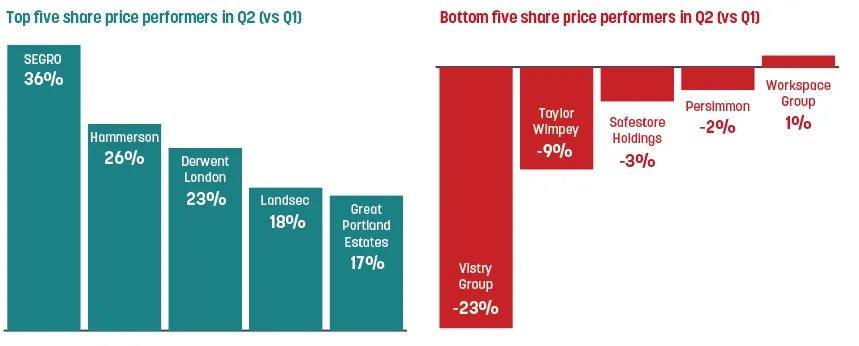
Shares in industrial and logistics giant SEGRO (the UK's largest real estate company) posted the biggest gain in the three months to the end of June, rising 36%, and were up 29% year-on-year.
Before California-based Prologis made its £14 billion bid for SEGRO, Oli Creasey, head of real estate research at Quilter Cheviot, said the offer was significant for SEGRO and its shareholders. The board of the UK real estate investment trust (REIT) announced it would recommend the deal to shareholders.
On July 22, Prologis submitted its final offer, valuing SEGRO at approximately £14 billion, or around 1,031.7 pence per share. The non-negotiable proposal includes the exchange of each SEGRO share for 0.0920 new Prologis shares. SEGRO's share price rose 4.19% following the announcement.
Prior to this, Prologis had made three takeover proposals, all of which were rejected by SEGRO. In the second quarter (June), SEGRO turned down a bid valued at £12.6 billion. Prologis then submitted an improved proposal, equivalent to 993 pence per share, valuing SEGRO at £13.5 billion, which included a cash component and a commitment to explore a potential secondary listing on the London Stock Exchange, but this was also rejected. Prologis recently revealed that SEGRO had also rejected an offer in 2024 that would have delivered 36.5% more value to shareholders than the current bid.
An analysis of UK REIT balance sheets by Property Week shows that SEGRO has a market capitalization of around £12 billion and a portfolio value of £19.1 billion, compared to an industry average of £5.8 billion. Although there has been a wave of M&A in the UK REIT sector in recent years, these deals have been concentrated at the lower end of the market.
Creasey said: "By any measure, SEGRO is the UK's largest REIT, and we always believed that a company of this size and complexity would not be a takeover target." But Prologis's move "upended that assumption."
Creasey added that the takeover bid had a ripple effect across the entire REIT sector. "If you look at the top ten REITs, about 5% to 10% of their share price gains in the second quarter occurred on the morning in June when news of the SEGRO acquisition broke – everyone had to adjust their expectations, thinking, 'If SEGRO can be acquired, then Derwent, Landsec, and British Land could be too.'"
This may help explain why Hammerson's share price rose 26% in the second quarter, Derwent London by 23%, Landsec by 18%, and Great Portland Estates by 17%.
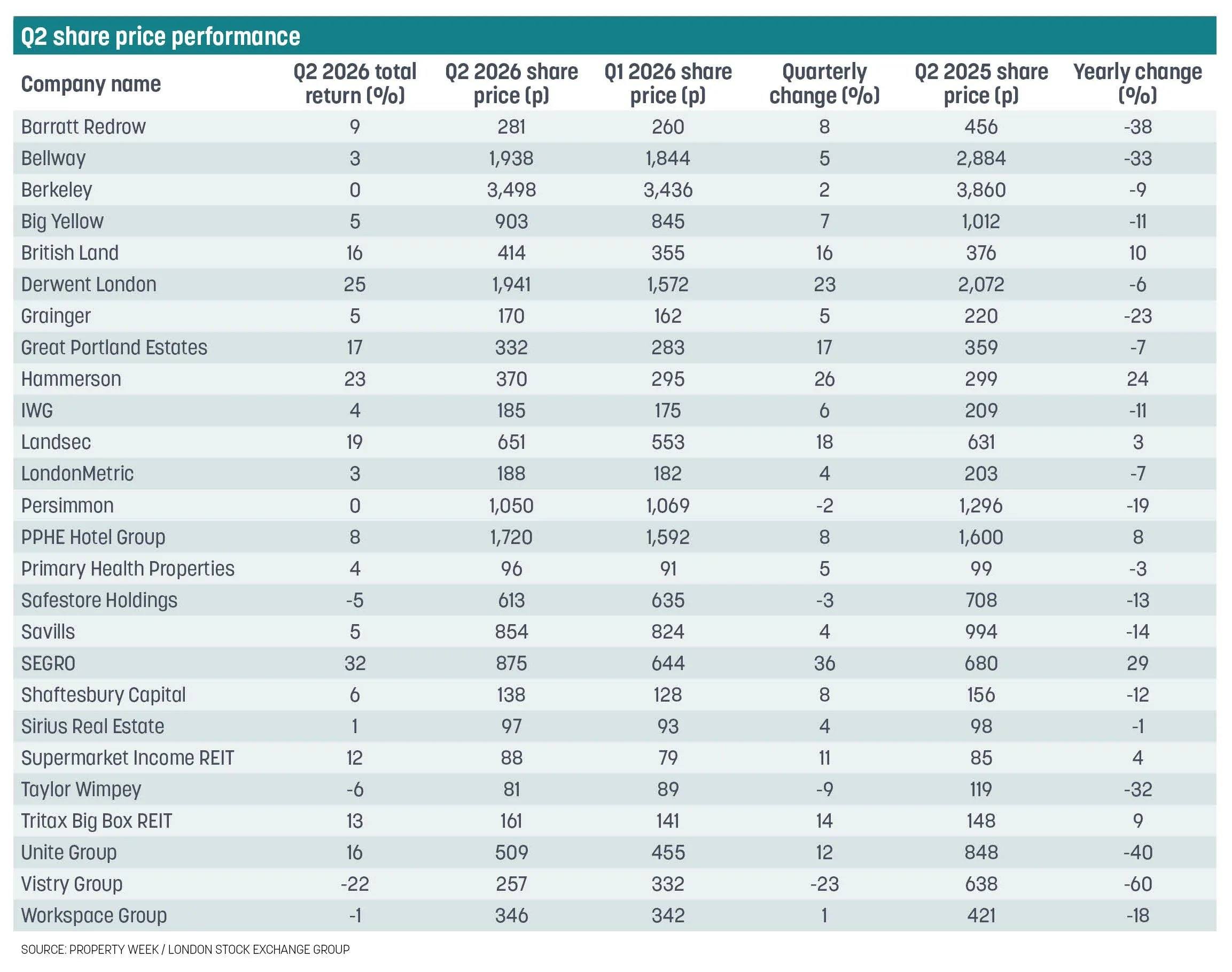
Homebuilders did not share this good fortune, posting a poor second quarter. Among the five companies with the biggest share price declines were Vistry, Taylor Wimpey, and Persimmon, falling 23%, 9%, and 2% respectively. On an annual basis, four of the bottom five homebuilders were: Vistry, down 60% year-on-year; Barratt Redrow, down 38%; Bellway, down 33%; and Taylor Wimpey, down 32%.
Alastair Stewart, an analyst at Progressive Equity Research, believes that political instability, the war in Ukraine, and ongoing economic uncertainty from the US-Israel and Iran conflicts mean "the homebuilder market has slowed significantly." He added that the Labour Party's first budget in 2024 sparked concerns, and there was much speculation ahead of the second budget in 2025: "There was a noticeable slowdown before that, even though it wasn't that bad for the market in the end. The second budget turned out to be okay from a housing perspective, and the market rebounded quickly after it." However, the outbreak of conflict in the Middle East soon curbed the recovery.
Creasey agreed that homebuilders are generally "in a tough spot." He believes the biggest decline came from Vistry, whose drop far exceeded others, attributable to company-specific issues rather than a broader market downturn. Creasey said: "We won't pretend to know exactly what's happening inside Vistry, but sometimes it feels a bit desperate." He noted that the company's home sales were higher than normal expectations, adding: "This means they are selling homes at slightly lower prices, prioritizing cash flow over profitability. This always raises questions about their balance sheet and its strength." Vistry shareholders have clearly reacted negatively to the company's strategy and performance, and this sentiment has, to some extent, permeated other companies in the sector.
Meanwhile, Taylor Wimpey, which posted the second-largest share price decline among homebuilders in the second quarter, discussed the price pressures facing its assets and the fact that the Southeast market is not particularly strong. According to Creasey, companies like Barratt Redrow, Persimmon, Berkeley Homes, and Bellway "had no dramatic events and were broadly flat for the quarter."
Stewart added that homebuilders also faced issues with bad weather. "Don't forget the heavy rain in January and February, which was completely unfavorable for home construction." He also noted ongoing political turmoil as the UK welcomed its seventh prime minister in ten years at Downing Street. "In this environment, consumers put home buying plans on hold. Basically, everything that could go wrong for homebuilders has gone wrong over the past few years."
Homebuilders are hoping that the latest prime minister, Andy Burnham, who has promised hope and change, will deliver on his pledges. For other REITs, the takeover bid for SEGRO appears to be a game-changer, as they could all become targets for larger overseas competitors.
Related Products


YHTank8400N Solvent-Free Liquid Epoxy Coating
JIANGSU YUNHU NEW MATERIAL TECHNOLOGY CO., LTD.
CITIC Heavy Industries Tunneling Equipment Tunnel Engineering Shield Machine
CITIC Heavy Industries Co., Ltd.
Pure Polyurethane Wall Panel BD-AEF-PIR-01
Baodu International Engineering Technology Co., Ltd.
Metal sound barriers that can reduce the transmission of road noise
Hebei Jinbiao Construction Materials Tech Corp., Ltd.


Ultra-Pure Ferrite Stainless Steel Products
Gansu JISCO Group Hongxing Iron and Steel Co., Ltd.
RISITA explosion-proof air conditioning
Guangdong RISITA Air Conditioning Equipment Co.,Ltd.
Ceiling light | led Ceiling Light | LED Indoor light | LED Ceiling lighting
Queendom Group Technology Co., Ltd.