IDC: China's Industrial Embodied Intelligent Robot Market Reaches 5.74 Billion Yuan in 2025
en.Wedoany.com Reported - International Data Corporation (IDC) recently released two reports, "China Industrial Embodied Intelligent Robot Market Share, 2025" and "China Industrial Embodied Intelligent Robot Technology Assessment, 2026," providing a systematic analysis of market landscape, technological capabilities, and industry trends. According to IDC data, the market size of China's industrial embodied intelligent robots in 2025 was approximately 5.74 billion yuan, of which the embodied intelligent application market using industrial robots as carriers reached approximately 3.62 billion yuan, representing the primary direction for current commercial deployment. Physical AI became a focal point of industry attention at WAIC 2026. Due to its data-intensive nature, complex tasks, and clear commercial value, industry is regarded as a key scenario for the early implementation of Physical AI, with industrial embodied intelligent robots serving as an important application form in the manufacturing sector. As competition shifts from robot hardware performance to comprehensive capabilities in models, data, engineering, and scenario deployment, such robots are becoming a significant direction in the development of intelligent manufacturing.
IDC defines industrial embodied intelligent robots as: intelligent robot systems designed for industrial production environments that integrate AI models, multimodal perception systems, robot control systems, and robot hardware, enabling robots to possess a closed loop of perception, learning, decision-making, and execution capabilities, allowing them to complete autonomous tasks and interact with personnel and production equipment in real industrial scenarios. Unlike traditional industrial robots that rely on preset programs and execute repetitive tasks in structured environments, industrial embodied intelligent robots can dynamically adjust operational strategies based on environmental perception and task understanding, and continuously optimize task execution capabilities through feedback from real production data.
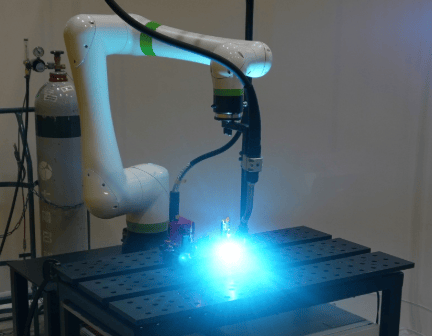
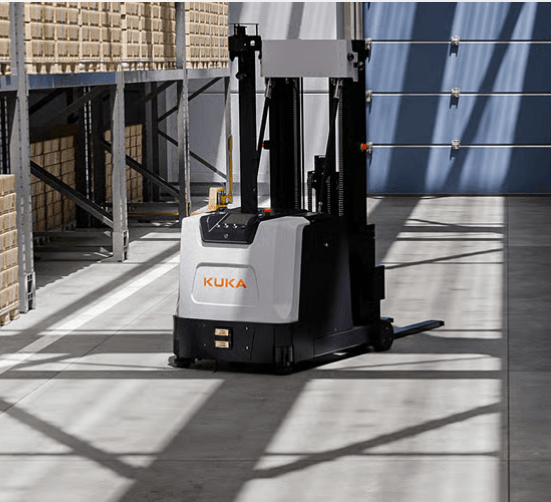
The market has now entered the phase of large-scale adoption. Using multi-form robots as carriers, it is driving the intelligent upgrade of industrial production lines and manufacturing workstations, promoting the development of manufacturing scenarios toward flexibility and autonomy. Among these, embodied intelligent applications using industrial robots as carriers occupy a dominant market position, mainly including collaborative robots, composite (mobile manipulation) robots, and multi-joint robots. Leveraging mature industrial foundations and integrating visual perception, force control technology, environmental understanding, and embodied intelligent model capabilities, these robots are delivered through an integrated "robot hardware + intelligent software + industry services" model and have been applied in industrial scenarios such as loading/unloading, quality inspection, grinding and repair, flexible assembly, and material handling.
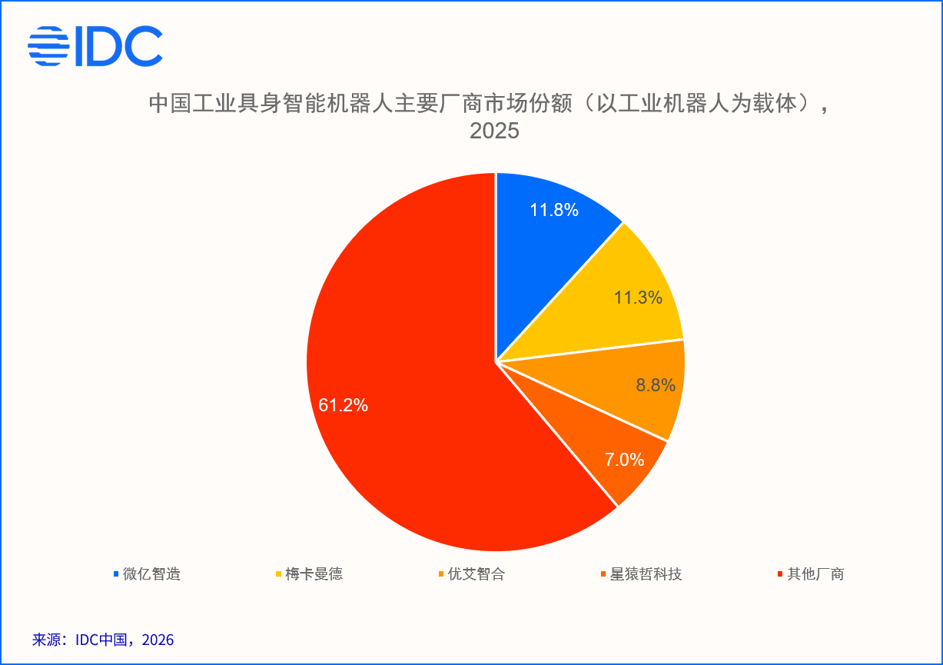
The above market structure shows that the current commercial mainstay still relies on mature industrial robot categories, rapidly penetrating various manufacturing workstations through an integrated "hardware + software + services" package model. However, the market landscape is changing. With the leap in AI model capabilities and declining hardware costs, players from different backgrounds are entering from their respective areas of advantage, and the competitive focus is shifting from single-product performance to system-level comprehensive capabilities.
In terms of the competitive landscape, industrial AI vendors have taken the lead in establishing competitive advantages, primarily derived from their capabilities in industrial vision, perception and decision-making, and scenario data accumulation. Companies represented by Weiyi Zhizao and Mech-Mind, leveraging their industrial AI technology and data closed-loop capabilities, have applied embodied intelligence to standardized scenarios such as quality inspection, grinding, repair, and loading/unloading, while promoting cross-industry replication. Meanwhile, a large number of robot hardware manufacturers, industrial automation vendors, and AI companies are also accelerating their layout, leveraging their respective accumulations in hardware, algorithms, software platforms, and industry resources to explore differentiated product positioning and commercialization paths, intensifying market competition. Chinese manufacturers are accelerating their global expansion. In 2025, the overseas model has gradually shifted from exporting standalone products to exporting integrated hardware-software solutions, with products entering overseas markets such as European automotive, Southeast Asian electronics, and North American manufacturing. Localized deployment, model optimization, and operations and maintenance service capabilities have become important supports for expanding overseas markets.
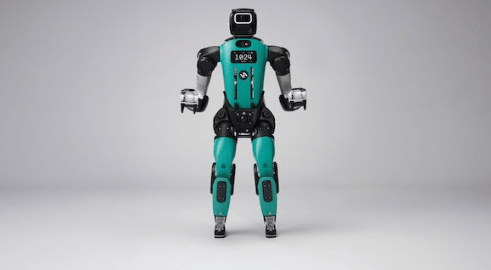
New types of embodied intelligent carriers, represented by humanoid robots, entered the industrial scenario exploration phase in 2025, with a market size of approximately 2.11 billion yuan. Applications were mainly concentrated in demonstration production line deployment, scenario validation, and POC testing. Humanoid robots possess greater morphological versatility and potential for adaptation to complex environments, but they are still in the stage of technological refinement and commercial model exploration. Factors such as product cost, reliability, engineering maturity, and actual production efficiency are still being further validated. Relevant data can be referenced in IDC's "Worldwide Annual Humanoid Robotics Tracker."
As industrial embodied intelligent robots move from technological validation to commercial application, the evaluation criteria of industrial users are changing. IDC user research shows that manufacturing enterprise users focus on vendors' comprehensive performance in "technological capability + engineering capability + commercial value." Based on this demand, IDC has constructed a technical evaluation framework covering eight dimensions: industrial intelligent decision-making, multimodal perception and understanding, autonomous operation and task execution, adaptation and continuous optimization in complex scenarios, industrial-grade reliability and engineering, industrial system integration and ecosystem, industry practice and large-scale deployment, and commercial value and ROI validation. This framework provides a comprehensive assessment of representative Chinese vendors conducting commercial exploration in scenarios such as automotive manufacturing, new energy, semiconductors, and 3C electronics. In the future, enterprise competitive advantages will come from the deep integration of industrial knowledge, data, models, and manufacturing systems.
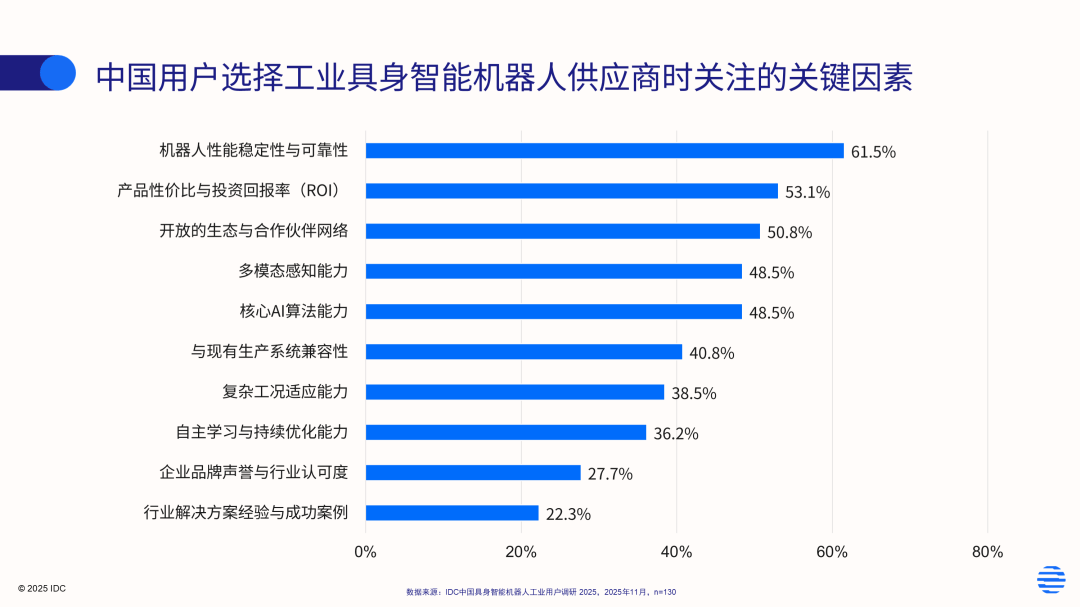
IDC believes that over the next three to five years, China's industrial embodied intelligent robot market will enter a phase of expansion from single-point scenario validation to production-process-level applications. Robots will break through the limitations of single tasks, deeply integrate with MES, WMS, ERP, PLC, and industrial internet platforms, and evolve from equipment executing single tasks to intelligent nodes within production systems. Industrial embodied intelligent models need to further integrate process rules, equipment mechanisms, and production experience, evolving from "completing tasks" to "understanding production processes." Model competition will depend not only on data scale but also on the ability to integrate industrial knowledge. Humanoid robots, mobile manipulation robots, collaborative robots, and specialized industrial robots will coexist in the long term, respectively suited for highly flexible unstructured tasks, cross-space tasks, human-robot collaboration scenarios, and high-precision high-stability tasks. The competitive focus lies not in form but in the ability to solve real industrial problems. As the market enters the batch deployment phase, real industrial data accumulation, model iteration efficiency, and large-scale delivery capabilities become key. Enterprises that can establish a closed loop of "data collection → model training → industrial deployment → feedback optimization" will gain long-term competitive advantages. IDC user research shows that more than 80% of manufacturing enterprises expect industrial embodied intelligent robot projects to achieve investment payback within two years. Solutions that enable rapid deployment, stable operation, and clear economic value will gain priority market recognition.
Li Junlan, IDC China Research Manager for Robotics and Embodied Intelligence, stated that competition in industrial embodied intelligent robots is shifting from single-point AI capabilities to comprehensive competition in software-hardware collaboration, industry know-how, and data closed-loop capabilities. Leading vendors continue to increase R&D investment, promoting the deep integration of embodied intelligence large models, industrial AI, and robot hardware. Driven by policy support, intelligent upgrading of the manufacturing industry, and overseas market expansion, Chinese vendors are expected to further enhance their global competitiveness.
Related Products

LBH4000 Batch Environmental Protection Asphalt Mixing Plant | Asphalt Batching Plant | Asphalt Mixing Plant
Jilin Province Road Construction Machinery Co., Ltd.
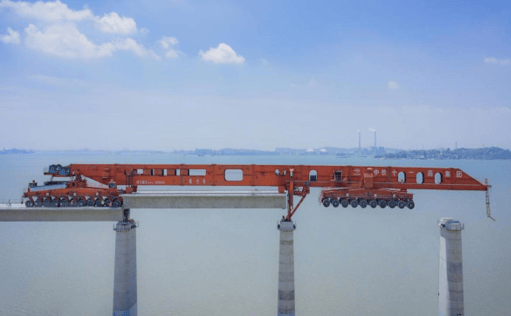
High-Speed Railway Lifting, Transporting, and Erecting Equipment: Integrated Transport and Erection Machine
Hanjiang Heavy Industry Co., Ltd. of China Railway 11th Bureau Group