US SunHydrogen 100cm² Module Achieves Over 10% Hydrogen Production Efficiency
en.Wedoany.com Reported - SunHydrogen, a photoelectrochemical technology company headquartered in Iowa, has achieved a solar-to-hydrogen (STH) conversion efficiency of over 10% with its 100 cm² hydrogen module in preliminary testing at Sparc Hydrogen's laboratory.
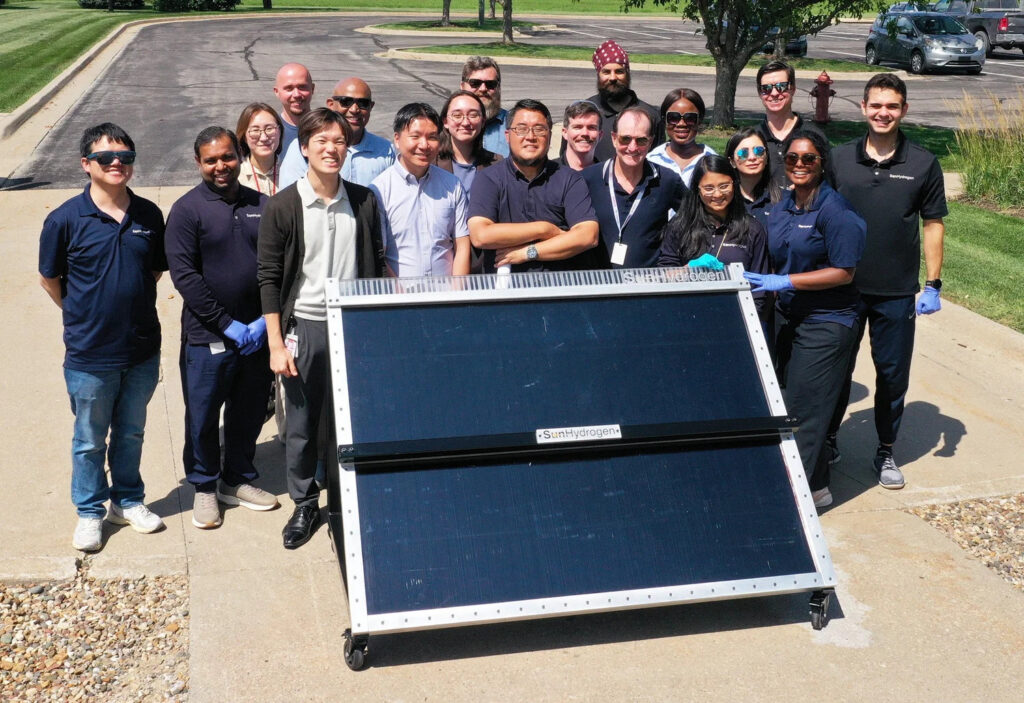
Previously, this 100 cm² module measured a solar-to-hydrogen efficiency of 10.8% on the active area at Honda's R&D facility. Honda and SunHydrogen continue to collaborate under a joint development agreement, aiming to transform this technology into installable hydrogen panels and achieve cost-effective commercial production.
Tor Erik Hoftun, Business Director at SunHydrogen, told pv magazine that the system employs an integrated semiconductor-electrocatalyst architecture, comprising light-absorbing semiconductors, specially designed contacts, and water-splitting catalysts that work together as a single hydrogen-producing module. When sunlight is absorbed, the semiconductors generate electrons and holes, and the contacts direct the charge carriers to the integrated hydrogen evolution and oxygen evolution catalysts respectively—electrons drive hydrogen production while holes drive oxygen production.
Traditional photovoltaic modules feature cell layouts and electrical contacts primarily designed to deliver power to external circuits, such as standalone electrolyzer stacks; SunHydrogen's semiconductor modules, by contrast, are specifically engineered for direct solar-to-hydrogen conversion.
Hoftun said that in photovoltaic terms, the semiconductor's current-voltage characteristics are matched to the electrochemical load, enabling the coupled module to operate at the working point that maximizes conversion of incident solar energy into chemical energy stored in hydrogen.
The hydrogen-producing module operates within a reactor housing that manages electrolyte circulation and the collection and handling of hydrogen and oxygen gases. Because the photovoltaic and electrochemical functions are directly coupled, this architecture eliminates the need for a separate electrolyzer stack and most conventional power conversion equipment. At the pilot and system level, auxiliary balance-of-system (BOS) components are still used for electrolyte circulation, gas handling, monitoring, control, and safety assurance.
Following the release of the test results, SunHydrogen entered into an agreement with Sparc Hydrogen, headquartered in Australia. Sparc Hydrogen is developing a process that produces hydrogen using concentrated sunlight, water, and photocatalysts without an electrolyzer. The two parties plan to evaluate integrating SunHydrogen's modules into Sparc Hydrogen's reactor to reduce hydrogen production costs.
Hoftun stated that during the 24-month Sparc Hydrogen collaboration, progress in laboratory testing under concentrated sunlight will depend on technology milestones; this will be followed by field testing under natural sunlight and levelized cost of hydrogen assessments at Sparc Hydrogen's Sharp facility in South Australia, with the potential for module supply or manufacturing license agreements.
Hoftun added that SunHydrogen is working with manufacturing partners such as CTF Solar to advance higher-efficiency products developed jointly with Honda R&D.
In outdoor testing, SunHydrogen achieved nearly 9% efficiency using a 1.92-square-meter, photovoltaic-sized development module.
Hoftun noted that if the joint development program with Honda R&D is extended, the next phase is expected to advance the module architecture to nearly 15% solar-to-hydrogen efficiency on the active area, with a focus on scaling it into larger, manufacturable modules.
Related Products


Hydrogen production and hydrogenation charging refueling gas integrated energy station
Shenzhen Kohodo Hydrogen Energy Co., Ltd.

G.652.D Wavelength-extended Non-dispersion Shifted Single-mode Optical Fiber
HONGAN GROUP CO., LTD.


Off-Grid Fuel Cell Supercharging Station (180kW Configuration)
Shanghai REFIRE Group Limited