Telesat Government Solutions and Cailabs Sign Optical Communications Cooperation Agreement for LEO Satellites
en.Wedoany.com Reported - On September 1, Telesat Government Solutions and Cailabs US signed a strategic cooperation agreement to evaluate the integration of the Telesat Lightspeed low Earth orbit satellite network with Cailabs' optical ground systems for space-to-ground optical communications supporting U.S. government and allied missions. The scope of cooperation includes joint research and capability demonstrations, as well as collaborative efforts targeting U.S. government program opportunities, including space data relay services.
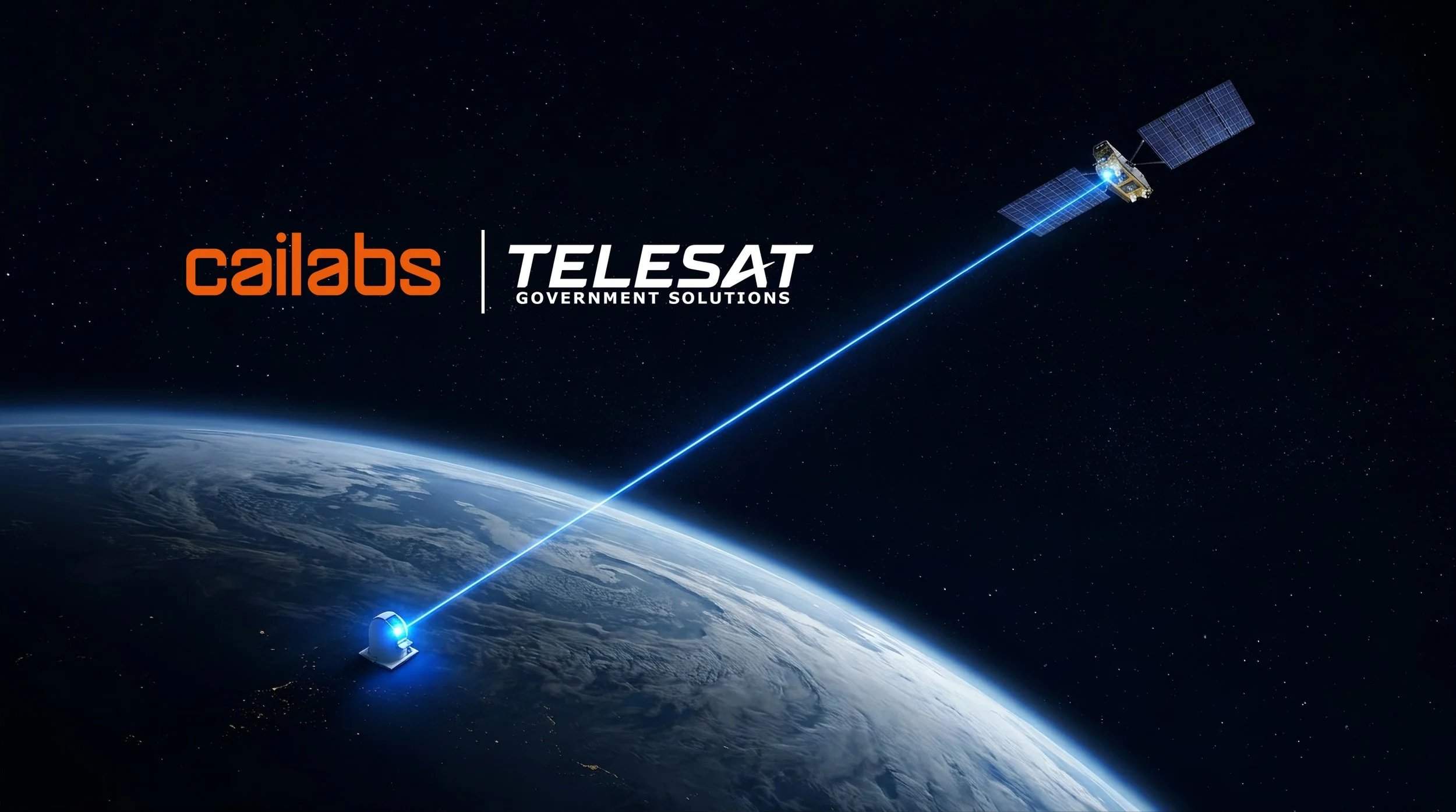
Under the agreement, the parties plan to connect the optical inter-satellite links configured on Telesat Lightspeed satellites with Cailabs' fixed and transportable optical ground stations, forming a communications chain from on-orbit data transmission to ground reception. Telesat Lightspeed employs a space mesh network architecture, with the current configuration featuring 900 optical inter-satellite link terminals, supporting both commercial Ka-band and military Ka-band communications.
Cailabs' optical ground systems utilize atmospheric turbulence compensation technology. Its ground stations have previously established multiple two-way space-to-ground optical links with LEO satellites equipped with TESAT SCOT80 optical communications terminals, completing verification of acquisition, tracking, and two-way data transmission. The optical terminals selected for Telesat Lightspeed belong to the same SCOT80 terminal series used in the aforementioned verification, which is also one of the technical areas covered by the two parties' system interoperability research.
Cailabs has currently deployed optical ground systems in multiple regions and is expanding its production capacity, targeting up to 50 optical ground stations per year. The cooperation between the two parties covers not only fixed ground facilities but also transportable optical ground systems for field deployment, with subsequent joint research and demonstration activities to validate integration capabilities with Telesat Lightspeed in government communications missions.
The Telesat Lightspeed program currently plans to deploy 225 LEO satellites. After signing a Canadian military satellite communications contract in August, Telesat increased its constellation size from 156 to 225 satellites, adding 69 satellites. According to the company's latest schedule, Lightspeed global services are planned to launch in the first quarter of 2028. The deployment plan announced in March 2026 shows that the first two production satellites are scheduled for launch in December 2026, followed by an intensive launch phase in 2027.
Related Products


Industrial and Commercial Point-Type Gas Detector
Jinan Benan Technology Development Co., Ltd.

Mine Explosion-proof and Intrinsically Safe Industrial Ethernet Ring Network (10 Gigabit/Gigabit)
Chongqing Mas Sci&Tech Co., Ltd.

Automatic Aiming Laser Remote Obstacle Removal Robot
Pinggao Group Weihai High-Voltage Apparatus Co., Ltd.

GYTA Type Non-Self-Supporting Aerial/Duct Optical Cable
TONGDING INTERCONNECTION INFORMATION CO., LTD.


Flat Portable Satellite Terminal 0.35m Aperture Manual Portable Terminal
China Starwin Science & Technology Co., Ltd.