Wedoany.com Report-Jun 27, Nuada, based in Newtownabbey, Northern Ireland, has successfully completed trials of its second pilot plant, Nuada Scout, at the University of Sheffield in 2025. Designed and operational within a year, the industrial pilot captures one ton of carbon dioxide (CO₂) daily from biomass-derived flue gases, achieving high purity and consistent performance.
The company’s innovative technology targets carbon-intensive industries such as cement, lime, and waste-to-energy, offering a solution to capture emissions before they reach the atmosphere. Unlike traditional methods, Nuada’s system uses a sponge-like metal-organic framework (MOF) sorbent to selectively adsorb CO₂, followed by a vacuum process to extract it. This approach consumes 90 percent less energy than conventional techniques and eliminates the need for large, complex chemical plants. “Nuada’s technology provides a compact and efficient alternative for industrial carbon capture,” a company spokesperson stated during the trial’s review.
Traditional carbon capture systems often involve energy-heavy processes and require significant infrastructure, making them costly and challenging to implement. Nuada’s method, however, is designed for easy integration, offering a cost-effective and scalable solution for industrial sites. The technology’s compact design reduces both energy use and installation complexity, supporting broader adoption across various sectors.
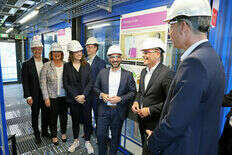
The Nuada Scout pilot is part of a project funded by the CCUS Innovation 2.0 program, supported by the Department for Energy Security and Net Zero’s £1 billion Net Zero Innovation Portfolio. This initiative underscores the commitment to advancing sustainable technologies to reduce industrial emissions. Representatives from the Department, the Carbon Capture and Storage Association, and Nuada’s investors recently visited the Sheffield site to observe the pilot in action and discuss the company’s progress.
By leveraging existing infrastructure and innovative materials, Nuada’s solution addresses the challenges of high costs and energy demands in carbon capture. The successful trial at the University of Sheffield marks a significant step toward commercial deployment, with potential to transform how industries manage emissions. The technology’s efficiency and scalability position it as a vital tool for achieving net-zero goals, supporting cleaner industrial processes globally.