
A research project led by Queen Mary University of London has achieved a breakthrough in automotive battery technology. The dual-layer electrode design, guided by in-situ imaging techniques, significantly enhances battery cycle stability and fast-charging capabilities, while promising to reduce production costs by 20% to 30%.
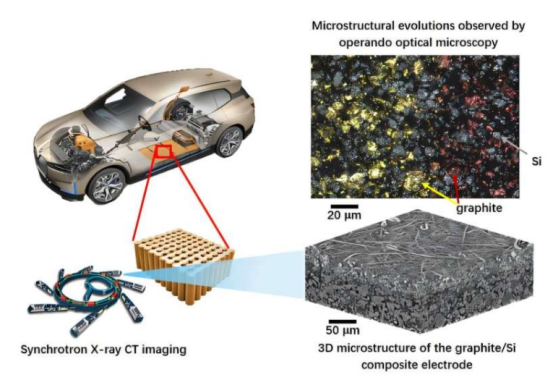
This study, published in Nature Nanotechnology, was led by Dr. Xuekun Lu, an expert in green energy at the university. The research team employed an evidence-based design approach to construct a silicon-based composite dual-layer electrode, effectively addressing the technical challenge of rapid electrode degradation caused by up to 300% volume expansion in silicon materials during charge-discharge cycles. This breakthrough opens new pathways for developing next-generation high-performance automotive batteries.
For the first time, the study utilized multi-scale, multi-modal in-situ imaging techniques to visualize microstructural changes from individual particles to the entire electrode level. Dr. Lu stated: "This work, by integrating multiple in-situ imaging methods, reveals for the first time the correlation mechanisms between microstructure and electrochemical performance across different scales. It creates conditions for innovative three-dimensional composite electrode structures, promising to break through current technical bottlenecks in automotive batteries regarding energy density, service life, and charging speed."
Professor David Greenwood, an expert at the High Value Manufacturing Catapult, commented: "High-silicon-content electrodes are a crucial direction for achieving high-energy-density batteries. This research deepens our understanding of the relationship between electrode microstructure and performance degradation, laying a scientific foundation for the design of superior automotive batteries in the future."