
The international LIGO-Virgo-KAGRA collaboration published a paper in The Astrophysical Journal Letters reporting the detection of two gravitational wave events in October and November 2024, both featuring unusual black hole spin characteristics. These gravitational wave detections provide new observational clues for studying black hole formation mechanisms in the universe.
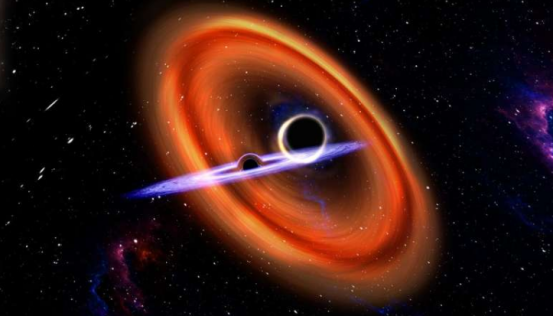
The first event, GW241011, occurred on October 11, 2024, approximately 700 million light-years from Earth, resulting from the merger of two black holes with masses 17 and 7 times that of the Sun. In this event, the larger black hole's rotation speed reached the highest level observed to date. The second event, GW241110, was detected on November 10, 2024, about 2.4 billion light-years away, formed from the merger of black holes with masses 16 and 8 times the Sun's. In this case, the primary black hole's spin direction was opposite to its orbital direction, marking the first observation of such a phenomenon.
Co-author Carl Johann Haster, Assistant Professor of Astrophysics at the University of Nevada, Las Vegas, stated: "Each new detection provides crucial insights into the universe, reminding us that every merger we observe is not only an astrophysical discovery but also a valuable laboratory for exploring the fundamental laws of physics. Early predictions suggested such binaries might exist, but this is the first direct evidence of their presence."
LIGO Scientific Collaboration spokesperson Professor Stephen Fairhurst from Cardiff University noted: "Since both events involve a black hole significantly more massive than its companion and spinning rapidly, they provide strong evidence for the theory that black holes form from previous mergers." Scientists believe these black holes likely formed through a "hierarchical merger" process in dense environments such as star clusters.
The research team verified key predictions of Einstein's general relativity by analyzing higher-order harmonics in the GW241011 signal. The observational data closely matched the rotating black hole model described by mathematician Roy Kerr. Additionally, observations of rapidly spinning black holes impose constraints on particle theories beyond the standard model, such as ultralight bosons.
Virgo Collaboration spokesperson Gianluca Gemme emphasized: "These detections highlight the observational power of the global gravitational wave observatory network. The unusual spin structures not only challenge our understanding of black hole formation but also provide evidence for hierarchical mergers in dense cosmic environments." The LIGO-Virgo-KAGRA network's fourth observing run is nearing its end, continuing until February 2025, and has identified approximately 300 black hole merger candidate events to date.