
The research team from the Nano Life Science Institute (WPI-NanoLSI) at Kanazawa University, Japan, recently published significant results in the journal Small, revealing the self-assembly mechanism of short peptides on the surfaces of two-dimensional materials such as graphite and molybdenum disulfide. This study provides new insights for the precise integration of biomolecules with inorganic materials.
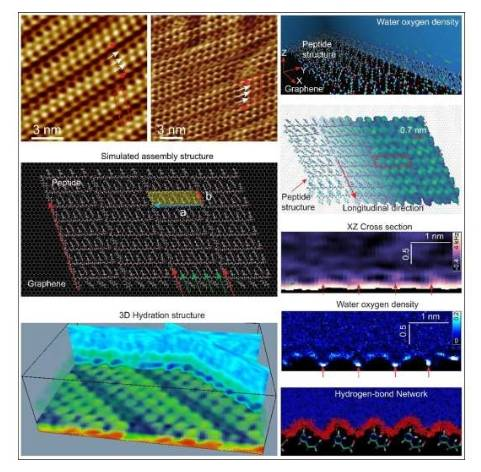
The research was jointly led by Ayhan Yurtsever, Takeshi Fukuma, and Linhao Sun, in collaboration with the Tokyo Institute of Science, DMXi Dentomimetix Company in the United States, and Aalto University in Finland. The team designed a series of tyrosine-histidine (YH) dipeptides and used frequency-modulated atomic force microscopy (FM-AFM) to observe these peptides forming linear structures aligned with the substrate lattice on two-dimensional material surfaces.
"Water molecules not only promote hydrogen bond formation but also provide the conformational flexibility required for peptide assembly," explained Yurtsever. Through 3D-AFM measurements and molecular dynamics simulations, the team discovered that the heterogeneous hydration shell formed by peptide-water interactions plays a key role in the assembly process. These findings lay the foundation for developing novel biosensors and bioelectronic devices.