
Recently, Australia's national science agency (CSIRO) unveiled a novel solar reactor that could achieve a breakthrough in clean energy technology for producing green hydrogen.
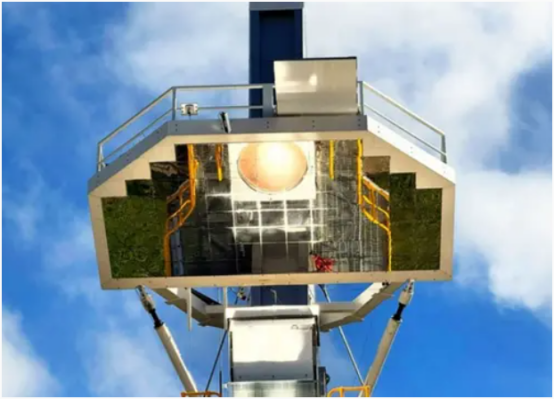
The system was developed by the CSIRO Newcastle Energy Centre and is a "beam-down" solar reactor. Unlike traditional solar thermal devices that concentrate sunlight onto a tower top, this design reflects light downward onto a ground platform. CSIRO chief research scientist and project leader Dr. Jin Zhao stated in a statement: "We haven't reached industrial scale yet, but we've proven it has strong reactivity under relatively mild conditions, and with further improvements, it can compete with electrolysis in performance and cost."
In Australia, solar panels are common on rooftops, but about 75% of the country's energy comes from fuels, particularly prominent in heavy industry and transportation sectors. These industries are difficult to electrify, prompting researchers to explore alternative clean energy solutions. Green hydrogen, as a promising pathway, can serve as a low-emission fuel for industries that cannot be directly electrified.
Typically, green hydrogen production involves electrolysis, which decomposes water into hydrogen and oxygen using electricity, but this process has high energy demands and costs. To address this issue, CSIRO researchers are developing more efficient and scalable new methods for industrial applications.
Supported by the Australian Renewable Energy Agency (ARENA), CSIRO demonstrated an innovative method using concentrated solar power and metal particles to produce green hydrogen. The heliostat field at the Newcastle Energy Centre tracks the sun and reflects light onto a central tower, powering Australia's first beam-down solar reactor. This reactor represents a major innovation, with a design different from traditional solar thermal systems that focus sunlight at the tower top; instead, it reflects sunlight downward onto a ground platform, similar to a magnifying glass but on a larger scale. A group of heliostats reflects sunlight onto the tower, which then redirects it to the solar reactor, where intense heat drives the reaction to decompose water into hydrogen and oxygen.
Using CSIRO's new beam-down solar reactor to produce green hydrogen, the key material is doped ceria, a modified form of the natural mineral cerium oxide. Doped ceria can absorb and release oxygen at lower temperatures, facilitating a two-step thermochemical process for water decomposition. When heated by concentrated solar power, it releases oxygen atoms; upon introducing steam, these particles absorb oxygen from water molecules, releasing hydrogen that can be captured for fuel or industrial applications, and doped ceria can be reused, making the process efficient and sustainable.
This system marks the first demonstration-scale test of doped ceria in a solar hydrogen reactor. The beam-down design of the solar thermal system differs from traditional designs by reflecting sunlight onto a ground-facing receiver, increasing flexibility for conducting chemical reactions at high temperatures and suitable for a wider range of research applications, such as metal refining.