
The GRASP Laboratory at the University of Liège in Belgium, in collaboration with Brown University in the United States, recently published innovative research results in Nature Communications, successfully achieving precise shaping control of water surfaces through 3D printing technology. This breakthrough opens new pathways for fields such as microfluidic manipulation, particle sorting, and marine pollution remediation.
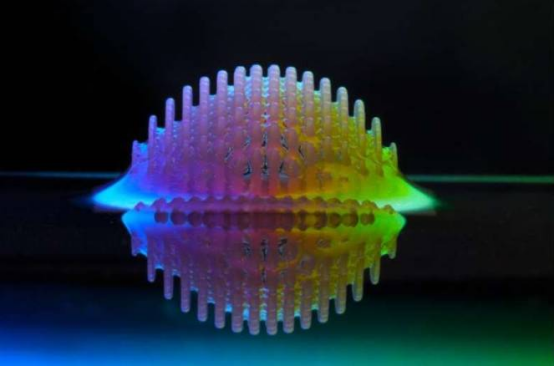
The research team used high-precision 3D printing technology to fabricate arrays of micro-ridge structures with precise spacing. By accurately regulating the geometric parameters of these structures, the researchers successfully utilized the meniscus effect generated by surface tension to construct programmable complex liquid relief landscapes. "We found that each ridge structure forms a local meniscus, and when densely arranged in a specific pattern, they can superimpose to form macroscopic water surface morphologies," explained physicist Megan Delens. The team has successfully reproduced various three-dimensional structures, including slopes, hemispheres, and even the Atomium in Brussels.
The innovative value of this technology lies not only in its precise morphological control but also in its potential applications. Laboratory director Professor Nicolas Vandewalle elaborated on its working principle: "When these liquid landscapes are properly tilted, objects of different densities will follow specific paths—lighter objects rise due to Archimedean thrust, while heavier objects slide down the 'water mountain.' This provides a new approach for environmental applications such as microplastic collection."
The research team particularly emphasized the technology's potential in environmental governance. By designing specific liquid morphologies, surface pollutants can be effectively guided and enriched, offering a passive solution for addressing marine microplastic pollution. Currently, the team is actively exploring advanced solutions such as magnetic materials to achieve real-time dynamic control of liquid surfaces, which will further enhance the technology's practical value in fields like microfluidic manipulation.