
Far beyond Pluto's orbit, in the outermost reaches of our solar system, lies Sedna—one of the most mysterious objects ever discovered. This reddish dwarf planet follows an extreme orbit, taking over 11,000 years to circle the Sun. Now, scientists are proposing a new mission using revolutionary propulsion technology to explore this distant world.
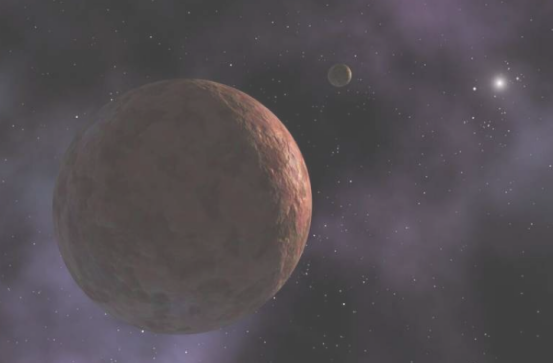
But Sedna is far more than a remote rock. It represents a new class of orbital bodies—sednoids—whose extreme paths suggest it may be the first known member of the inner Oort Cloud. Studying Sedna could unlock secrets about the early formation of the solar system and its gravitational influences.
Its surface is among the reddest in the solar system, hinting at complex chemistry and possibly clues to organic compounds in the outer regions. At its current distance, temperatures never rise above -240°C, making it one of the coldest places in the solar system.
The distant planet is expected to pass through its perihelion—its closest point to the Sun—in 2075–2076, then slowly recede once more. Even at this closest approach of 76.19 astronomical units (about 76 times the Earth-Sun distance), Sedna will still be extraordinarily far—nearly three times Neptune's distance. After this brief window, it will embark on its long, dark journey again, not returning to relative proximity for centuries.
A new feasibility study published on the arXiv preprint server examines two cutting-edge technologies capable of reaching Sedna within this narrow opportunity window. The first involves Direct Fusion Drive (DFD), a conceptual nuclear fusion engine designed to generate both thrust and electrical power simultaneously. For DFD, researchers assumed a 1.6-megawatt system with constant thrust and specific impulse—a massive leap beyond current propulsion capabilities.
The second is a clever enhancement of solar sail technology. Rather than relying solely on solar radiation pressure, this approach uses thermal desorption—the release of molecules or atoms attached to a surface when heated—to generate thrust. The mission would leverage a gravity assist around Jupiter, using the giant planet’s immense gravitational field as a slingshot.
The analysis revealed striking results for these two vastly different technologies. According to the paper led by Elena Ancona from Italy's Bari Polytechnic University: DFD could reach Sedna in approximately 10 years, with 1.5 years of powered flight. The solar sail, aided by Jupiter's gravity, could complete the journey in just 7 years. The solar sail's superior flight time stems from its ability to accelerate continuously without carrying heavy fuel, while the fusion drive's advantage lies in its potential to enter orbit rather than merely fly by.
This speed difference highlights a fundamental trade-off in deep space exploration. Due to performance differences, DFD can achieve orbital insertion, while the solar sail is limited to a flyby. An orbital mission allows for in-depth study—mapping the surface, analyzing composition, and potentially discovering moons or other features. A flyby, though faster, offers only a brief snapshot.
Both proposed technologies face immense development hurdles. DFD remains largely conceptual, requiring breakthroughs in fusion containment and control—challenges that have eluded us for decades. The model suggests it could propel a ~1,000kg spacecraft to Pluto in four years, but real-world performance remains uncertain.
The advanced thermal desorption solar sail represents a more revolutionary yet potentially nearer-term approach, building on proven solar sail principles with added innovation. It relies on precisely timed gravity assists and novel materials science—challenging, but possibly more achievable in the short term.
However, with Sedna currently approaching, the window to reach it is rapidly closing. Whether humanity rises to this challenge depends on our willingness to invest in revolutionary propulsion technologies and embrace the risks inherent in pushing the boundaries of space travel.