
Recently, a Chinese research team proposed a space solar power (SSP) demonstration mission plan aligned with the first step of the China Academy of Space Technology (CAST) SSP development roadmap, which calls for deploying a demonstration mission between 2026 and 2030.

Corresponding author Hou Xinbin stated in an interview with Photovoltaics magazine that the core concept of this mission is to validate several critical technologies in a single limited mission—these technologies form the foundational core for subsequent missions. As these are disruptive innovations, in-space validation will enhance the technical feasibility of SSP.
Space solar power (SSP), as a potential green energy production method, collects solar energy via spacecraft and transmits it back to Earth using wireless power transmission (WPT). In this proposed mission, microwave power transmission (MPT) is the core technology, while laser power transmission (LPT), high-voltage thin-film solar arrays, and concentrated solar arrays will also be tested.
The mission's solar array consists of a 10kW ultra-light thin-film solar array using gallium arsenide (GaAs) cells with efficiency exceeding 30%. Covering an area of 35 square meters, it comprises three parts: a high-voltage solar array generating 1kW/500V for demonstration; a medium-voltage solar array producing about 5kW/100V to power the main MPT and low-voltage LPT payload systems as well as the platform bus; and a dummy solar array to simulate structural characteristics. Additionally, a 2.4-meter aperture concentrated solar array is used, collecting a total of 6.18kW of solar energy.
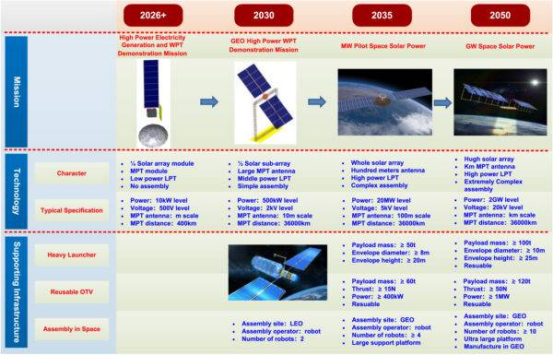
The MPT system includes a microwave transmission subsystem, beam control subsystem, and receiving subsystem. The demonstration system features a 2m×2m antenna operating at 5.8GHz, planning to transmit approximately 4kW of microwave power to the ground receiving subsystem over a distance of 424 to 600km. The receiving subsystem consists of a rectenna, beam direction measurement system, and pilot signal transmitter.
For LPT, two use cases are demonstrated: energy transmission to the ground and to a trailing spacecraft. The LPT system comprises a laser subsystem, laser transmission and beam control subsystem, and receiving subsystem. Depending on mission objectives, the transmitted laser power will be 1kW, with space transmission distances of 10 to 50km and ground transmission distances exceeding 400km. A 1064nm fiber laser is selected for this mission.
Hou Xinbin summarized that the team will continue follow-up research in subsequent missions, including system design and key technology development, while also exploring how to apply these innovative technologies to other fields.
The mission proposal was published in the Journal of Space Solar Power and Wireless Transmission under the title "High-power Generation and Wireless Transmission Demonstration Mission—First Step in Space Solar Power Development," authored by scientists from the China Academy of Space Technology, Shandong Institute of Aerospace Electronics Technology, Shanghai Institute of Aerospace System Engineering, Xidian University, and Chongqing University.