
A research team from IMDEA Nanociencia and Universidad Católica del Sagrado Corazón has developed a novel gas sensor based on mechanically interlocked carbon nanotubes (MINT), demonstrating excellent selectivity and sensitivity in detecting volatile organic compounds (VOCs). The findings have been published in the Journal of the American Chemical Society.
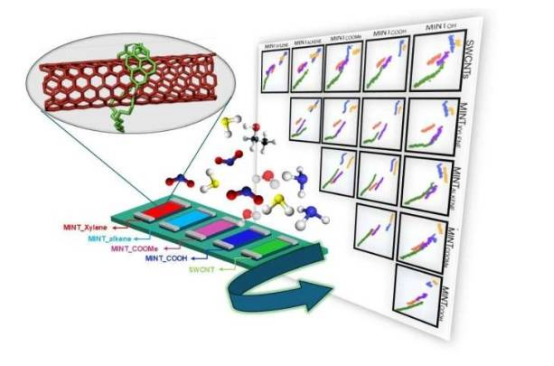
The study addresses the poor selectivity of traditional carbon nanotube sensors by mechanically interlocking cyclic molecules with carbon nanotubes. The MINT technology enables precise identification of gases such as ammonia, nitrogen dioxide, and acetone at ppb-level detection limits without altering the fundamental structure of the nanotubes. The researchers stated: "This modification significantly enhances the sensor's recognition capability in complex environments."
An array system composed of MINT sensors exhibits artificial olfaction-like functionality, effectively distinguishing target gases from interfering substances. Experimental data show up to 10-fold sensitivity improvement and drastically reduced response times. The sensor operates at room temperature, offering a new approach for developing low-power environmental monitoring devices.
The breakthrough lies in its customizability: by tuning the structure of interlocked molecules, researchers can optimize sensor performance for specific applications. This lays the foundation for smart electronic nose systems, with future potential in industrial safety monitoring, medical diagnostics, and beyond.