
On June 3, NASA's Perseverance rover abraded a rock surface, cleared the debris, and used instruments to study its pristine interior for mineral composition and geological origin. Nicknamed "Kenmore" by the science team, it is the 30th rock Perseverance has studied in such depth, beginning with a 5cm-wide abrasion patch.
"Kenmore is a weird, uncooperative rock," said Ken Farley, Perseverance deputy project scientist at Caltech in Pasadena, California. "It looked promising—something we could abrade well and maybe sample if science warranted. But during abrasion, it shook, and small pieces flaked off. Fortunately, we reached deep enough below the surface to proceed with analysis."
The science team aims to peer beneath wind-battered, dust-covered surfaces to uncover critical details about a rock's composition and history. Abrasion also creates a flat surface for close-up instrument observation.
Abrasion Timeline
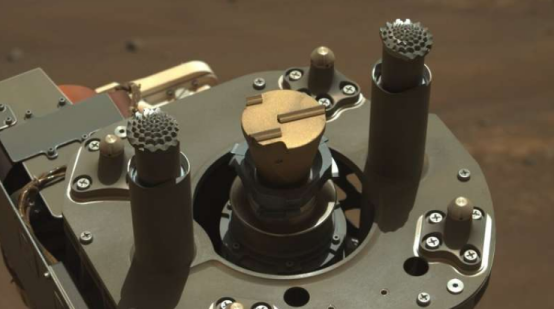
NASA's earlier rovers, Spirit and Opportunity, used a Rock Abrasion Tool (RAT) with diamond-powder tips, rotating at 3,000 RPM while pressed into rock by the arm. Steel wire brushes then swept away debris (tailings).
Curiosity uses a Dust Removal Tool (DRT) with wire bristles to clear dust before drilling. Perseverance, however, employs a specialized abrasive bit and a more powerful gas Dust Removal Tool (gDRT) to blow away dust.
"We use Perseverance's gDRT to blast 12psi (~83kPa) of nitrogen onto the tailings and dust covering the fresh abrasion," said Kyle Kaplan, robotics engineer at NASA's Jet Propulsion Laboratory in Southern California. "Each abrasion gets five blasts—one to vent the tank, four to clear the patch. The gDRT has a long way to go. Since landing in Jezero Crater over four years ago, we've fired it 169 times. About 800 nitrogen shots remain."
Compared to brushing, gDRT avoids introducing terrestrial contaminants into the Martian rock under study.
The rover team has collected data from over 30 abrasion patches, with in-situ science largely complete. After gDRT clears tailings, the WATSON camera (on the rover's arm like gDRT) takes close-up images.
Then, SuperCam, from its mast vantage, fires thousands of laser pulses, using a spectrometer to analyze the composition of microscopic plumes released. It also uses another spectrometer to examine visible and infrared light reflected from the patch.
"SuperCam observed both the abrasion and the powdery tailings beside it," said Cathy Quantin-Nataf, SuperCam team member and science lead for the "Crater Rim" campaign at Université de Lyon, France. "The tailings show the rock contains clay minerals—hydroxides bound with iron and magnesium, typical of ancient Martian clays. The abrasion spectra reveal increased iron and magnesium."
SHERLOC and PIXL also scanned Kenmore. Besides confirming clays, they detected feldspar (making much of Kenmore appear bright in sunlight). PIXL found a manganese hydroxide mineral—the first such detection on the mission.
After Kenmore data collection, Perseverance will move to new areas to explore Jezero Crater rim rocks, both cooperative and uncooperative.
"Early in a rover mission, you learn one thing: not all Martian rocks are created equal," Farley said. "Data from rocks like Kenmore will help future missions avoid wasting time on odd, uncooperative ones. Instead, they'll know whether a rock can be easily abraded, sampled, split for hydrogen and oxygen as fuel, or used as habitat building material."
Long-distance Drive
On June 19 (sol 1540), Perseverance broke its single-drive autonomous navigation record, traveling 1,348 feet (411m)—~210 feet (64m) more than its previous record on April 3, 2023 (sol 753). Using AutoNav, the rover shortens travel time between science sites when planners map its general route.
"Perseverance drove the length of four and a half football fields—and could've gone farther," said Camden Miller, Perseverance rover driver at JPL. "But the science team wanted us to stop there. We nailed the target stop. Every day on Mars, we're learning how to get the most from our rover. What we learn today, future missions won’t have to relearn tomorrow."