
Magnet-superconductor hybrid systems are key to unlocking topological superconductivity, which may host Majorana modes for fault-tolerant quantum computing. However, creating stable, controllable interfaces between magnetic and superconducting materials remains a challenge.
Traditional systems often suffer from lattice mismatch, complex interfacial interactions, and disorder, which can obscure topological signatures or mimic them with trivial phenomena. Atomic-scale precision in magnetic structure control has long been a hurdle.
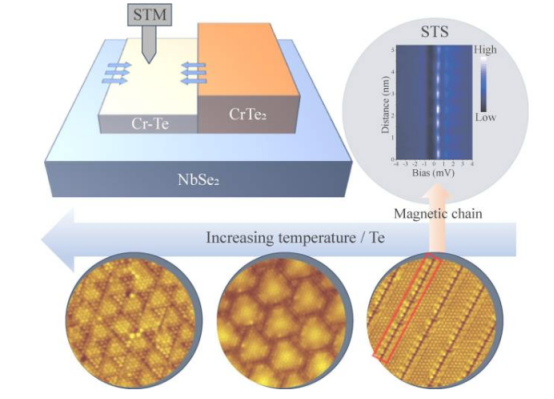
Researchers published a paper in Materials Futures introducing a novel sub-monolayer CrTe₂ / NbSe₂ heterostructure. By precisely depositing Cr and Te on an NbSe₂ substrate, they observed a two-stage growth process: A compressed Cr-Te layer with a 0.35nm lattice constant; An atomically flat CrTe₂ monolayer with a 0.39nm lattice constant. Annealing the Cr-Te layer triggers stress-release reconstruction, forming stripe-like patterns with localized magnetic moments at the edges—effectively creating one-dimensional magnetic chains.
Scanning tunneling spectroscopy (STS) confirmed the presence of these moments and Yu-Shiba-Rusinov (YSR) states at the edges, highlighting the interaction between magnetic Cr atoms and the superconducting NbSe₂ substrate. This tunable, periodic strain-induced structure offers a promising platform for topological quantum computing and Majorana mode exploration.
Looking ahead, the team plans to refine strain control via annealing, substrate engineering, and dynamic modulation. Future studies will focus on tailoring these 1D magnetic chains for specific quantum applications, enabling detection of topological superconductivity and Majorana modes. Large-scale statistical studies and advanced spin-resolved measurements will further elucidate the interplay of strain, magnetism, and superconductivity.
This work marks a significant step toward practical quantum technologies. The CrTe₂ / NbSe₂ heterostructure leverages lattice mismatch to construct 1D magnetic chains, providing a versatile materials platform for quantum spintronics and topological quantum computing.
With nanoscale magnetic tunability and robust superconductivity, NbSe₂ holds breakthrough potential in next-generation quantum device design. This study opens new avenues for strain-engineered materials in quantum science.