
Researchers at the Grainger College of Engineering at the University of Illinois Urbana-Champaign have published a new study in Applied Physics Reviews, revealing a novel technique that uses superconducting qubits to sensitively characterize magnon behavior. Magnons, collective quantum excitations of spins in magnetic materials, are of great significance for improving quantum computing devices. However, effective utilization of magnons requires an in-depth understanding of their properties and limitations. In this study, the team successfully achieved precise characterization of highly excited magnon states by coupling a ferromagnetic material through a microwave cavity to a superconducting qubit.
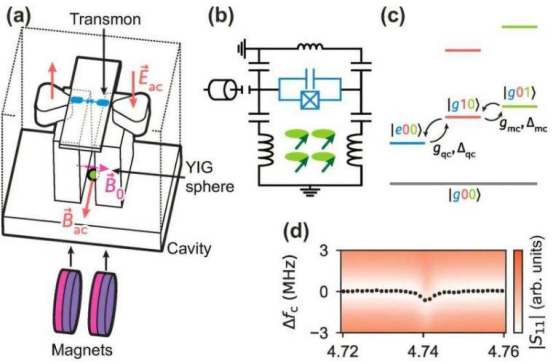
Lead author Sonia Lani noted: "To apply magnons in quantum computing, we need to correctly understand the system's limitations. Currently, there is no complete theoretical explanation for the significance of certain effects or their potentially harmful impacts." Through experiments, the team demonstrated the potential of superconducting qubits as flexible probes for studying magnons across a broad range of magnetic systems, offering value for both quantum computing interconnects and fundamental scientific exploration. Magnon-based devices can enhance quantum computer functionality—such as nonreciprocity and frequency conversion—but these capabilities rely on assumptions of linear magnon behavior, whose practical effectiveness remains to be verified.
In the experiments, Lani's team employed two techniques—dispersive frequency shift and parametric pumping—to explore magnon dynamics. The dispersive frequency shift method leverages the relationship between magnon number and the operating frequency of superconducting qubits to achieve precise determination of magnon populations, with only a 0.5% error. The parametric pumping technique temporarily establishes an interaction between the qubit and magnons and controls its strength, providing a new approach for measuring magnon numbers and tracking excitation decay. Lani stated: "Parametric pumping allows us to accurately explore how magnon dynamics evolve over time without affecting the performance of the superconducting qubit sensor." The study further found that yttrium iron garnet (YIG) maintains easily interpretable linear behavior and damping characteristics even with as many as 2,000 magnon excitations. Moving forward, the team plans to explore more magnetic materials with stronger excitations to uncover nonlinear effects that emerge from magnon interactions.