
The China Institute of Atomic Energy (CIAE), in collaboration with Xiamen University, has successfully developed a prototype Sr-90 radiovoltaic isotope power source. The research results, titled "Radiovoltaic Sr-90 Isotope Battery Based on a Scintillation Light-Guiding Concentrator Structure," were published in the top international optics journal Light: Science & Applications (impact factor: 23.4). This achievement provides new possibilities for applying radiovoltaic isotope batteries in extreme environments and specialized equipment, and holds significant importance for advancing China's isotope power technology system and the development of its isotope-technology disciplines.
A radiovoltaic isotope battery converts radiation energy into light through scintillation, which is then converted into electricity by photovoltaic devices—forming a two-stage energy-conversion process. Its advantage lies in using high-energy radiation sources while avoiding radiation damage to the device, ensuring stable high power output and long operational life. These batteries can be used in deep space exploration, deep-sea and polar-region monitoring, disaster early warning, and other harsh environments, providing maintenance-free energy for electronic equipment for decades.
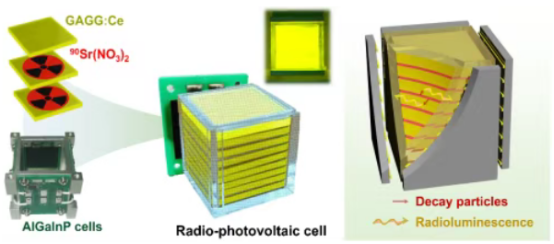
To address the low conversion efficiency and low output power of traditional radiovoltaic isotope batteries, the CIAE Nuclear Technology Integrated Research Institute project team innovatively proposed an Sr-90 radiovoltaic isotope battery based on a scintillation light-guiding concentrator structure. Using cerium-doped gadolinium gallium aluminum garnet (GAGG:Ce) to build a concentrator light-guide transduction structure, and coupling and stacking it alternately with an Sr-90 radiation source, the design enables efficient transport and concentrated emission of scintillation light. Combined with a spectrally matched AlGaInP photovoltaic module, the battery's volumetric energy density and output power are significantly enhanced. Tests show that a single-module prototype achieves an output power of 48.9μW and an energy-conversion efficiency of 2.96%. Multi-module integration can further realize milliwatt-level output, with both the transduction efficiency and output power surpassing international nuclear-battery benchmarks. In the future, pairing the battery with energy-storage devices could enable instantaneous watt-level power output, further expanding its application potential.
Next, the project team will continue to focus on practical application needs, striving to further improve the energy-conversion efficiency and output power of radiovoltaic batteries, and steadily promote the engineering and industrialization of this technology.