
On July 2, Tianjin University announced that Professor Jin Chao from the School of Environmental Science and Engineering and Professor Liu Haifeng from the School of Mechanical Engineering, together with multiple research institutions, have explored ways to overcome the carbon reduction bottleneck and achieve carbon neutrality. The study is expected to dispel external concerns about the potential negative impacts of carbon dioxide removal (CDR) technologies and fears that large-scale deployment of CDR might increase fossil fuel consumption and delay decarbonization. The findings were recently published in the international journal Nature Reviews Clean Technology.
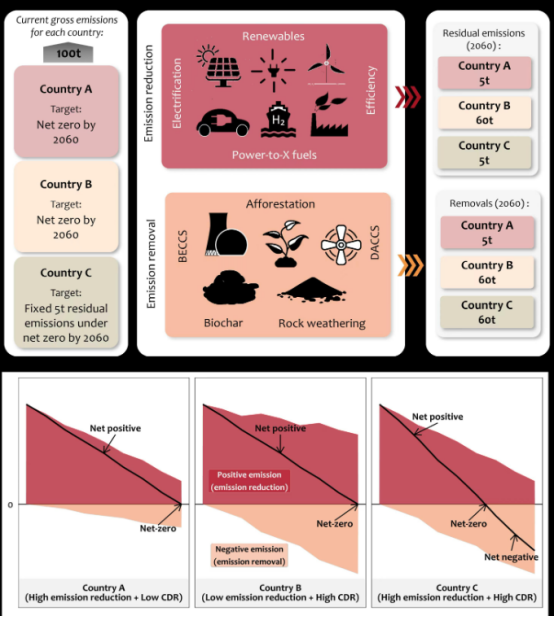
Global carbon reduction relies on two key approaches: upstream emission reduction (e.g., increasing the share of wind/solar power and hydrogen to reduce fossil fuel use) and downstream carbon removal (e.g., afforestation and direct air capture to lower atmospheric CO₂ concentrations).
Currently, upstream emission reduction is the primary focus worldwide. However, at the present rate of emissions, the remaining carbon budget to keep warming below 1.5°C by 2100 could be exhausted within the next five years. Relying solely on upstream measures cannot meet the temperature goals set for planetary cooling.
At the same time, current global climate policies focus only on achieving net-zero emissions without clearly defining how to balance upstream reduction and downstream removal. "Placing emission reduction hopes on future CDR is like overdrawing a credit card—it's full of uncertainty," noted Jin Chao. Without strict emission controls now, the amount of CO₂ requiring removal later will grow exponentially. CDR is essential for removing excess carbon from the Earth and achieving global emission reductions and cooling. However, uncertainties remain regarding future investment in CDR, whether deployment will meet net-zero requirements, and its economic viability. Moreover, large-scale CDR could consume vast amounts of arable land and water, threatening human survival. These concerns have led to widespread skepticism toward CDR.
To address these issues in global climate policy, the researchers propose a "dual-track" strategy that independently sets separate targets for upstream emission reduction and carbon removal. By establishing these two distinct goals and walking on "two legs," the overall net-zero target can be achieved more effectively. Upstream reduction and CDR are not in opposition; setting dedicated targets for both will accelerate decarbonization while promoting CDR technology development, successfully resolving the deadlock surrounding CDR and global carbon reduction.
The study shows that compared to approaches that do not distinguish between upstream reduction and CDR targets, separate target-setting delivers better outcomes in short-term decarbonization, year of achieving carbon neutrality, timing of negative emissions, and peak temperature rise.
(Photo provided by Tianjin University)