
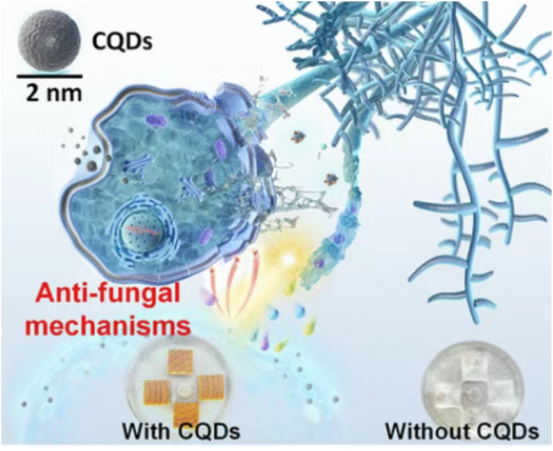
A research team led by Professor Cao Jinzhen from Beijing Forestry University has used a microwave-assisted method to synthesize nitrogen-doped carbon quantum dots (CQDs). By adjusting the ratio of carbon and nitrogen sources, the team precisely tuned the structure and surface functional groups of the CQDs, yielding materials with outstanding antifungal performance. At a concentration of 360ppm, these CQDs completely inhibited the growth of two major wood-decay fungi (brown-rot Postia placenta and white-rot Trametes versicolor). Through comparative structural analysis, the researchers found that higher nitrogen doping resulted in richer functional groups and surface defects, increased graphene-like layer counts within the core, reduced planar size, and enlarged interplanar spacing. This unique structure imparts a positive surface charge to the CQDs and significantly boosts their reactive oxygen species (ROS) quantum yield.
The antifungal mechanism was comprehensively elucidated using fungal morphology, metabolomics and multi-omics approaches. Biological SEM and TEM observations showed that positively charged nanoscale CQDs adhere to fungal cell walls via electrostatic interactions, penetrate the cell membrane, disrupt physiological metabolism, inhibit biofilm formation, and cause cytoplasmic leakage. Quantitative enzyme activity assays revealed that CQDs dramatically reduce fungal secretion of cellulase (endo- and exo-glucanase) and hemicellulase activities, thereby suppressing enzymatic degradation of cellulosic materials.
Using near-infrared chemical imaging (NIR-CI), the team demonstrated that photo-generated ROS from CQDs oxidatively damage polysaccharides, proteins, and lipids in fungal cell walls/membranes while interfering with nucleic acid synthesis and disrupting energy metabolism. Multi-omics analysis confirmed significant downregulation of genes related to cell-wall component synthesis after CQD treatment. For brown-rot fungi that also employ non-enzymatic Fenton reactions to generate destructive radicals, the surface functional groups of CQDs enable Fe³⁺ chelation, effectively blocking the Fenton pathway and preventing non-enzymatic cellulose degradation.
The team believes CQDs hold enormous potential for wood preservation and functional modification, including anticorrosion treatment of timber and bamboo to extend service life as construction materials, mold protection for paper and cotton textiles, and development of eco-friendly coatings or additives for furniture and packaging, and possible future use in food packaging and medical materials due to their low toxicity.
Cellulosic materials (e.g., wood, bamboo, cotton fabrics) are the most widely used natural polymers in daily life but are highly susceptible to fungal attack, leading to decay and mildew. Traditional commercial fungicides often contain heavy metals or toxic chemicals, posing threats to environmental safety and human health. Developing environmentally friendly, non-toxic, and efficient new antifungal agents has therefore become an urgent need. The team targeted this technical bottleneck, hoping to find a green solution through nanomaterial innovation.
The team has been conducting research on wood and bamboo protection and modification since 2004. Their developed organic preservative microemulsions have obtained multiple national invention patents and achieved excellent results in practical application in the field of wood and bamboo protection.
CQDs are a new type of nanomaterial with wide and inexpensive raw material sources, simple preparation methods, low toxicity, environmental friendliness, and additional properties such as fluorescence and self-healing. Their antibacterial effects against bacteria have attracted widespread attention. The nanoscale size, large specific surface area, and abundant surface functional groups (e.g., amino groups) of CQDs enable strong electrostatic interactions with bacterial cell membranes, allowing easy penetration and triggering cell death.
The antibacterial performance of CQDs against bacteria drew the team's attention. Although lignocellulosic materials like wood can also suffer bacterial degradation, fungal attack remains the primary concern during use. This inspired the team to explore the effectiveness and mechanism of CQDs in inhibiting fungal damage to cellulosic materials. Compared with bacteria, fungi exhibit different growth patterns and metabolic processes. For example, how do ROS generated by CQDs affect fungal growth and reproduction? Where exactly does ROS-induced oxidative damage occur in fungal cell walls? These questions remained to be explored.
Some fungi, such as brown-rot fungi, utilize the Fenton reaction to reduce Fe³⁺ to Fe²⁺ with the help of reducing chelators, subsequently generating free radicals via reaction with hydrogen peroxide that degrade cellulose. The dual enzymatic and non-enzymatic attack mechanisms of fungi on cellulosic materials are often overlooked in most studies. Elucidating the mechanism of CQDs against fungi on cellulosic materials is of great significance for developing the next generation of green and efficient antifungal agents.
The team stated that this research is part of Topic 2 "Scientific Basis for Quality Enhancement and Efficiency Improvement of Wood and Bamboo Modification" under the 14th Five-Year National Key R&D Program project "Structural and Chemical Mechanisms of Wood and Bamboo Resource Utilization," launched in 2023.
Prior to project approval, the team conducted extensive exploratory research, including esterification and resin impregnation modification of wood cell walls. While these methods effectively improved decay resistance and dimensional stability, they caused two critical issues: increased wood density (losing the high strength-to-weight ratio) and severely reduced toughness (significantly lowering impact and tensile resistance). These changes limited applications in many fields. Therefore, the team aimed to develop antifungal agents for wood, bamboo, and other cellulosic materials that are lightweight, high-strength, green, and environmentally friendly.
Compared with pure cellulose, lignocellulosic materials like wood and bamboo have more complex structures and compositions. The team thus focused on wood and bamboo while also testing effects on cotton fabrics. The main chemical components (cellulose, hemicellulose, and lignin) serve as nutrients for wood-decay fungi, and their inherently small cell-wall pores (only a few nanometers) require antifungal agents with strong activity, good water solubility, compatibility with wood components, and small particle size. CQDs meet all these requirements simultaneously, showing immense potential for antifungal applications in wood, bamboo, and other cellulosic materials.
CQDs can be prepared from a wide range of raw materials, yielding differences in particle size and functional groups. The team used common urea/citric acid as precursors, prepared CQDs with varying nitrogen-doping levels by ratio adjustment, and focused on the structure–activity relationship between CQD structure and antifungal performance as well as the mechanism against fungi. Antifungal effects were validated on potato dextrose agar (PDA) medium to determine optimal concentration, with preservation tests conducted on bamboo, cotton fabrics, and other materials to ensure universality.
By characterizing particle size distribution, surface chemistry, and heteroatom doping, they deeply analyzed the influence of these factors on antifungal performance and established corresponding structure–activity relationship models. Using brown-rot fungus (Postia placenta) as a model, the team systematically elucidated the antifungal mechanism of CQDs on cellulosic materials via bio-electron microscopy, confocal laser microscopy, infrared imaging, transcriptomics, and in vitro Fenton reaction simulation to reveal both enzymatic and non-enzymatic pathways.
The paper, titled "Antifungal Performance and Mechanisms of Carbon Quantum Dots in Cellulosic Materials," was recently published in ACS Nano, with Ph.D. candidate Zhao Xiaoqi from Beijing Forestry University as first author and Professor Cao Jinzhen as corresponding author.
Overall, this study not only solves the environmental challenges of wood preservation but also opens new directions for nanomaterial applications in biology. The team looks forward to collaborating with interdisciplinary groups to explore further potential of CQDs in medical antibacterials, environmental remediation, and other scenarios.
In the future, the team plans to further optimize CQD stability and cost, develop industrial-scale preparation processes, explore synergistic effects with other natural antimicrobials to enhance overall performance, and investigate additional extended applications of CQDs in wood modification.