
A major breakthrough in brain-computer interface (BCI) research at the intersection of advanced equipment manufacturing and biomedical engineering brings new hope to more than one billion people worldwide with disabilities. Robotic systems hold immense potential to dramatically improve daily life for the disabled, and BCIs—which enable direct communication between the brain and external devices by bypassing traditional muscular control—are receiving intense attention.
While invasive BCIs offer high-precision robotic control, they require risky surgical implantation and ongoing maintenance, limiting their use to a small subset of patients with severe conditions.
For over two decades, Professor Bin He at Carnegie Mellon University has focused on non-invasive BCI solutions, particularly EEG-based approaches that require no surgery and adapt to diverse environments. His team has achieved a series of pioneering milestones with EEG-based BCIs, including the world's first drone flight, robotic arm control, and continuous robotic hand motion controlled solely by thought.
A new study published in Nature Communications from the He Jiankui Laboratory marks значительный progress: real-time decoding of individual finger movement intent and dexterous control of a robotic hand at the finger level using non-invasive EEG, bringing EEG-based BCIs significantly closer to everyday practical use.
Professor Bin He, from Carnegie Mellon's Department of Biomedical Engineering, emphasized that restoring hand function is critical for both disabled and able-bodied individuals—even minor improvements can dramatically enhance capability and quality of life. However, real-time decoding of dexterous individual finger movements using non-invasive brain signals has been extremely challenging, primarily due to the limited spatial resolution of EEG.
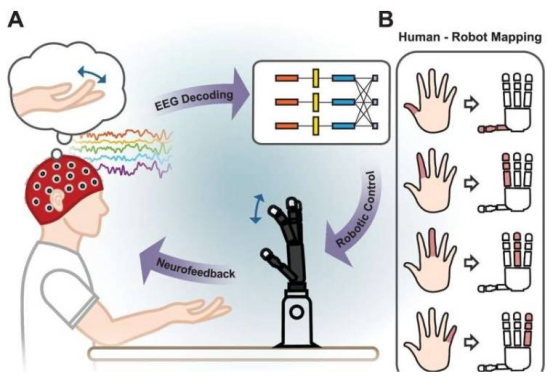
Professor He's team has now achieved a groundbreaking advance in EEG-based BCIs. They developed a real-time, non-invasive robotic control system that drives corresponding robotic finger movements using both motor execution and motor imagery of individual fingers. In experiments with human subjects, participants successfully completed two-finger and three-finger control tasks using thought alone. This success stems from a novel deep-learning decoding strategy and a continuously fine-tuned network that decodes non-invasive EEG signals.
Looking ahead, Professor He's team aims to achieve even finer finger-level tasks, such as typing. He added that the insights gained from this research hold enormous potential to enhance the clinical relevance of non-invasive BCIs, making them applicable to a much broader population. The study also highlights the transformative potential of EEG-based BCIs, expanding their scope from basic communication to complex motor control.