
To build a modern grid capable of flexibly handling fluctuating renewable energy from solar, wind, and other sources, engineers at West Virginia University have achieved a major breakthrough: a reversible fuel cell that can switch between energy storage and power generation while producing hydrogen from water. The research was published in Nature Energy.
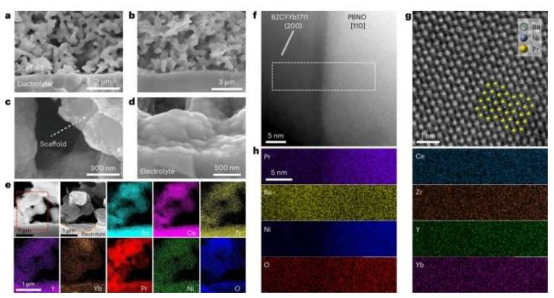
This fuel cell offers significant advantages. Compared with similar technologies, it withstands the heat and steam generated during long-duration, high-power industrial-scale operation, solving three critical challenges that have plagued existing proton ceramic electrochemical cells (PCECs): instability in high-steam environments, weak interlayer bonding, and poor proton conduction—issues that previously prevented large-scale deployment.
Xingbo Liu, professor of materials science and associate dean for research at the Benjamin M. Statler College of Engineering and Mineral Resources, explained that PCECs' ability to switch between energy storage and electricity production makes them a potentially pivotal technology for the U.S. grid, which is striving to integrate intermittent renewable sources. The team created a conformal coating scaffold by connecting electrolytes, then applied and sealed a steam-stable, water-absorbing electrocatalyst layer that remains intact across temperature changes, allowing protons, heat, and current to move efficiently through the structure.
The prototype operated for over 5,000 hours at 600°C and 40% humidity, decomposing water molecules via electrolysis to produce electricity and hydrogen. Previous small-scale PCECs lasted only 1,833 hours under the same conditions, with performance degrading over time. Professor Liu said the tested system uses CCS cells to store hydrogen and perform electrolysis, performing excellently in both storage and generation modes and smoothly switching between them in cycles lasting up to 12 hours—providing a pathway to balance grids incorporating intermittent renewables.
The research was led by Hanchen Tian (then a Ph.D. student and postdoctoral researcher at WVU) and Wei Li (research assistant professor), with contributions from postdoctoral researcher Qingyuan Li, Debangsu Bhattacharyya (GE Plastics Materials Engineering Professor), and assistant professor Wenyuan Li.
Tian explained that in conventional PCEC designs, steam penetrates the electrolyte causing failure, and differential thermal expansion between electrolyte and electrodes weakens connections during use. The WVU team incorporated barium ions to help the coating retain moisture and promote proton movement, and nickel ions to create larger, stable, and flat CCS cells. Because this PCEC operates on water vapor, it can be powered by brackish or low-quality water.
Tian stated that all results demonstrate potential for industrial-scale expansion, making mass production of CCS fuel cells feasible. This fuel cell maintains strength and stability under extreme conditions, offering new hope and direction for green manufacturing and the construction of modern grids.