
Researchers at Tokyo Institute of Science report a novel time-division MIMO technique that enables phased-array receivers to operate significantly faster while achieving outstanding area efficiency and low power consumption. By rapidly switching and reusing signal paths, the system dramatically reduces circuit complexity in 5G and 6G networks, including non-terrestrial nodes. Implemented in 65nm CMOS, it achieved a record 38.4Gbps across 8 data streams.
Next-generation 6G wireless communication promises ultra-high data rates and global coverage, revolutionizing worldwide connectivity. Central to this vision is the use of low-Earth-orbit (LEO) satellites to create non-terrestrial networks seamlessly integrated with terrestrial systems. Achieving this requires advanced phased-array antennas capable of multi-beam operation—simultaneously transmitting and receiving multiple radio beams in different directions and ranges.
MIMO (Multiple-Input Multiple-Output) technology is also essential to meet the soaring data-throughput demands of future 6G networks by multiplexing multiple signal streams over the same radio channel.
However, conventional MIMO systems face a critical challenge: circuit complexity scales with the product of antenna count and MIMO streams, making large-scale MIMO integration extremely difficult. For satellites, this issue is even more severe due to strict constraints on weight, size, and power, severely limiting practical deployment of traditional MIMO architectures.
To overcome these barriers, a team led by Professor Kenichi Okada from the Department of Electrical and Electronic Engineering at Tokyo Institute of Science developed a breakthrough solution. Their work was presented at the 2025 IEEE Symposium on VLSI Technology and Circuits (June 8–12, 2025) and introduces a novel time-division MIMO technique that allows phased-array receivers to operate far faster than conventional systems while maintaining excellent area efficiency and low power.
The key innovation is the team's proprietary non-uniform time-sharing method, which enables high-speed beam switching within the phased-array module without scaling circuitry according to the number of MIMO streams. Unlike traditional spatial-multiplexing systems, this design reuses signal paths across different streams via rapid random switching, dramatically reducing required chip area.
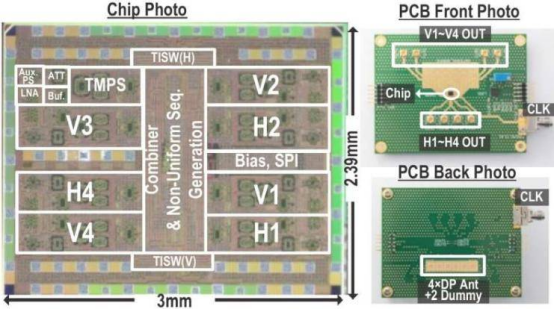
The researchers implemented the receiver in 65nm silicon CMOS process, integrating high-speed switched phase shifters to enhance interference resilience. The system features eight signal paths with synchronized switching and operates at clock frequencies up to 3.2GHz.
Over-the-air measurements demonstrated outstanding performance: the receiver successfully handled 4×4 MIMO signals in both horizontal and vertical polarizations, achieving a maximum data rate of 38.4Gbps across eight streams.
"Among recently reported millimeter-wave phased-array MIMO receivers, this device exhibits the highest bit rate to date and the best area efficiency," Professor Okada explained.
Overall, this technology represents a critical advance for 6G. By enabling multi-beam capability in LEO satellites while preserving compact circuitry and low power, the proposed innovation paves the way for practical large-scale MIMO systems capable of meeting next-generation wireless network demands.
Okada stated: "Our developed receiver can be integrated into 5G/6G IoT devices, mobile terminals, and LEO satellites. This is a major step toward the commercialization and application of new communication services utilizing ultra-high bit rates, including non-terrestrial networks."
Further efforts in this field are expected to help realize the vision of a fully connected Earth, leveraging terrestrial and satellite networks in ways previously thought impossible.