
A joint team from the U.S. Department of Energy's Ames National Laboratory and Iowa State University has published a major breakthrough in Science Advances, reporting the first-ever observation of a quantum phenomenon called the "Higgs echo" in superconducting niobium. This discovery opens new possibilities for quantum information storage and processing.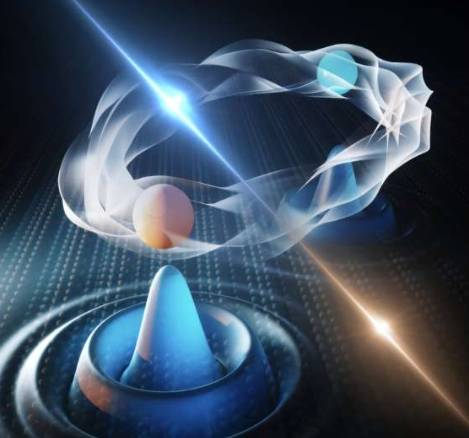
Using terahertz spectroscopy, the researchers excited the Higgs mode in the superconductor — a collective electron oscillation analogous to the Higgs boson — with precisely timed radiation pulses. Unlike conventional quantum echoes, the newly discovered Higgs echo arises from a unique interaction between the Higgs mode and quasiparticles, enabling it to preserve quantum path information within the material. "This echo has a memory function that can be used for encoding and retrieving quantum information," explained project leader Professor Jigang Wang.
The study overcomes a long-standing bottleneck in controlling quantum coherence in superconductors. Experiments showed that by tuning the sequence of terahertz pulses, the intensity and duration of the echo signal can be effectively manipulated, laying the foundation for new types of quantum memory. Current superconducting qubits suffer from short coherence times, but the properties of the Higgs echo offer a promising route to significantly extend the lifetime of quantum states.
The team is now exploring the potential of this phenomenon in topological quantum computing and high-precision quantum sensing. Professor Wang stated, "Understanding the physical mechanisms behind these quantum echoes will drive the development of more stable and controllable quantum technologies."
More information:
Chuankun Huang et al., Unconventional quantum echo revealed by interference of Higgs coherence, *Science Advances* (2025). Journal information: *Science Advances*