
A research team led by Professor Hiroshi Nishihara from the Research Institute for Science and Technology at Tokyo University of Science has published a cover article in the journal Small, successfully developing two innovative methods for the controllable synthesis of coordination nanosheets. This research resolves the global challenge of selectively synthesizing heterometallic ordered nanosheets and provides a critical material foundation for next-generation flexible electronics and clean energy technologies.
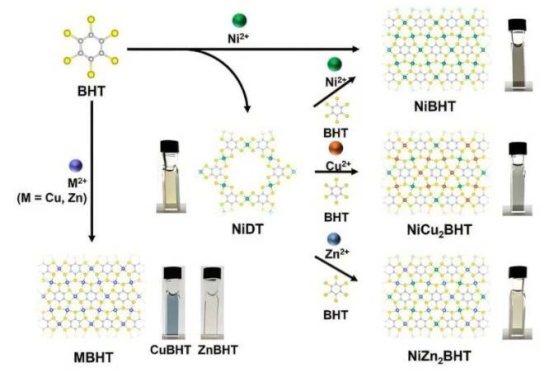
The team achieved a breakthrough by using a single-phase reaction system and precisely controlling the molar ratio of nickel ions to benzenehexathiol (BHT), enabling for the first time the selective preparation of porous NiDT and non-porous NiBHT nanosheets. Compared to traditional two-phase interfacial reactions, the new method produces stable colloidal solutions that can be directly used as functional inks or chemical reaction precursors. Project leader Professor Nishihara stated: "This technology establishes for the first time a controllable synthesis pathway for coordination nanosheets."
In application validation, porous NiDT nanosheets exhibited excellent electrocatalytic performance, with hydrogen evolution reaction activity significantly surpassing conventional materials. Even more remarkably, the team successfully synthesized highly crystalline and conductive NiCu₂BHT heterometallic nanosheets via a metal-exchange reaction, opening new avenues for developing high-performance electronic devices.
Another breakthrough of the study lies in the development of solution-processing technology for coordination nanosheets. The researchers confirmed that these colloidal solutions can be directly coated onto various substrates or mass-produced using printing techniques. Professor Nishihara emphasized: "The emergence of nanosheet ink technology makes large-scale manufacturing of flexible electronic devices and high-efficiency catalysts possible."