
A research team from National Taiwan University has published groundbreaking results in the Journal of the American Chemical Society, developing a universal interface technology applicable to both perovskite and organic solar cells. By introducing an Interspersed Assembled Monolayer (IAM) strategy, the study simultaneously enhanced the conversion efficiency and stability of both types of solar cells.
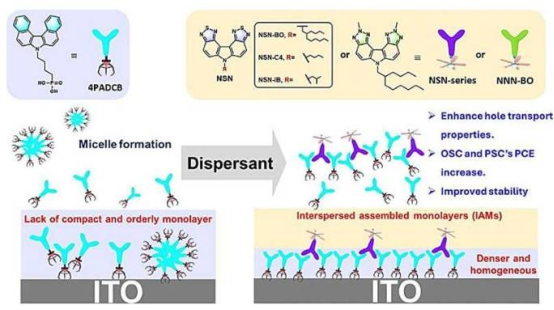
Traditional self-assembled monolayer (SAM) technology has struggled to meet the differing interfacial requirements of organic and perovskite solar cells due to their distinct photovoltaic mechanisms. The team innovatively incorporated secondary molecules with strong push-pull effects into the SAM framework, forming the IAM structure. This design not only suppressed micelle formation defects but also improved hole transport efficiency by optimizing dipole moments.
The team systematically investigated the impact of side-chain structure on IAM performance and found that steric hindrance effects are the key factor in improving film quality. Experimental data showed that after applying IAM technology, the conversion efficiency of organic solar cells increased from 18.12% to 19.23%, while perovskite solar cell efficiency rose from 23.84% to 25.01%, with device stability also significantly improved.
"This technology provides a universal chemical solution that can effectively reduce R&D costs and accelerate the realization of net-zero carbon emission goals," said corresponding author Professor Pi-Tai Chou. The research opens new pathways for solar cell interface engineering and is expected to drive the development of clean energy technologies.