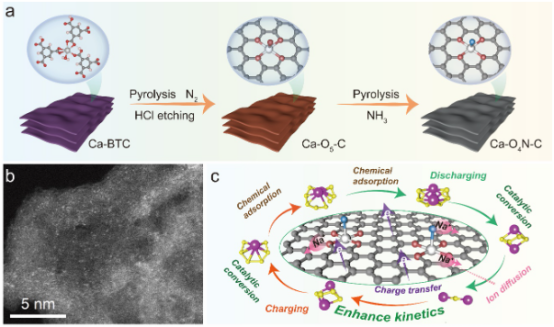
Sodium-sulfur batteries have attracted widespread attention due to their high theoretical energy density (1274Wh kg⁻¹) and the abundant reserves of sodium and sulfur. Recently, researchers Wang Hui and Zheng Fangcai from the High Magnetic Field Center at the Hefei Institutes of Physical Science, Chinese Academy of Sciences, achieved a breakthrough in the performance of main-group metal catalysts for sodium-sulfur batteries. They proposed an axial N-ligand regulation strategy to induce localized charge at calcium (Ca) single-atom sites, significantly enhancing the reaction performance of sodium-sulfur batteries. The findings were published in the international journal Nature Communications.
Conventional wisdom held that main-group metals lack catalytic activity for sodium-sulfur battery reactions due to their delocalized s/p band electronic structure. Therefore, tailoring the coordination environment of main-group metal sites is key to obtaining highly active catalysts for sodium-sulfur batteries.
Addressing this scientific challenge, the team employed an ammonia heat-treatment strategy to successfully prepare a highly active Ca single-atom catalyst. By introducing axial N-coordination atoms into a planar Ca−O−C single-atom structure, this approach modulated the p-orbital electronic structure of the Ca single-atom sites, strengthening p-p orbital hybridization between the Ca atoms and sulfur species. This revealed the mechanism by which Ca single atoms enhance sodium polysulfide adsorption and catalysis. Sodium-sulfur batteries based on this catalyst exhibited outstanding electrochemical performance: after 100 cycles at 0.2C, the battery retained a capacity of 1211mAh g⁻¹ while demonstrating excellent cycling stability.
This work not only provides new insights for the design of main-group single-atom catalysts for sodium-sulfur batteries but also strongly demonstrates the critical role of single-atom coordination environment regulation in boosting the catalytic activity of main-group metals. The research was supported by the National Key R&D Program of China, the National Natural Science Foundation of China, the Natural Science Foundation of Anhui Province, the President's Top Talent Cultivation Program of Hefei Institutes of Physical Science, the Collaborative Innovation Project of Hefei Science Center of CAS, and the Anhui Provincial Key Laboratory of High Magnetic Fields.